


Open-Source Security: How ‘Claude-BugHunter’ Transforms AI Assistants into Offensive Researchers
As generative AI tools become embedded in modern engineering workflows, security researchers and red teams are moving beyond basic prompting to specialized, context-aware AI automation. Leading this shift is Claude-BugHunter, an open-source skill bundle created by security research entity elementalsouls.
Designed as a drop-in extension for Claude Code—while extending cross-harness support to systems like Codex CLI and OpenCode—the toolkit equips AI assistants with the domain expertise, attack matrices, and validation hygiene of a senior security engineer.
Inside the Architecture: 83 Skills and 681 Disclosed Vulnerability Patterns
Rather than relying on generic security guidance, Claude-BugHunter operates on a curated knowledge layer built directly from real-world offensive research and bug bounty disclosures:
[Claude Code Engine] ◄──► [Claude-BugHunter Knowledge Layer]
│
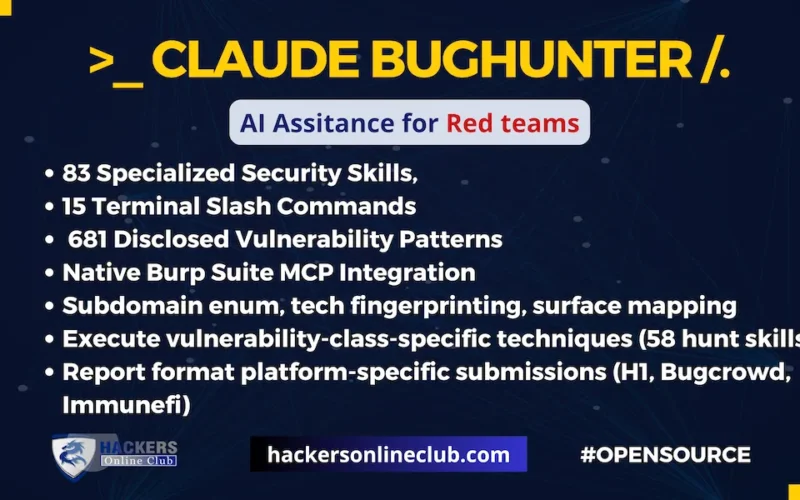
├─► 83 Specialized Security Skills
├─► 15 Terminal Slash Commands
├─► 681 Disclosed Vulnerability Patterns
└─► Native Burp Suite MCP Integration
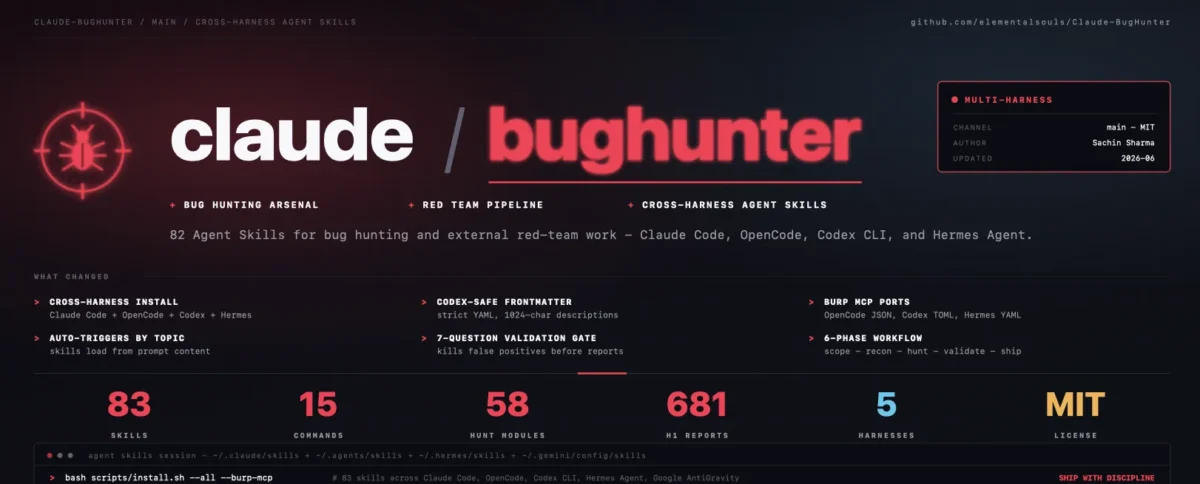
- Targeted Offensive Coverage: The bundle packs 83 specialized skills across 24 core vulnerability classes, covering web applications, APIs, SaaS setups, GraphQL, and OAuth/JWT implementations.
- Real-World Intelligence: It incorporates 681 real-world disclosed report patterns sourced directly from HackerOne disclosures. This allows the agent to recognize complex vulnerability chains and edge-case execution paths.
- Enterprise Infrastructure Matrices: Coverage extends beyond basic web security to include complex enterprise environments—such as Microsoft 365/Entra ID attack paths, Okta identity chain analysis, VMware vCenter/Workspace ONE flaws, and SSL-VPN appliance attack flows.
- Burp Suite MCP Integration: Through Model Context Protocol (MCP) support, Claude can interface directly with Burp Suite’s proxy, scanner, and repeater to execute and analyze real-time HTTP requests during active assessments.
The 6-Phase Execution Workflow
Claude-BugHunter operates through a structured methodology to keep assessment outcomes focused and verifiable:
1. Reconnaissance ──► Subdomain enum, tech fingerprinting, surface mapping
2. Map & Rank ──► Identify high-value targets & prioritize attack vectors
3. Active Hunt ──► Execute vulnerability-class-specific techniques (58 hunt skills)
4. Validate ──► Enforce the 7-Question Gate before confirming findings
5. Report ──► Format platform-specific submissions (H1, Bugcrowd, Immunefi)
6. Iterate ──► Loop back non-linearly as new attack surfaces emerge
Scope Control & The 7-Question Gate
A critical feature of the framework is its strict adherence to scope and operational safety. To prevent AI hallucination or unvetted bug reporting, Claude-BugHunter subjects every potential finding to a mandatory 7-Question Gate before drafting a report:
1. Active Exploitability: Can this vulnerability be triggered right now with a reproducible HTTP request?
2. Impact Alignment: Is the business impact clearly recognized by the target program’s rules of engagement?
3. Scope Authorization: Is the asset explicitly listed as in-scope for the assessment?
4. Access Prerequisites: Can the attack succeed without ungranted administrative access?
5. Novelty Check: Is the behavior distinct from documented or intended functionality?
6. Proof of Concept Quality: Is there concrete evidence (such as response signatures or order confirmations) proving real-world impact?
7. Exclusion Check: Is the finding free from “out-of-scope” or low-value submission lists?
Out-of-Scope by Design: Claude-BugHunter intentionally excludes internal Active Directory attacks (BloodHound, Kerberoasting), C2 framework tradecraft (Cobalt Strike, Sliver), and EDR/AV evasion routines to maintain a dedicated focus on external attack surfaces and bug bounties.
Quickstart Installation Guide
For security teams and researchers using Claude Code, the bundle can be installed as a plugin or via local git cloning:
Option A: Claude Code Plugin Installation (Recommended)
Execute the marketplace commands directly within Claude Code:
/plugin marketplace add elementalsouls/Claude-BugHunter

/plugin install claude-bughunter@elementalsouls
Option B: Terminal Copy Installation
Clone the official GitHub repository and execute the environment installer:
git clone https://github.com/elementalsouls/Claude-BugHunter.git

cd Claude-BugHunter

bash scripts/install.sh Use ./scripts/install.ps1 on Windows
Technical Summary Matrix
| Feature Area | Specifications & Capabilities |
| Repository URL | [github.com/elementalsouls/Claude-BugHunter](https://github.com/elementalsouls/Claude-BugHunter) |
| Primary Target | External Red Teaming, Web Security, API Security, Bug Bounty |
| Core Components | 83 Skills, 15 Slash Commands, 681 Disclosed Vulnerability Patterns |
| Integrations | Burp Suite via MCP, Claude Code, Codex CLI, OpenCode, Hermes Agent |
| Licensing | Dual-Licensed: MIT (Code/Scripts) & CC BY 4.0 (Methodology/Content) |