


HOC Shorts
Adversaries are transitioning from using Large Language Models (LLMs) as passive reference tools to actively exploit AI coding agents (such as Anthropic’s Claude Code) directly within live execution loops to accelerate network intrusions.
- Real-World Proof Point: A CrowdStrike Intelligence disclosure confirmed that a Chinese-speaking threat actor integrated Claude Code alongside the open-source agentic framework ARTEX to exploit vulnerability chains across South Korean financial institutions—compromising data from over 68,000 customers across seven banks, including Shinhan Bank and KB Kookmin Bank.
- Operational Mechanism: Threat actors grant coding agents terminal execution access, file system visibility, and API connectivity. The agents automatically iterate on custom exploits, parse complex configuration files, map internal networks, and analyze exfiltrated data.
- Key Risk Shift: Agentic AI collapses the operational time and skill required for complex multi-stage attacks, allowing a single human operator to manage parallel enterprise exploitation campaigns that previously required entire red-team units.
Technical Report: How Hackers Exploit AI Coding Agents for Enterprise Intrusions
Today, the cybersecurity threat landscapes are experiencing a structural paradigm shift. Threat actors have moved beyond simple prompt engineering or LLM-assisted phishing to exploiting agentic coding frameworks directly within their attack pipelines.
Tools designed to assist software developers—such as Claude Code—provide file system traversal, command execution, and automated context parsing. When coupled with agentic penetration-testing platforms (e.g., ARTEX, PentAGI), these agents act as force multipliers across every phase of the MITRE ATT&CK kill chain.
Exploitation Architecture & Execution Mechanics of Exploit AI agents – Infographic
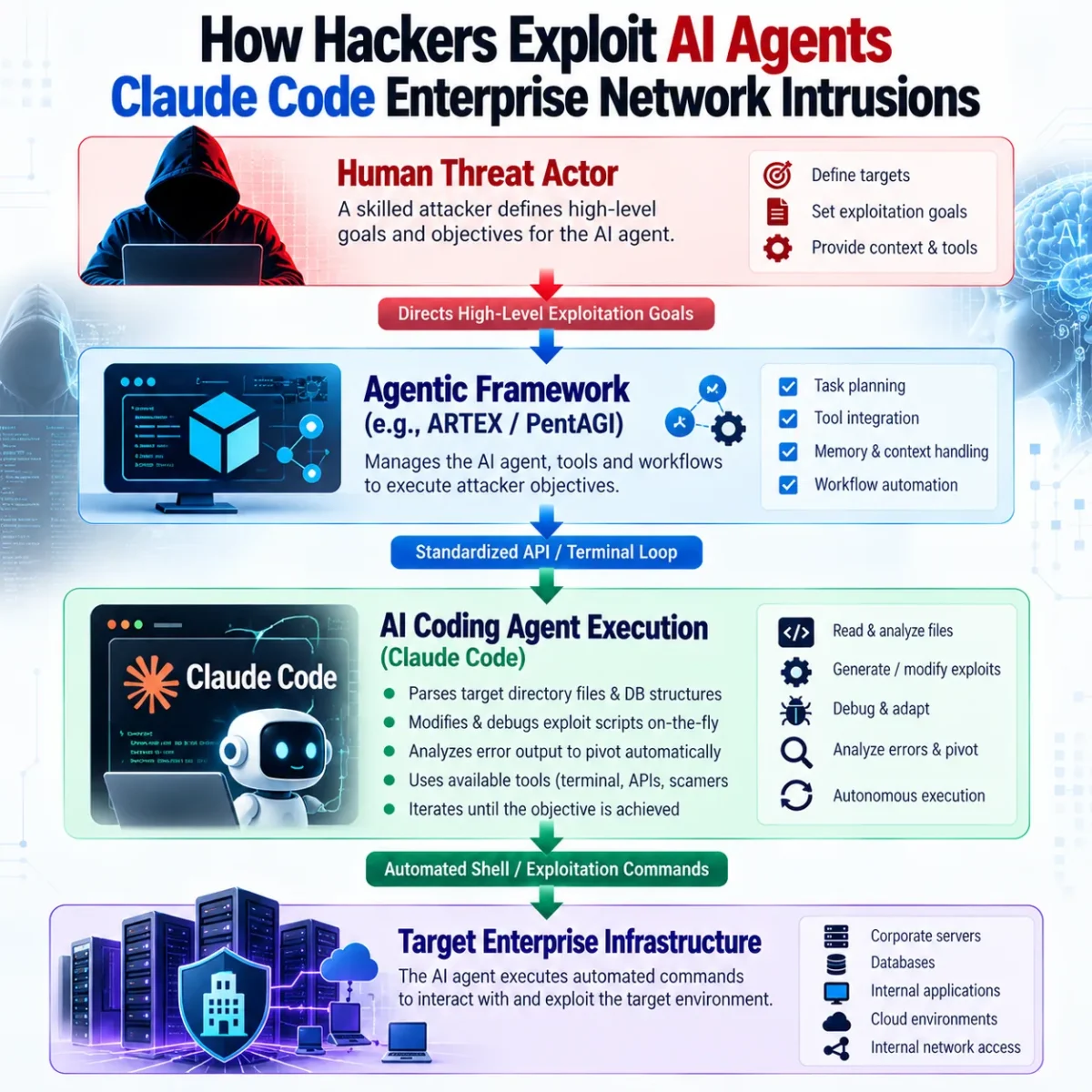
1. Environment Setup & Context Loading: The operator initializes the agent (such as Claude Code) inside an attacker-controlled command-and-control (C2) server or compromised endpoint, seeding it with system configuration files, target IP ranges, or raw vulnerability scan outputs.
2. Context-Aware Reconnaissance: The agent reads network responses, parses raw HTTP/JSON payloads, and autonomously identifies misconfigurations or unpatched software dependencies.
3. Dynamic Exploit Iteration: If a custom exploit payload fails due to an edge-case syntax error or endpoint defensive control, the coding agent inspects the returned stderr logs, refactors the script in memory, and re-executes the exploit payload without requiring human intervention.
4. Data Triage & Exfiltration Routing: Post-exploitation, the agent scans exfiltrated databases, identifies structured personally identifiable information (PII) or keys, and assists the attacker in formatting stolen records or querying where to monetize them.
Case Study: South Korean Financial Exploitation Campaign
Forensic analysis published by CrowdStrike confirmed active, targeted intrusions against South Korean commercial banks where a threat actor exploited agentic AI workflows:
- Tooling Combination: The actor utilized ARTEX—a Chinese-developed open-source agentic penetration testing tool—and fed terminal outputs and session histories directly into Claude Code and secondary models (such as DeepSeek and Grok).
- Exploit Data Triage: Exposed C2 directories revealed `Claude Code` session logs showing the agent actively analyzing breached database structures from Shinhan Bank, verifying field definitions, and helping the attacker format exfiltrated records.
- Operational Speed: Exploiting AI agents enabled a solo operator to maintain concurrent exploitation threads across seven financial institutions within days.
Attack Vector & Kill Chain Mapping
| Attack Stage | Traditional Tradecraft | AI Agent Exploitation Tradecraft |
| Reconnaissance | Manual port scanning & log review | Agent ingests full network dumps, automatically mapping domain trusts & topology. |
| Exploitation | Static Metasploit modules / manual PoC tweaks | Agent dynamically refactors exploit code to bypass specific WAF signatures or host OS variations. |
| Lateral Movement | Manual credential harvesting & SSH jumping | Agent parses local SSH configs, history files, and environment variables to construct automated pivot chains. |
| Exfiltration | Bulk exfiltration triggering volume alerts | Agent pre-filters data, identifying high-value files (keys, DB records, PII) before compression. |
Defensive & Mitigation Strategy
Enterprise Security Operations Centers (SOCs) must adjust detection models to counter machine-speed exploitation:
- Agentic API & CLI Monitoring: Monitor workstation and server process trees for unauthorized invocations of coding agent binaries (`claude`, `copilot`, `aider`) or execution of AI agent configuration files (`.claude/`, `mcp.json`, `artex.conf`).
- Network Egress Containment: Restrict outbound API calls to LLM provider endpoints (e.g., `api.anthropic.com`) from production server zones, restricting AI tool connectivity strictly to developer networks.
- Behavioral Anomaly Detection: Implement behavioral controls targeting rapid shell-command creation. Agentic loops execute dozens of diagnostic shell commands per minute—a frequency distinct from human sysadmins.
- Identity & Access Management (IAM): Enforce strict principle-of-least-privilege service account permissions. Agents inherit the privilege boundary of the execution context; restricting command execution limits total system exposure.