



Google HEIR (Homomorphic Encryption Intermediate Representation) an open-source project. The initiative aims to solve one of the biggest trade-offs in modern computing: balancing AI features with absolute user data privacy.
By automating the translation of standard machine learning (ML) models into Fully Homomorphic Encryption (FHE) pipelines, Google is turning what was once considered the “holy grail” of cryptography into an accessible, one-click reality for developers.
What is Homomorphic Encryption, and Why Does It Matter?
Under end-to-end encryption (E2EE), data is safe while sitting on a server (data-at-rest) or moving across the network (data-in-transit). However, to run an AI model, process a search query, or calculate credit risk, the cloud server must first decrypt your data (data-in-use). If that server is compromised, your private information is exposed.
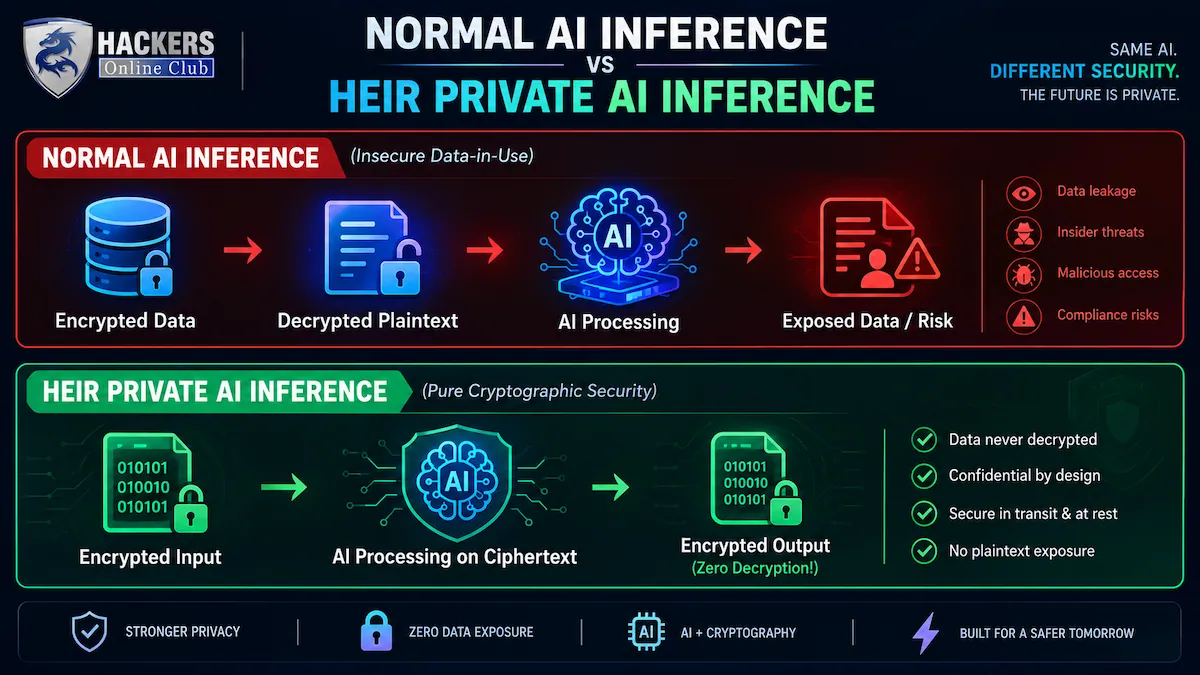
Fully Homomorphic Encryption (FHE) fundamentally changes this. It allows servers to run mathematical computations directly on encrypted data (ciphertexts). The cloud processes your request, generates a result, and sends it back—all without ever decrypting or “seeing” the original data.
Google HEIR: Bridging the Cryptography Gap
Until now, deploying homomorphic encryption required specialized teams of cryptographers to manually rebuild model mathematics line-by-line.
Google built HEIR—a general-purpose compiler toolchain built on the MLIR (Multi-Level Intermediate Representation) framework—to completely automate this workflow:
- Automated Model Conversion: HEIR takes standard, pre-trained AI models written in Python or frameworks like PyTorch/TensorFlow and automatically lowers them into FHE-compatible circuits.
- No Cryptography PhD Required: Developers can write standard code while HEIR handles scheme selection, circuit arithmetization, ciphertext layout (“packing”), and parameter selection under the hood.
- Pure Cryptographic Guarantees: Unlike hardware-based Confidential Computing (such as CPU Enclaves or TEEs), FHE doesn’t rely on trusting third-party chips or cloud hypervisors. Protection is backed by pure mathematics.
Real-World Applications Featured by Google
Google demonstrated HEIR’s real-world capabilities across four distinct private-inference applications:
1. Content Recommendation & Personalization: Recommending items or media based on user profiles without the server knowing the user’s viewing history or tastes.
2. Credit Card Fraud Detection: Evaluating financial transactions against risk models without exposing user purchase history in cleartext.
3. Encrypted Network Intrusion Detection: Analyzing network traffic payloads for malicious patterns without inspecting private data packets.
4. Voice Wake-Word Detection: Identifying voice triggers from encrypted audio clips.
Performance & Hardware Acceleration Partnerships
Historically, FHE suffered from massive computational overhead—sometimes running up to 1,000 times slower than unencrypted processing.
To overcome latency barriers and prepare HEIR for production enterprise use, Google has partnered with leading hardware accelerator creators, including Belfort, Niobium, Cornami, and Optalysys. These partnerships allow the HEIR compiler to target dedicated cryptographic silicon directly, reducing processing times from minutes to milliseconds.
Summary Overview: HEIR at a Glance
| Feature / Metric | Traditional Cloud AI | Hardware Enclaves (TEE) | Google HEIR (FHE) |
| Data Protection | In Transit & At Rest Only | In Memory (Hardware-bound) | In Transit, At Rest, AND In Use |
| Trust Model | Trust Cloud Provider | Trust CPU Chip Manufacturer | Pure Cryptographic Verification |
| Developer Complexity | Low | Medium | Low (One-Click Conversion) |
| Target Workloads | All Workloads | General Microservices | Private AI Inference & High-Value Batching |
| Project Status | Standard Practice | Enterprise Standard | Open Source (heir.dev) |