
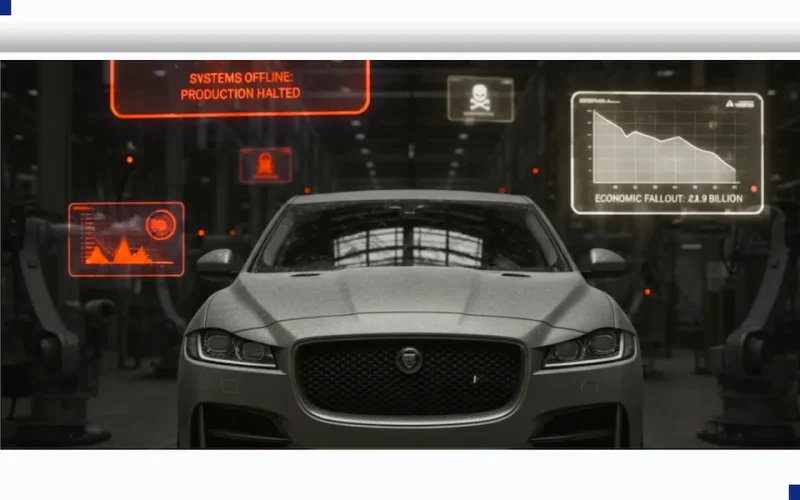
It’s been called the most expensive cyber attack in UK history. In late August, luxury car manufacturer Jaguar Land Rover (JLR) was hit by a massive digital intrusion that forced the company to pull the plug on its entire global production line for nearly six weeks.
The incident was more than just a tech failure; it was a crisis that cost JLR hundreds of millions and actually slowed down the entire UK economy.
Key points
| Detail | Summary |
| When it Happened | Started around September 1, 2025. |
| The Action | JLR shut down its entire IT system and stopped all car production worldwide. |
| The Cost to JLR | Posted a £485 million loss for the quarter, including £196 million in direct recovery costs. |
| Cost to the UK | Experts estimate the total economic damage at up to £1.9 billion. |
| Who Did It | A hacking group called Scattered Lapsus$ Hunters claimed responsibility. |
1. The Digital Disaster
When JLR detected the security breach, it had no choice but to take drastic action. To stop the hackers from spreading, the company powered down its network, which included all the connected systems that run its high-tech factories in the UK, Slovakia, and elsewhere.
This move immediately halted the production of cars like the Range Rover and Jaguar, leaving roughly 1,000 vehicles unmade every day.
- Customer Data at Risk: While JLR stresses it has no evidence that customer data was stolen, it did tell regulators there was a “possibility of customer data having been leaked”. The full investigation into what was stolen is ongoing.
2. The Unprecedented Impact
The shutdown’s effect was far-reaching and shocked the UK government and financial markets.
- Financial Hit: The extended pause in production—lasting close to six weeks—meant JLR sold far fewer cars, leading to the massive financial losses reported for the quarter.
- Slowing the Economy: The problem was so big that the lack of production contributed to a slowdown in the UK’s national economy, knocking a chunk off the country’s economic growth in September.
- Supply Chain Chaos: JLR relies on a huge network of smaller suppliers, especially in the West Midlands. When JLR stopped, those suppliers had to stop too, forcing thousands of workers to be temporarily laid off. The government even had to step in with a loan guarantee to help these smaller businesses survive the crisis.
3. The Security Lessons Learned
The JLR attack highlights a critical flaw in modern manufacturing: connectivity is a double-edged sword.
- The Connected Factory Problem: JLR’s “smart factories” are highly connected for efficiency. When the IT network (emails, logistics, planning) was hacked, the factory floor (Operational Technology or OT) couldn’t operate safely, proving that if your business systems are too linked, a breach in one area can shut down everything.
- The Outsourcing Risk: The company had recently outsourced a major part of its IT to a contractor. This move has raised questions about whether consolidating and simplifying key systems made them an easier, larger target for a single devastating attack.
Following the crisis, JLR is now focused on a massive effort to rebuild and strengthen its entire digital infrastructure. The industry is watching closely, knowing that in today’s digital world, cybersecurity is the biggest insurance policy a company can have.