


HOC Shorts
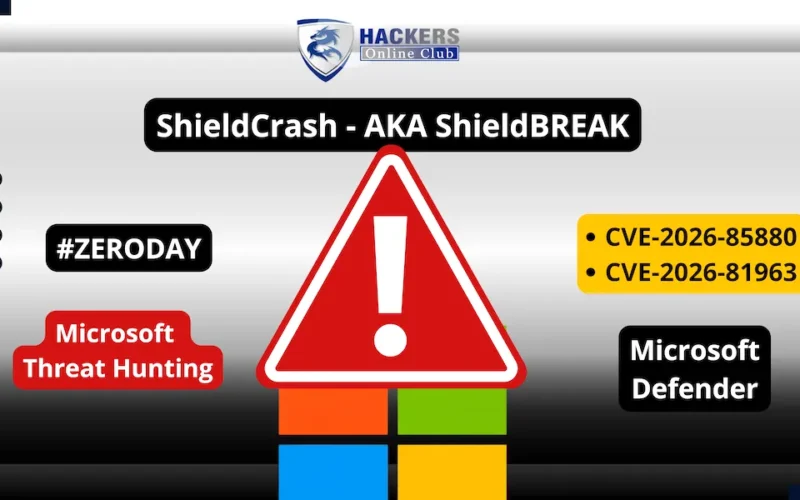
Critical Security Report: Exposed as ‘ShieldCrash‘ Bypasses Microsoft Defender just after release September 2026 Patch Tuesday.
Enterprise Security Operations Centers (SOCs) face elevated risk following Microsoft’s September 2026 Patch Tuesday rollout. While the microsoft patched a record-setting 974 vulnerabilities—including two actively exploited in-the-wild zero-days (`CVE-2026-85880` and `CVE-2026-81963`)—a fresh zero-day threat emerged almost simultaneously.
Hours after the patch deployment, security researcher (operating under the handle Nightmare Eclipse) publicly released ShieldCrash. The functional proof-of-concept (PoC) exploit serves as an immediate patch bypass for ShieldBreak (`CVE-2026-69414`) a Windows Defender zero-day Vulnerability, a high-severity elevation of privilege (EoP) vulnerability within the Microsoft Malware Protection Engine (`mpengine.dll`).
[Low-Privilege User / Payload] ──► Exploits ALPC / Update Stack Zero-Days (CVE-2026-85880)
│
▼
Escapes AppContainer / Sandbox Boundaries
│
▼
Executes ‘ShieldCrash’ Bypass via Cloud Filter API
│
▼
Manipulates Privileged mpengine.dll Callbacks
│
▼
Achieves Unrestricted NT AUTHORITY\SYSTEM Access
1. Executive Summary: The September 2026 Threat Landscape
The convergence of record-breaking vulnerability disclosures, active in-the-wild exploitation, and immediate zero-day patch bypasses represents an acute operational challenge for enterprise infrastructure:
Record Cumulative Volume: Microsoft’s security release addresses 974 total CVEs, driven by widespread adoption of AI-assisted vulnerability discovery across internal red teams and external security researchers.
- Active In-The-Wild Zero-Days: CISA added both `CVE-2026-85880` (Windows ALPC Heap Buffer Overflow) and `CVE-2026-81963` (Windows Update Stack Link Following) to its Known Exploited Vulnerabilities (KEV) catalog, setting an emergency federal compliance deadline.
- Immediate EDR Subversion: The release of ShieldCrash proves that fixing specific execution paths does not eliminate underlying design flaws in how endpoint security engines parse user-mode cloud file callbacks.
2. Deep-Dive Vulnerability & Exploit Breakdown
A. ShieldCrash Zero-Day (Microsoft Defender Patch Bypass)
ShieldCrash bypasses the structural fixes deployed for ShieldBreak (`CVE-2026-69414`) in version `1.1.26080.3` of the Microsoft Malware Protection Engine.
- Exploit Vector: The attack abuses the Cloud Filter API (CFAPI) during placeholder file hydration.
- Mechanism: An authenticated local user registers a custom sync root. When `mpengine.dll` attempts to scan the file, user-mode callbacks manipulate filesystem handles and Windows Object Manager links, inducing a race condition.
- Impact: The engine’s privileged thread executes arbitrary file reads as `NT AUTHORITY\SYSTEM` on fully patched Windows installations.
B. CVE-2026-85880 (Windows ALPC Heap Buffer Overflow)
- Component: Windows Advanced Local Procedure Call (ALPC) subsystem.
- Impact: Discovered by researchers at Volexity and Proofpoint, this heap overflow allows a low-privilege application trapped inside an AppContainer sandbox to break boundaries and escalate directly to `SYSTEM` privileges without user interaction.
C. CVE-2026-81963 (Windows Update Stack Link Following)
- Component: Windows Update Stack.
- Impact: An improper link resolution vulnerability that allows authenticated local attackers to redirect file overwrite operations during update execution, granting full administrative control.
3. Vulnerability Comparison & Priority Matrix
| Vulnerability Alias | CVE / Identifier | Target Component | Severity / CVSS | Exploitation Status | Action Priority |
| Windows ALPC Zero-Day | CVE-2026-85880 |
Windows ALPC Subsystem | 7.8 (Important) | Active In-The-Wild (CISA KEV) | Immediate (Phase 1) |
| Update Stack Link Flaw | CVE-2026-81963 |
Windows Update Stack | 7.8 (Important) | Active In-The-Wild (CISA KEV) | Immediate (Phase 1) |
| ShieldCrash PoC | Pending Assignment | Defender Engine (mpengine.dll) |
High (EoP Primitive) | Unpatched Zero-Day (PoC Public) | Active Hunting (Phase 1) |
| Windows DNS Server | CVE-2026-69730 |
Windows DNS Infrastructure | 9.8 (Critical) | Unexploited (SigRed Successor) | High (Phase 2) |
4. Enterprise Threat Hunting: Microsoft Sentinel KQL Queries
Security operations teams should deploy these three Kusto Query Language (KQL) queries in Microsoft Sentinel (via Microsoft Defender for Endpoint telemetry) to detect active exploitation attempts targeting ShieldCrash and ALPC sandbox escapes.
Query 1: Detecting CFAPI Sync Root Registration by Non-Admin Users
Identifies standard user processes attempting to register Cloud Filter sync roots (`cfapi.dll`) to trigger file hydration race conditions.
```kql

// Title: Cloud Filter API (CFAPI) Sync Root Registration by Non-Admin Process

DeviceImageLoadEvents

| where TimeGenerated >= ago(7d)

| where FolderPath endswith @"\cfapi.dll" or FolderPath endswith @"\cldapi.dll"

| where not(

AccountName in~ ("SYSTEM", "LOCAL SERVICE", "NETWORK SERVICE")

or InitiatingProcessFileName in~ (

"OneDrive.exe", "Dropbox.exe", "GoogleDriveFS.exe",

"iCloudDrive.exe", "msedgewebview2.exe", "MsMpEng.exe"

)

)

| project TimeGenerated, DeviceName, AccountName, InitiatingProcessFileName, InitiatingProcessCommandLine, FolderPath
Query 2: Detecting Anomalous Child Processes Spawned by Defender (`MsMpEng.exe`)
Surfaces administrative command shells or script interpreters spawned directly from Microsoft Defender worker processes.
```kql

// Title: Anomalous Child Process Spawned by Microsoft Defender Process

DeviceProcessEvents

| where TimeGenerated >= ago(7d)

| where InitiatingProcessFileName in~ ("MsMpEng.exe", "NisSrv.exe", "MpCmdRun.exe")

| where FileName in~ ("cmd.exe", "powershell.exe", "pwsh.exe", "wscript.exe", "cscript.exe", "rundll32.exe", "regsvr32.exe")

| where not(FileName in~ ("MpSigStub.exe", "werfault.exe", "wermgr.exe"))

| project TimeGenerated, DeviceName, AccountName, InitiatingProcessFileName, FileName, CommandLine, ProcessId
Query 3: Detecting Unprivileged Reparse Point / Junction Creations in System Folders
Flags unauthorized attempts to create symbolic links or junction points targeting System32 or Defender directories.
kql

// Title: File System Junction Point Creation Targeting System32 via Standard User

DeviceFileEvents

| where TimeGenerated >= ago(7d)

| where ActionType in ("FileCreated", "FileModified", "SymbolicLinkCreated")

| where FolderPath has_any (@"C:\Windows\System32\", @"C:\Windows\SysWOW64\", @"C:\ProgramData\Microsoft\Windows Defender\")

| where not(AccountName in~ ("SYSTEM", "LOCAL SERVICE", "NETWORK SERVICE"))

| project TimeGenerated, DeviceName, AccountName, InitiatingProcessFileName, ActionType, FileName, FolderPath
5. Actionable Remediation & Mitigation Roadmap
1. Deploy September Cumulative Updates: Immediately push the September 2026 OS update packages across all workstations and servers to fix `CVE-2026-85880` and `CVE-2026-81963`.
2. Enable Automatic Antimalware Definitions: Verify that Microsoft Defender settings permit automatic background updates so endpoints immediately pull out-of-band updates superseding `mpengine.dll` version `1.1.26080.3`.
3. Restrict Unprivileged Sync Roots: Enforce Group Policy / Intune administrative templates to block non-administrative users from mounting custom cloud storage sync providers or registering unapproved drivers.
4. Enforce Least Privilege: Restrict standard user accounts from executing unverified binaries or PowerShell scripts to break the initial execution phase required for local privilege escalation.