


HOC Shorts
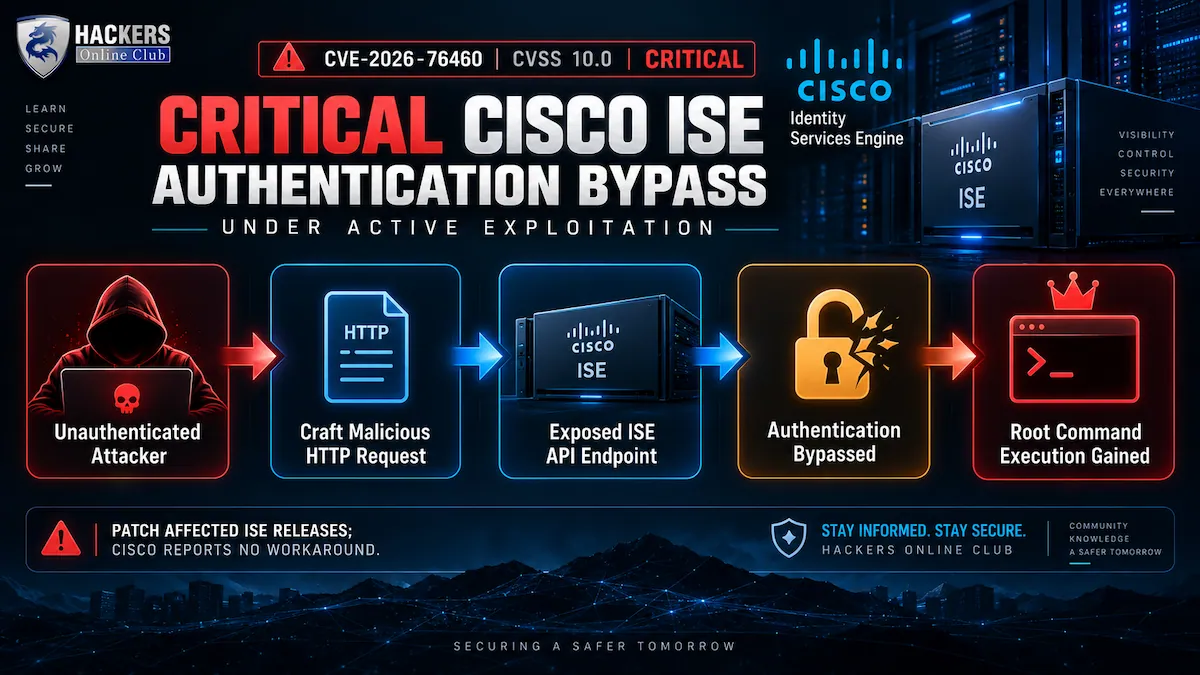
Cisco has issued a critical security advisory cisco-sa-ISE-ABP-VNSW7Tn5 warning of a maximum-severity CVSS 10.0 authentication bypass vulnerability in Cisco Identity Services Engine (ISE) and Cisco ISE Passive Identity Connector (ISE-PIC).
Tracked as CVE-2026-76460, the flaw allows unauthenticated remote attackers to bypass web management interface controls and obtain root privileges on impacted nodes. Cisco PSIRT and CISA have confirmed active exploitation in the wild, adding the vulnerability to CISA’s Known Exploited Vulnerabilities (KEV) catalog. Administrators must apply software updates immediately.
What Are the Key Points?
The advisory discloses an unauthenticated remote code execution vector targeting core network access control infrastructure:
- Unauthenticated API Exploitation: The issue is caused by weak authentication controls on certain Cisco ISE API endpoints. A malicious user could send specially designed HTTP requests to get around the authentication process.
- Full Root Compromise: Successful exploitation grants unauthenticated attackers access to the web-based management interface and command execution with root privileges on the underlying operating system.
- Active In-the-Wild Exploitation: Confirmed actively exploited in target environments; the vulnerability was originally discovered during a Cisco Technical Assistance Center (TAC) support engagement.
- Zero Workarounds Available: Cisco explicitly notes that no official workarounds exist to resolve the vulnerability.
What Is the Impact on Enterprise Security?
1. Network Authentication Breakdown: Cisco ISE acts as the central policy decision point for enterprise enterprise Zero Trust, NAC, and 802.1X environments. A root-level compromise allows threat actors to tamper with access policies or pivot across the corporate network.
2. Forensic Evasion Risks: Because attackers obtain root privileges, Cisco warns that threat actors can tamper with local logs and remove indicators of compromise (IoCs) to conceal their presence.
3. Mandatory Federal Remediation: CISA’s KEV addition mandates federal civilian agencies to remediate or isolate affected instances under Binding Operational Directive (BOD) guidelines.
What Should You Do? (Actionable Steps)
[ 1 ] Audit Deployment Logs: Review `access.log` files across all ISE nodes for suspicious usernames or anomalies. Run the CLI verification command:`admin show logging application ise-kong/access.log | include dummyuser`
[ 2 ] Cross-Check External Logs: Validate perimeter firewall and egress network logs for unexpected outbound transfers or suspicious command-and-control (C2) connections initiated from ISE IP addresses.
[ 3 ] Apply Infrastructure ACLs (Mitigation): Restrict management and control plane access exclusively to trusted administrative subnets using infrastructure ACLs (iACLs).
[ 4 ] Upgrade to Fixed Releases: Deploy the official software patch corresponding to your release train:
Cisco ISE Fixed Software Matrix
| Affected Version | First Fixed Patch Release | Remediation Status |
| Cisco ISE 3.1 | 3.1 Patch 12 | Update Available |
| Cisco ISE 3.2 | 3.2 Patch 11 | Update Available |
| Cisco ISE 3.3 | 3.3 Patch 12 | Update Available |
| Cisco ISE 3.4 | 3.4 Patch 7 | Update Available |
| Cisco ISE 3.5 | 3.5 Patch 4 | Update Available |
| Cisco ISE 3.0 & Prior | End of Software Maintenance | Migrate to Supported Release |