


HOC Shorts |
Amazon Web Services published security bulletin 2026-180-AWS (content type: Important), disclosing a network-layer vulnerability affecting open-source AI agent infrastructure.
- The Vulnerability (`CVE-2026-125926`): Identified as a Server-Side Request Forgery (SSRF) flaw (also tracked as `GHSA-fc39-fwh3-wv5r`) in how `mcp-gateway-registry` validates the upstream address of registered Model Context Protocol (MCP) servers.
- The Impact: An authenticated user with permissions to register or modify a server can point the upstream address toward internal network services. In certain scenarios, the gateway relays the internal responses directly back to the user, exposing private services or cloud metadata endpoints.
- Immediate Remediation: Affected deployments running versions `v1.0.3` through `v1.34.0` must upgrade immediately to `v1.35.0` or later, audit existing registered server entries, and enforce IMDSv2 on EC2 instances.
AWS Security Bulletin 2026-180: Mitigating SSRF Risks in MCP Gateway Registries
Amazon Web Services released security advisory, alerting cloud architects and security operators to an important Server-Side Request Forgery (SSRF) vulnerability.
Tracked as `CVE-2026-125926` and `GHSA-fc39-fwh3-wv5r`, the flaw resides in the server registration and update API of `mcp-gateway-registry`—an open-source registry and gateway used to centralize discovery, access control, and proxying for Model Context Protocol (MCP) tool assets.
Reported through coordinated disclosure by security researcher novice-22, the vulnerability underscores the critical need for strict URL and network boundary validation inside rapidly evolving agentic AI architectures.
Technical Breakdown of CVE-2026-125926
The vulnerability stems from insufficient validation of user-supplied upstream addresses during MCP server registration or modification routines:
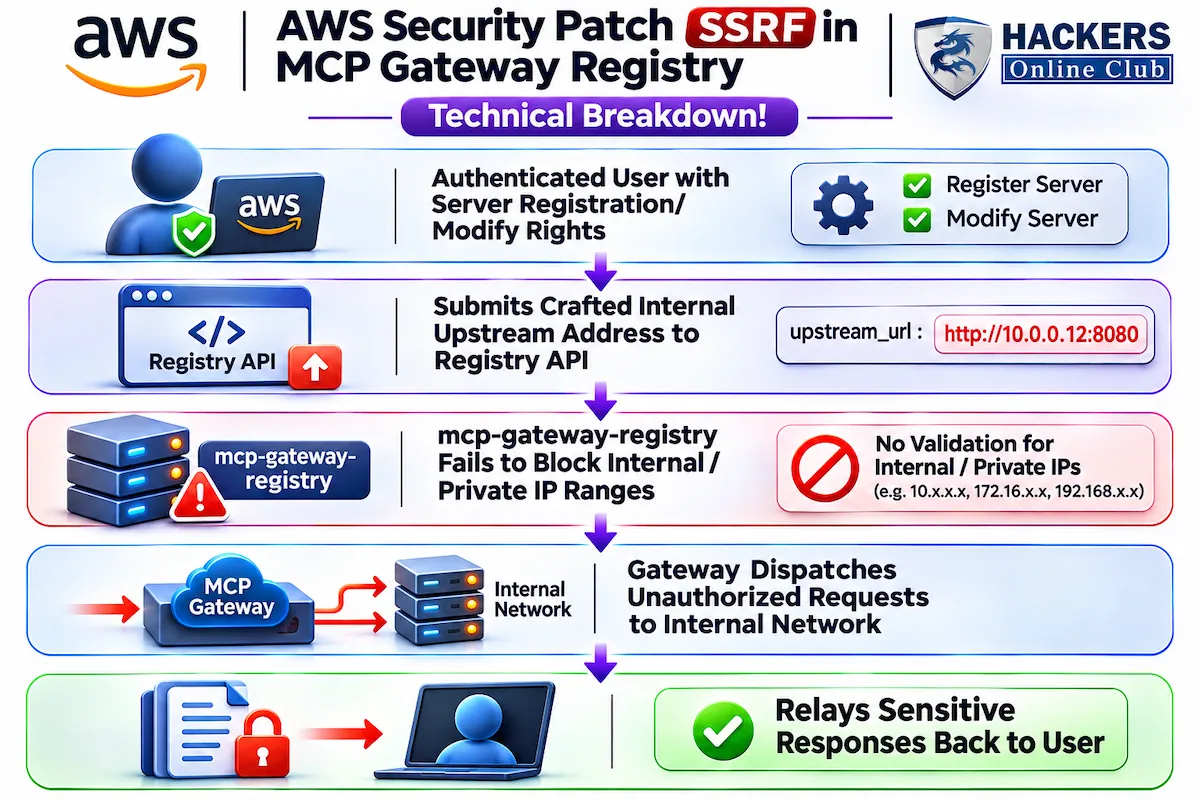
- Exploitation Mechanics: When an authenticated user holding permissions to add or edit an MCP server submits a crafted upstream URL, the gateway fails to block requests targeting private or internal network infrastructure.
- Data Exposure Risk: Because the gateway acts as a proxy for registered tool assets, it dispatches outbound requests toward internal endpoints on the deployment’s network—and in some cases, returns those internal responses directly to the requesting user.
Affected Versions & Patch Matrix
| Component / Project | Impacted Versions | Minimum Fixed Version | Additional Notes |
mcp-gateway-registry |
>= v1.0.3 and <= v1.34.0 |
v1.35.0 |
Any forked or derivative codebases must also incorporate the upstream patches. |
> Important Version Note: A separate vulnerability in the product’s external management API was previously resolved in version `1.25.0`. Deployments running `1.25.0` through `1.34.0` carry that earlier fix, but remain fully vulnerable to `CVE-2026-125926` until upgraded to `1.35.0`.
Mandatory Post-Upgrade Actions & Workarounds
Because upgrading to `v1.35.0` validates upstream addresses on new registrations and updates without altering pre-existing database entries, administrators must execute manual post-upgrade checks:
1. Post-Upgrade Audit Checklist
- Inspect Registered Servers: Review the upstream addresses of all currently registered MCP servers and remove or correct any unintended endpoints.
- Review Application Logs: Audit logs spanning the timeframe when an affected version was active to identify unauthorized server registrations or address changes.
- Rotate Cloud Credentials: If the registry runs with an attached IAM/cloud role and log audits cannot rule out suspicious activity, review the role’s activity logs and rotate its credentials immediately.
2. Interim Defensive Workarounds
If immediate upgrading is delayed, apply the following network and identity controls (note that these do not replace the post-upgrade audit steps above):
- Enforce IMDSv2: On Amazon EC2 deployments, mandate Instance Metadata Service Version 2 (IMDSv2) to mitigate SSRF-based credential harvesting.
- Restrict Egress Traffic: Block outbound network access from both the registry and auth-server components to internal networks, allowing connections strictly to verified destinations.
- Tighten IAM & Registration Permissions: Limit server registration and modification privileges strictly to trusted administrative accounts, and apply least-privilege permissions to all attached component roles.