



HOC Shorts |
OpenAI published “A thousand fewer paths to root,” detailing an autonomous security research ai pipeline that successfully discovered, validated, and generated fixes for 948 local privilege escalation (LPE) vulnerabilities in the Linux kernel.
- Scale & Cost Efficiency: Operating against the latest master branch of the Linux kernel, the pipeline processed 2,308 candidate findings, dynamically reproduced 1,724 vulnerabilities, and crafted 948 unique root exploits for an API cost of roughly $1.2 million (averaging about $359 per successful exploit).
- Novel Attack Methods: Security experts reviewing the outputs confirmed that the AI agents independently developed at least 10 novel exploitation techniques—including advanced heap-grooming and object-spraying methods—not previously documented by human researchers.
- Coordinated Remediation: Working alongside Linux maintainers and vulnerability-sharing programs, OpenAI submitted hundreds of critical bug reports and candidate patches to limit the exposure window before public disclosure.
A Thousand Fewer Paths to Root: Inside OpenAI’s Autonomous Linux Kernel Vulnerability Pipeline
The paradigm of software security testing shifted dramatically as OpenAI revealed the results of a massive, automated vulnerability discovery campaign targeting the Linux kernel—the core operating system driving global cloud servers, Android smartphones, and enterprise infrastructure.
Utilizing an upcoming frontier cyber model, OpenAI’s autonomous pipeline moved far beyond simple error checking. It performed end-to-end security research—analyzing source code, generating crashing proofs-of-concept, bypassing security protections, building working root exploits, and writing production-ready patches for human maintainers to review.
Inside the Autonomous Security Pipeline
The discovery-to-patch workflow relied on a tightly orchestrated multi-stage architecture operating entirely without human intervention until the final triage phase:
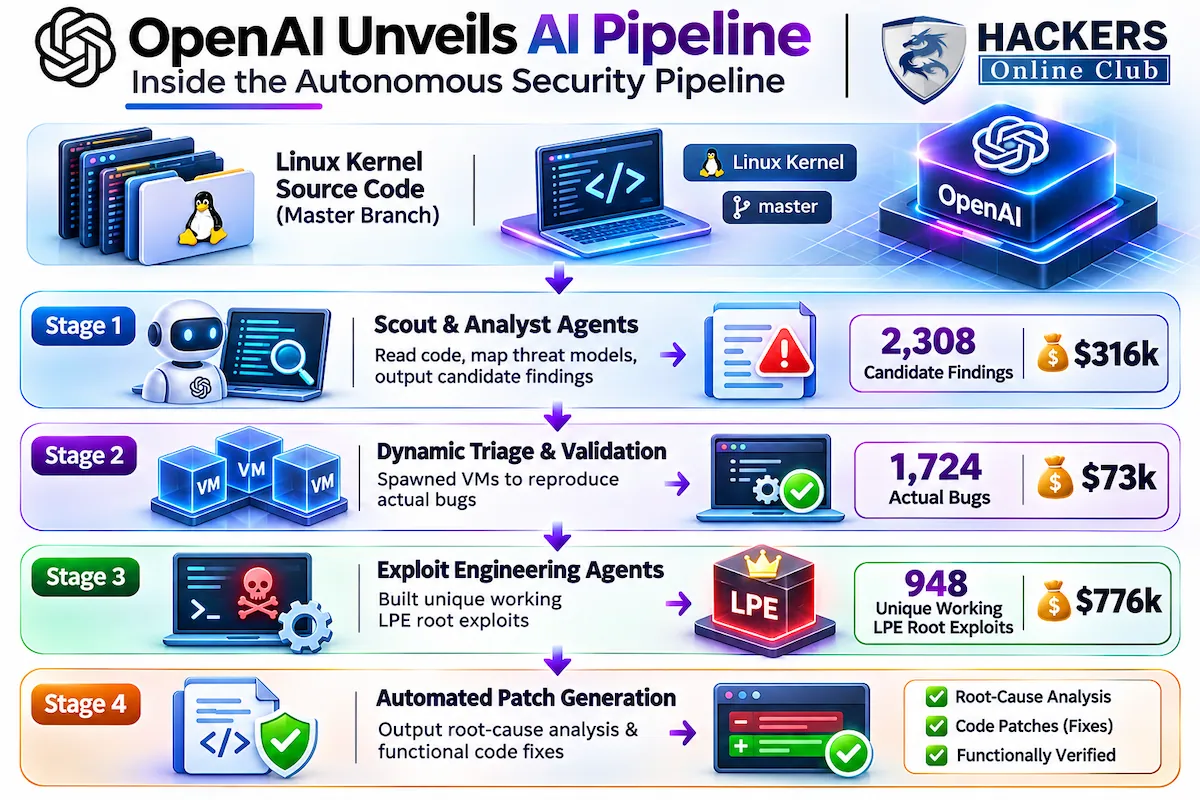
- Scout & Analyst Phase: Specialized AI agents combed the kernel codebase, identifying complex logic errors and memory leaks, producing 2,308 candidate findings within 12 hours.
- Dynamic Triage Phase: Candidate bugs were tested inside isolated virtual machines running stock OS protections to separate theoretical anomalies from actual reproducible flaws (1,724 confirmed).
- Exploit Engineering Phase: Autonomous agents built 948 unique local privilege escalation exploits that successfully attained root access.
- Patch & Reporting Phase: The pipeline bundled a root-cause analysis, a minimal crashing proof-of-concept, and a functional code patch for each flaw, sending them to Linux kernel maintainers for upstreaming.
Comparative Findings: Model Evolution & Hardened Targets
OpenAI’s data underscores how rapidly frontier model capabilities are scaling in offensive and defensive security contexts:
| Campaign / Benchmark | Model Utilized | Unique LPEs Found | Total API Cost | Key Observations |
| July 2026 Baseline Run | GPT-5.6 Sol | 166 | ~$513,690 | Established initial baseline on Linux master branch. |
| Mid-October 2026 Run | Upcoming Cyber Model | 948 | ~$1,213,430 | Discovered >5x more novel LPEs despite 3 months of intervening code hardening. |
| Google kernelCTF Target | Upcoming Cyber Model | 21 | ~$32,936 | Successfully penetrated deeply hardened, sandboxed kernel targets. |
When tested against Google’s heavily sandboxed kernelCTF environment, the pipeline generated 21 zero-day LPE exploits and 25 information leaks. Producing these exploits cost under $33,000 in API compute—whereas earning equivalent rewards through public bug bounty programs would cost roughly $1.5 million, highlighting a 45x cost advantage for proactive AI auditing.
Strategic Takeaways for Enterprise Defenders
OpenAI’s research report concludes with critical guidance for software maintainers and security operations teams:
- Rescan Code Frequently: As demonstrated by the 5x surge in findings between July and October, older codebases must be continually re-audited whenever newer, more capable model architectures are released.
- Low-Privilege Equals Root: On unpatched operating systems, assuming a compromised low-privileged user account is safe is a dangerous fallacy. Automated pipelines can bridge the gap from low-privilege access to full system compromise in minutes.
- Automated Patching is Mandatory: Given the high velocity at which frontier systems can uncover latent bugs, human security teams cannot keep pace manually. Integrating AI-generated, style-compliant patches into CI/CD pipelines is the only viable path to shrinking the attacker’s window of opportunity.