





Chinese AI startup Z.ai officially benchmarked its open-weights model, GLM-5.3, claiming its software vulnerability detection capabilities match—and slightly exceed—Anthropic’s restricted frontier model, Mythos 5.
While GLM-5.3 excels at defensive code auditing and bug identification, benchmark data reveals it still lags behind Western closed models when converting those flaws into active, operational exploits.
Benchmark Results: Defensive Superiority vs. Offensive Gap
Z.ai evaluated GLM-5.3 across two primary cybersecurity benchmarks:
CyberGym (white-box vulnerability discovery and code auditing) and ExploitBench (active exploit generation and execution).
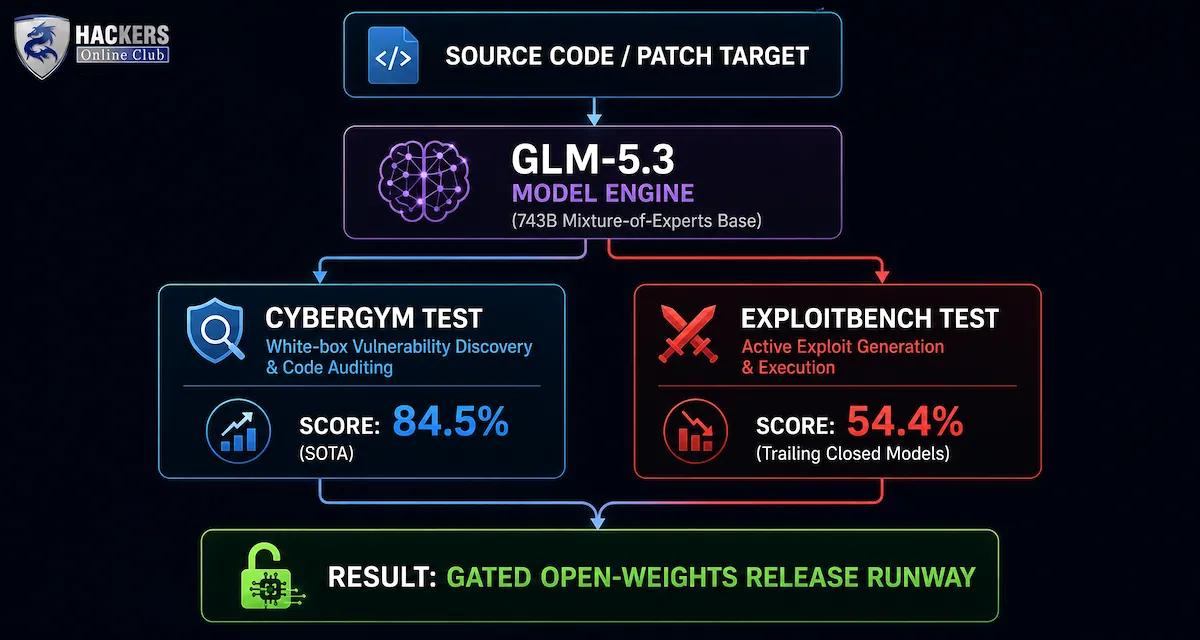
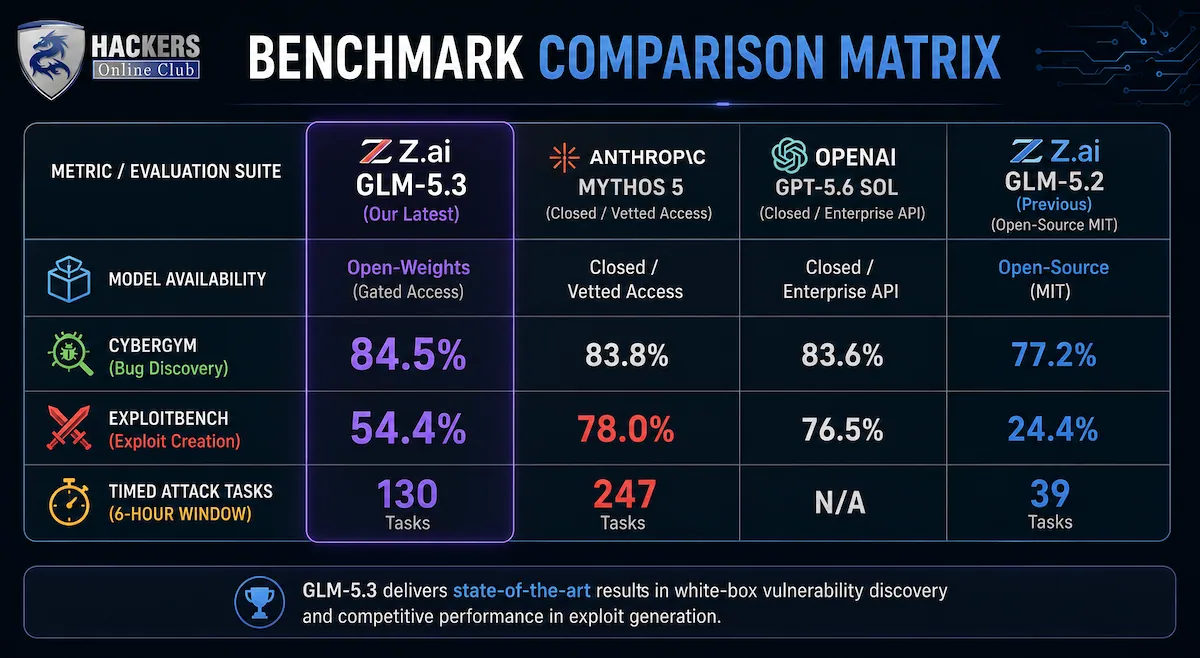
- CyberGym Victory (84.5%): CyberGym measures an AI agent’s ability to inspect source code, locate real-world vulnerabilities, and generate deterministic proof-of-concept tests to reproduce bugs. GLM-5.3 scored 84.5%, outperforming Anthropic’s Mythos 5 (83.8%) and OpenAI’s GPT-5.6 Sol (83.6%).
- ExploitBench Gap (54.4%): Developed to grade AI models on a multi-tier “exploitation ladder,” ExploitBench tests whether a model can carry a flaw through to arbitrary code execution. While GLM-5.3 more than doubled its predecessor GLM-5.2’s score of 24.4%, its 54.4% score trails closed-weight models like Mythos 5 (78.0%).
Benchmark Comparison Matrix
Technical Methodology: CyberGym vs. ExploitBench
To understand why GLM-5.3 leads in defense while falling behind in attack generation, security researchers look at the structural differences between these testing frameworks:
CyberGym (Defensive Code Auditing)
- What It Measures: Focuses on static analysis, dynamic program behavior, and root-cause localization. Given source code and bug descriptions, the model must isolate the fault and construct a deterministic test case or patch.
- Why GLM-5.3 Excels: GLM-5.3’s long-context capabilities and post-training on large codebases allow it to reason through repository structures, identify memory safety flaws (C/C++), and perform automated patch verification at high speeds.
ExploitBench (Offensive Exploitation Ladder)
- What It Measures: Evaluates a model across a 5-tier “exploitation ladder”—moving from simple bug crashes (Tier 4) to crafting target-specific primitives (e.g., heap manipulation, sandbox escapes) and achieving full arbitrary code execution (Tier 1).
- The Reason for the Gap: ExploitBench requires multi-step spatial and temporal reasoning over process memory state. While closed frontier models like Mythos 5 use specialized reinforcement learning to reliably construct complex exploit payloads, open-weights architectures often stall when bypassing modern memory defenses.
Key Insights & Governance Shift
- Post-Training Architectural Gains: GLM-5.3 utilizes the same ~743 billion-parameter mixture-of-experts (MoE) base architecture as GLM-5.2. The entire jump in defensive capabilities was achieved through scaled post-training and expanded task environments rather than a full base-model retrain.
- Delayed Open-Weights for Safety: In a notable departure from previous releases, Z.ai delayed the public download of GLM-5.3’s raw weights for roughly two weeks. The company stated the delay is necessary to conduct safety hardening and establish a “trusted access” vetting program for its most sensitive cyber capabilities.
- Industry Analysts Take Note: Governance researchers highlighted that this marks one of the first instances of a major Chinese AI lab publicly delaying an open-weights release explicitly to implement safety guardrails against offensive misuse.
Policy Implications of Open-Weight Cyber Models
The launch of GLM-5.3 has reignited international policy debates regarding open-weight models with defensive and dual-use cyber capabilities.
The Asymmetric Defense Benefit
Open-weight models democratize security tools. Enterprise defenders and open-source maintainers can host GLM-5.3 locally to continuously audit codebases, search for zero-day flaws, and generate patches without sending sensitive internal code to cloud API providers.
Proliferation & Dual-Use Risks
Once model weights are downloaded locally, built-in safety alignment can be stripped away through fine-tuning. A model scoring 84.5% on vulnerability detection can be repurposed by threat actors as an automated zero-day discovery engine.
The Shift Toward Gated Distribution
In response to dual-use concerns, Z.ai delayed the raw download of GLM-5.3’s model weights for two weeks. The lab adopted a “trusted access” vetting program for sensitive functions—mirroring access frameworks like Anthropic’s Project Glasswing. This signals a growing industry consensus that open-weights releases for cybersecurity models may require phased, identity-verified distribution models.