



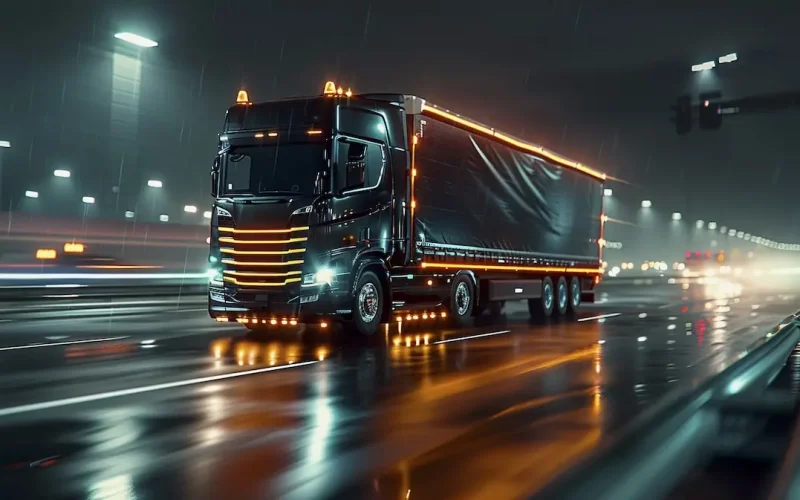
The emergence of autonomous vehicles has been praised as a revolutionary development that might revolutionize the transportation sector.
Proponents contend that these driverless cars would improve security, lower collision rates, and address the transportation industry’s manpower scarcity. Skeptics are concerned that these sophisticated technologies might create additional hazards for drivers, though.
As technology progresses, the issue of whether self-driving trucks will improve safety in the future or create new risks still has to be answered.
The Promise of Safety Through Automation
Self-driving truck proponents think technology may remove a large number of human mistakes that cause traffic accidents. Reaction delays, fatigue, attention, and impaired driving are some of the most frequent causes of collisions involving human drivers. With cutting-edge sensors, cameras, and artificial intelligence, autonomous vehicles are built to continuously scan their surroundings and make snap judgments.
The sophisticated algorithms self-driving trucks use enable them to analyze enormous volumes of data, spot dangers, and respond to them quickly. Autonomous trucks do not suffer from attentional lapses as human-driven trucks do. Other capabilities that help the trucks are lane-keeping assistance, real-time traffic data processing, and automated braking.
As stated by NBC Bay Area news, another promise of these trucks is that they can reduce traffic jams usually caused by robotaxis. There have been several videos where a driverless car is shown to block traffic or collide with an emergency vehicle. However, self-driving trucks are promised to be made with advanced technologies that can prevent such jams.
Autonomous trucks are also said to be beneficial to logistics companies and the climate. It is estimated that they can cut fuel consumption by 13% to 32%. Reduced fuel consumption means direct benefits to logistics companies, who also don’t have to pay for human drivers. It also means that less carbon gasses will be exhausted from the trucks, which will benefit the environment.
Will self-driving trucks reduce traffic accidents overall?
Theoretically, autonomous vehicles might lower the number of accidents caused by mistakes made by people. Their success in terms of safety is contingent upon more technology advancements, regulatory supervision, and their interactions with human-driven automobiles on the road.
Reduced Fatigue and Increased Efficiency
Driver fatigue is one of the biggest reasons behind truck accidents worldwide. Data shows that it may cause around 13% to 40% of all truck crashes based on studies from US government agencies.
Consider the recent example where a truck driver was delivering a load from Missouri in December 2022 and was headed to Virginia. Although the driver was operating alone, he was under the disguise of being working as a team. This allowed the driver and its company to skirt HOS rules.
Similarly, one incident was recorded where the driver was seen nodding off in a dash cam before the accident. The news article from News4JAX shows that he was driving a semi-truck and seemed to be tired. Soon after he was nodding off, he hit two cars on the side of the road.
This shows how common fatigue is when it comes to truck accidents. In such situations, the victims of the crashes should consider hiring a local attorney. A local attorney will know all the regional regulations and also some law enforcers, which will help you with the case.
Consider another example of a truck accident that occurred in St. Louis. According to Fox2Now, the crash took the life of a person who was working on his car. The truck hit the guy while replacing a flat tire on his car, according to St. Louis Metropolitan Police. A few miles down the roadway, the semi-truck came to a stop and called for help, but the person was declared dead.
In such a situation, the family of the victim can hire a St. Louis truck accident lawyer. The attorney can help them get the right compensation and collect all the evidence and documents required. Moreover, a lawyer can communicate with any witnesses present at the crime scene to strengthen your case.
According to TorHoerman Law, local attorneys can also negotiate with insurance companies on your behalf. Accident cases are usually settled outside the court after negotiation with the insurance company of the party at fault. However, the insurance officers working on the case often try to underpay for your injuries and damages. Experienced attorneys can negotiate effectively with them to get you the best possible settlement.
Driver tiredness is eliminated by self-driving trucks, which is one of its main advantages. Truck drivers frequently work hard schedules, putting in lengthy stretches without any downtime. This may result in impaired decision-making, delayed reflexes, and sleepy driving. Conversely, self-driving trucks do not require breaks to function constantly. This would allow trucks to run around the clock without being constrained by human rest cycles.
How is liability different in autonomous truck accidents compared to regular truck accidents?
Liability in typical truck accidents frequently centers on the driver or the trucking firm. Liability for autonomous trucks may transfer to the software creators, the manufacturers, or the businesses responsible for maintaining the autonomous systems. It may be difficult to ascertain who is at fault in truck accidents; a lawyer can assist with this process.
Early Concerns and Accidents
Although there is hope for increased safety, self-driving trucks are not without difficulties. There have been events that raise questions about the safety of autonomous vehicles on public roads, as with any developing technology. There have been several self-driving vehicle and truck incidents that have made headlines.
Occasionally, these mishaps have been linked to malfunctions in the truck’s sensors or software, which could cause trouble in identifying specific obstructions.
For instance, adverse weather that obstructs sensors or cameras—such as persistent rain or snow—can be difficult for autonomous systems to handle. Furthermore, there have been instances where the system has misinterpreted complex road conditions, such as construction zones or roads with hazy lane markers.
For instance, one accident involved a TuSimple autonomous truck, which was blamed for a human error. However, as stated by The Verge, passing it as a human error was an attempt by TuSimple to simplify things.
An internal report presented by TuSimple says that the accident occurred because the new driver didn’t reboot the autonomous vehicle’s system. There was a 2.5-minute left-turn command that was not deleted, but the truck executed it later. However, experts say that the system should have prevented the execution of an outdated command. Therefore, putting the blame on human error is not ideal here.
Human Oversight and Safety Concerns
Even though autonomous trucks are meant to drive themselves, many systems still need a human operator, especially during the testing and trial stages. When something goes wrong with the autonomous system, it is the responsibility of these human operators to step in and help. On the other hand, the very existence of this “safety driver” may give rise to fresh safety issues.
It is believed that having a human backup might lead to a delusion of security. Excessive dependence on technology by a human operator may lead to a decrease in their own attentiveness. When manual intervention is required, this may result in slower reaction times. Humans might not be ready to take over soon enough to avoid an accident if the system malfunctions unexpectedly.
Are self-driving trucks ready for widespread use?
Self-driving trucks still have difficulties in complicated, unpredictable locations like cities despite their potential on roads and other controlled conditions. It can take some time before the technology is widely used because it is still being developed and tested.
Self-driving trucks have a lot of potential to improve efficiency, road safety, and labor issues. There is no denying that autonomous trucks have the potential to minimize accidents brought on by human mistakes. There are still issues with existing technology, though, and these need to be resolved.
Given the unpredictable nature of road conditions and the number of incidents that have happened, it’s possible that self-driving trucks aren’t yet entirely prepared. Maintaining a balance between automation and human control will ensure these trucks increase road safety rather than pose new risks.