



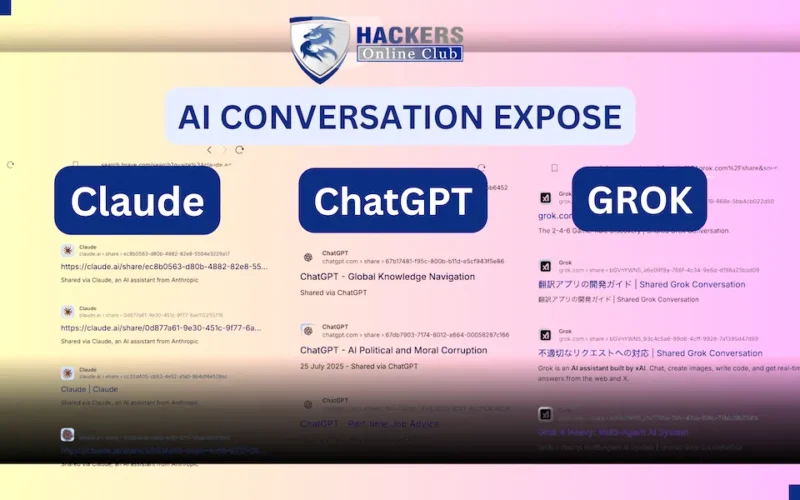
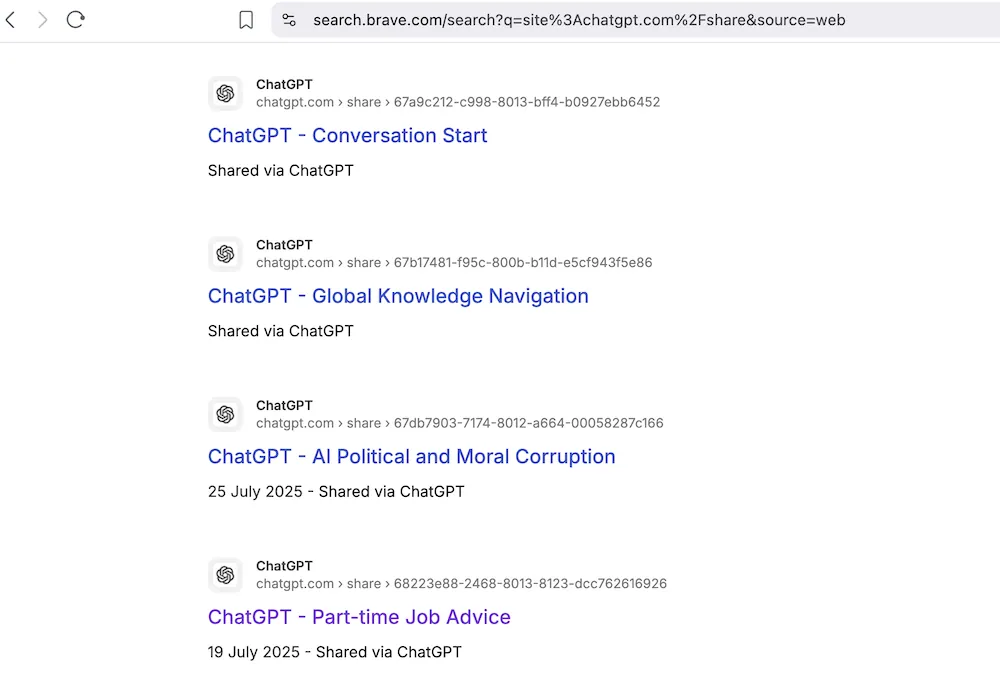
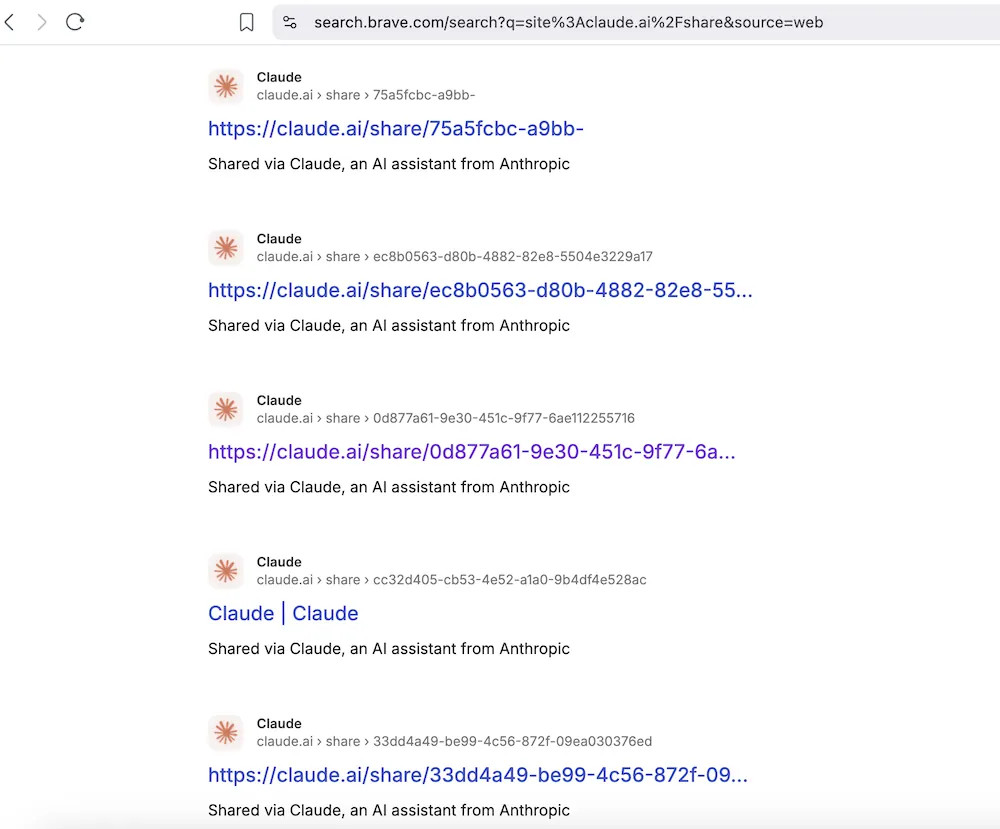
A growing privacy crisis is unfolding in the artificial intelligence sector as simple search engine “dorks” are revealing hundreds of thousands of supposedly private conversations on major platforms. When i tried and confirmed following basic queries on brave browser such as
`site:grok.com/share`, `site:chatgpt.com/share`, and `site:claude.ai/share`
are returning fully readable, indexed chat logs, effectively turning intimate user prompts into public records.
What is AI Chat Dorking?
“Chat dorking” is the practice of using advanced search operators, often called Google Dorks, in search engines like Google, Bing, and Brave Search to find publicly accessible web pages. Security researchers recently found that a few simple search queries can expose thousands of AI chat conversations that have been indexed by search engines and are accessible to anyone.
Here is our comprehensive breakdown of the vulnerability, its implications, and how to protect yourself.
KEY POINTS
- The Mechanism: When users click “Share” on these platforms, a unique URL is generated. If the AI provider fails to apply noindex meta tags or strict robots.txt rules, search engines crawl and archive these links, making prompts permanently searchable.
- Cross-Platform Vulnerability: While recent headlines have heavily focused on Grok, this same dorking technique applies seamlessly to Anthropic’s Claude and OpenAI’s ChatGPT. This indicates an industry-wide misconfiguration in how shared conversational links are handled at the platform level.
- Brave Browser Proof of Concept (PoC): I check and its working PoC using the Brave browser. Despite Brave’s aggressive tracker-blocking and privacy shields, the dorks still successfully retrieve exposed chats via standard search indices. This proves the leak is a server-side indexing failure by the AI providers, not a client-side browser flaw or local tracking issue.
PRIVACY IMPLICATIONS
The exposed data is rarely anonymized. A routine dork search reveals conversations containing:
- – Personally Identifiable Information (PII): Full names, home addresses, phone numbers, and email drafts.
- – Corporate Intelligence: Proprietary source code, internal debugging logs, and unreleased business strategies.
- – Sensitive Personal Data: Mental health inquiries, medical symptom checks, and personal financial advice requests.
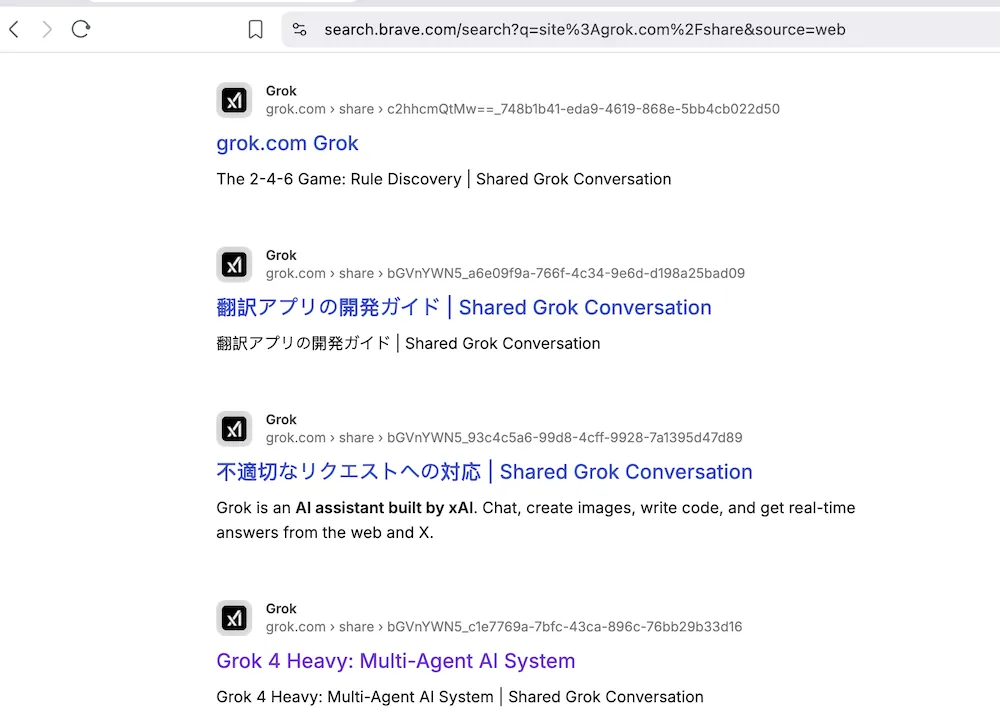
Since shared chat links remain active and are accessible without authentication, anyone who finds them through a search engine can view the shared conversation.
Wherever I try these dorks, they don’t work in either Google Chrome or Safari. Only it works on Brave browser.
INDUSTRY IMPACT
– Scale of Exposure: Recent open-source intelligence (OSINT) analyses suggest hundreds of thousands of conversations are currently visible and searchable on major engines like Google and Bing.
– Regulatory Scrutiny: This mass exposure invites severe scrutiny under GDPR, CCPA, and emerging global AI safety frameworks, which mandate strict data minimization and explicit user consent for data processing.
– Erosion of Trust: Users increasingly rely on AI for sensitive, private tasks. Publicly searchable chat logs fundamentally break the implied contract of confidentiality between the user and the AI provider.
WHAT USERS CAN DO (IMMEDIATE MITIGATION)
- Audit and Revoke Links: Immediately visit your account’s shared link management page (for example, `grok.com/share-links`) to review and permanently revoke access to any previously generated share URLs.
- Assume “Share” Means “Public”: Treat any AI platform’s “Share” button as a public publishing tool, not a private collaboration feature.
- Sanitize Your Prompts: Never input real PII, corporate secrets, passwords, or sensitive credentials into consumer-grade AI chat interfaces.
- Demand Enterprise Solutions: Organizations must mandate the use of enterprise-tier AI offerings (e.g., ChatGPT Enterprise, Claude for Teams) that contractually guarantee data is not used for model training and that sharing features are strictly walled off from public search indexing.
WHAT PLATFORMS MUST DO
AI providers cannot shift the burden of privacy solely onto the user. Platforms must:
- Immediately implement default `noindex, nofollow` meta tags on all shared chat URLs.
- Make “discoverable by search engines” an explicit, informed opt-in with clear, unavoidable warnings, rather than an ambiguous or hidden default setting.
- Introduce expiration dates for shared links by default (e.g., links that auto-revoke after 7 or 30 days).
THE BOTTOM LINE
AI chat sharing has made collaboration easier, but privacy protections have not kept pace. Until platforms apply the same level of security to shared chat URLs as they do to password-reset links, “chat dorking” will remain an effective technique for large-scale data collection.
Stay secured. Verify your share settings. And remember: on the internet, if it can be indexed, it will be found.