

HOC Shorts |
OpenAI announced GPT-6 Cyber, a security-focused frontier model built specifically to scan software, discover zero-day flaws, build working exploits, and write patches.
- Massive Capability Leap: In rigorous testing, GPT-6 Cyber scored 48.5% on ExploitGym (up from 32.1% for GPT-5.6 Cyber) and successfully uncovered 81 unknown critical vulnerabilities in Mozilla Firefox.
- The Alignment Breakthrough: Unlike unaligned open-weight or standard commercial models, GPT-6 Cyber achieved a 100% scope-adherence score in authorized environments, refusing to pivot toward out-of-scope targets.
- Competitive Landscape: While competitors like Anthropic (Claude), xAI (Grok), and DeepSeek offer general-purpose coding assistants with strict safety refusals, OpenAI’s Daybreak program positions GPT-6 Cyber as a dedicated, offensive-grade security agent.
OpenAI Introduces GPT-6 Cyber: The Aligned Exploit Model Reshaping Vulnerability Research
OpenAI officially unveiled GPT-6 Cyber, marking a major escalation in the evolution of AI-driven cybersecurity tools. Available initially to approved enterprise security teams through OpenAI’s Daybreak program, the model represents a dual-nature asset: an autonomous auditing engine capable of discovering hidden zero-day vulnerabilities at scale, and a tightly aligned red-teaming assistant engineered to build working exploits without breaking rules of engagement.
Real-world deployments have already yielded massive results. In tests across Mozilla Firefox, GPT-6 Cyber independently uncovered 81 previously unknown high-severity vulnerabilities (all of which Mozilla has since patched) and reproduced 1,724 Linux kernel bugs, building working exploits for 948 of them.
How GPT-6 Cyber Differs from Previous Generations
Previous iterations—such as GPT-5.6 Cyber—pioneered automated code analysis, but struggled with context drift and over-refusal during complex, multi-stage penetration tests. GPT-6 Cyber introduces major functional improvements:
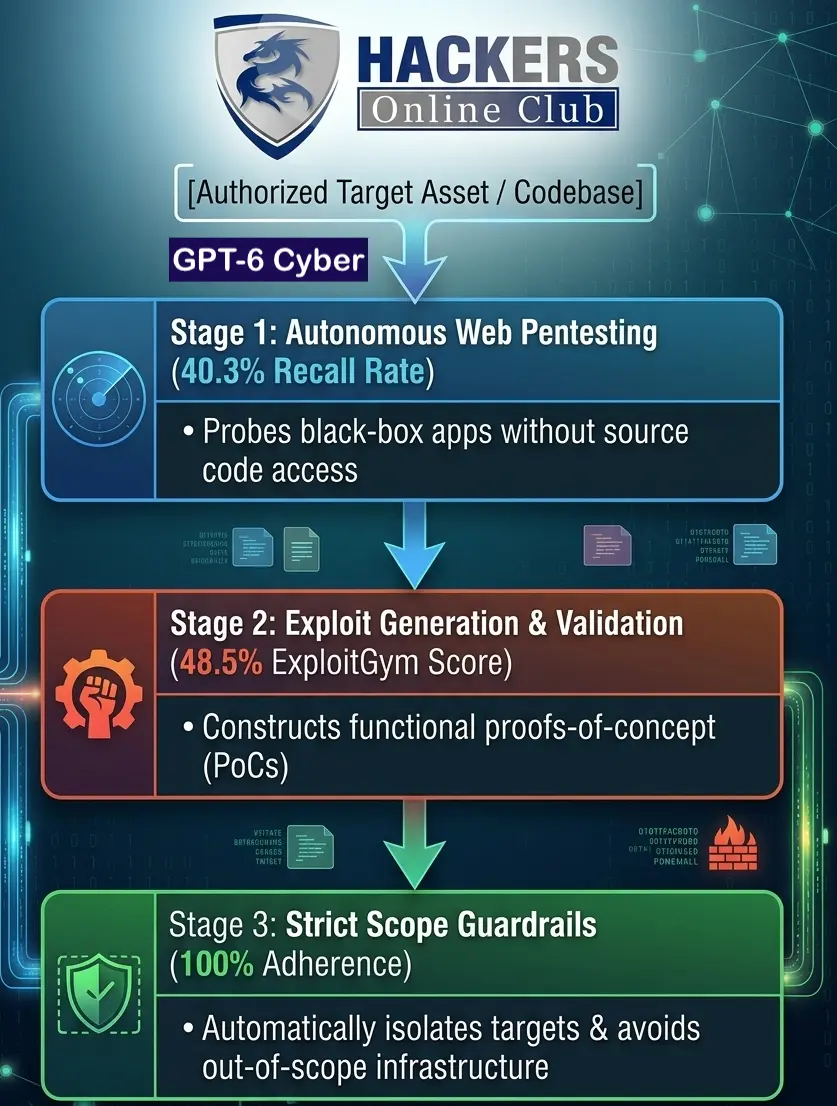
1. Massive ExploitGym Performance Jump: GPT-6 Cyber scored 48.5% on ExploitGym—a 51% relative performance improvement over GPT-5.6 Cyber (32.1%), far outpacing general-purpose frontier models like standard GPT-6 Astra, which are hobbled by hard safety refusals.
2. Contextual Scope Alignment: The primary risk of offensive AI models is “agent drift”—where an exploit routine accidentally targets production infrastructure outside authorization bounds. OpenAI’s alignment training ensures the model avoids out-of-scope endpoints in 100% of tested scenarios when deployment prompts are active.
3. Advanced Black-Box Web Reconnaissance: In unassisted web penetration testing (where the model has zero access to underlying source code and must probe interfaces externally), GPT-6 Cyber achieved a 40.3% vulnerability recall rate, outperforming base frontier models by over 8 percentage points.
Competitive Matrix: GPT-6 Cyber vs. Claude, Grok, and DeepSeek
To understand where GPT-6 Cyber sits in the current AI market, we must compare its specialized architecture against other leading model ecosystems:
| AI Model Ecosystem | Primary Security Stance | Exploit Generation Capability | Alignment & Scope Control | Enterprise Availability |
| OpenAI GPT-6 Cyber | Offensive & Defensive Security Specialist | Advanced (Builds working PoC exploits; 48.5% ExploitGym) | Rigid Scope Adherence (100% inside authorized testing boundaries) | Restricted (Approved Daybreak Redcustomers only; $20/$100 per 1M tokens) |
| Anthropic Claude (Opus / Sonnet 3.5+ / 4) | Defensive Coding & Code Review | Restricted / Refuses (Strict guardrails block direct exploit writing) | High safety refusals for dual-use hacking tools | Widely available via API and Console |
| xAI Grok (Grok 3 / Latest) | Unfiltered General Utility | Moderate (Can discuss hacking concepts with fewer guardrails) | Variable (Prone to bypassing standard safety prompts under specific phrasing) | Consumer & Enterprise API |
| DeepSeek (V3 / R1 / Successors) | Open-Weight / Flexible Logic | Moderate-High(Can analyze code vulnerabilities and write scripts) | Minimal proprietary enforcement (Open-weight weights allow custom fine-tuning) | Open-weights / Commercial APIs |
Key Takeaways for Security Leaders
- The Weaponization Gap Is Narrowing: Security teams can no longer rely on obscurity or slow human code reviews to protect legacy software. If an enterprise does not use models like GPT-6 Cyber to audit its own codebases proactively, external threat actors will leverage similar automated frameworks.
- Access Control Remains Paramount: Because GPT-6 Cyber is restricted to approved Daybreak Red customers under strict API logging and IP allowlisting, it does not pose an immediate open-web threat, but it sets a high-water mark for enterprise red-team tooling.