


HOC Shorts
Google officially announced Gemini 4 Carbon, its latest frontier AI model optimized for autonomous cyber defense, long-horizon software engineering, and threat analysis.
- Controlled Staged Rollout: Access is initially restricted to vetted security professionals through Google’s Fairwind Program to prevent immediate dual-use offensive weaponization by malicious actors.
- State-of-the-Art Security Metrics: Carbon sets new performance records across public security benchmarks, achieving 88.2% on SEC-bench Pro (finding real-world zero-days) and 54.8% on ExploitGym (validating threat severity).
- Defensive Breakthrough: Achieved a 0.0% attack success rate on the Gray Swan Indirect Prompt Injection (IPI) Benchmark, resisting every evaluated injection attempt.
Google DeepMind officially announced Gemini 4 Carbon, the latest addition to its flagship model generation. Positioned directly as an enterprise security asset, Gemini 4 Carbon introduces advanced capabilities tailored to automate vulnerability research, threat validation, and root-cause patch deployment.
Unlike general-purpose LLMs, Carbon was built to handle long-horizon tasks—allowing it to navigate massive codebases, trace memory leaks across dependencies, and execute multi-day security audits without losing execution context.
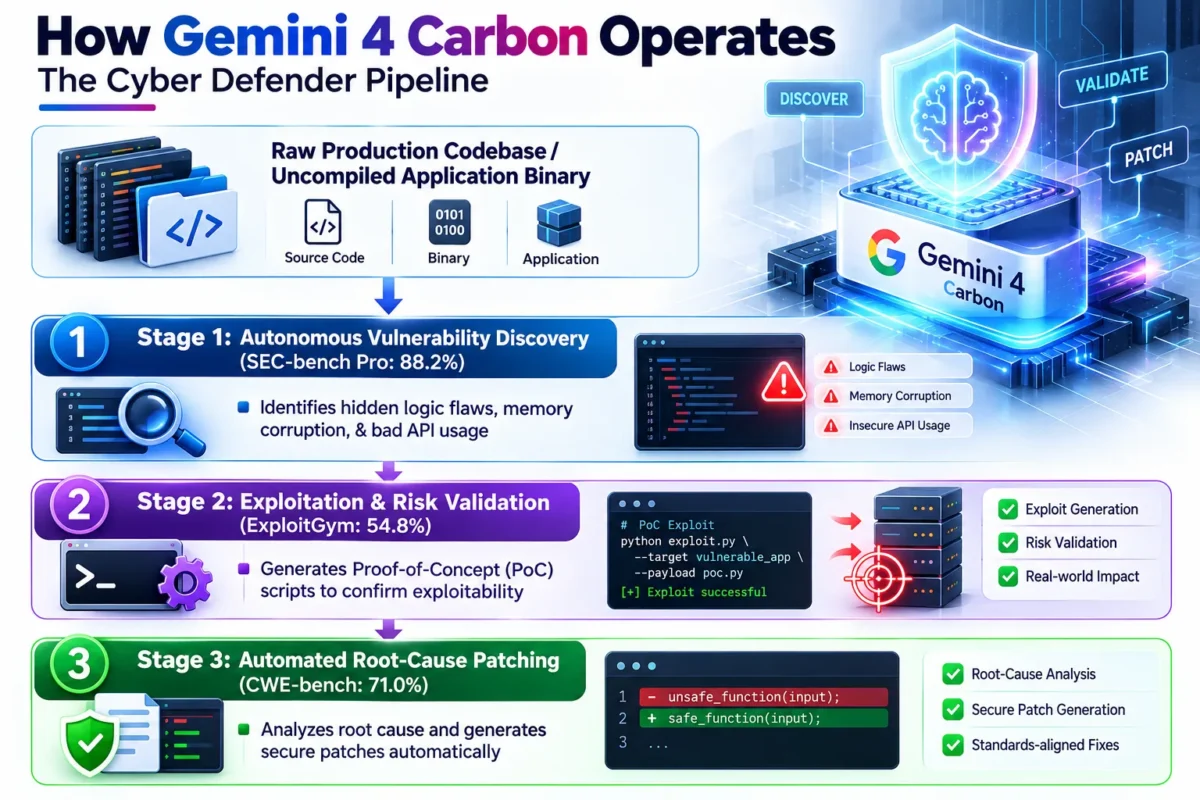
The Cyber Defender Pipeline: How Gemini 4 Carbon Operates
1. Autonomous Discovery: Carbon parses large repositories to uncover hidden architectural flaws and unpatched logic bugs before external threat actors locate them.
2. Exploitation Validation: Security teams spend substantial time filtering false-positive scanner alerts. Carbon evaluates whether a discovered vulnerability is practically exploitable in production, assigning validated threat scores.
3. Automated Remediations: Once a bug is validated, the model generates functional pull requests that fix the root cause without breaking underlying system dependencies.
Our teams are already seeing strong gains in cyberdefense. On internal benchmarks, Carbon achieves more than 2x uplift in success rate for generating secure code over Argon. As another example, the Chrome team has reported that Carbon performed more than 10X better than another lab’s large frontier model when generating high quality patches, said Koray Kavukcuoglu SVP, Google DeepMind and Chief AI Architect, Google. With Gemini 4 Carbon, our goal is to deliver meaningful leaps in software engineering and cybersecurity defense without compromising on safety or reliability.
Key Technical Benchmarks & Safety Performance
Google reported that external evaluations for Carbon were conducted without restrictive safety filters to establish raw reasoning capacity, followed by alignment training that completely eliminated specific attack paths.
| Security Benchmark / Capability | Gemini 4 Carbon Score | Operational Significance |
| SEC-bench Pro | 88.2% | Industry-leading detection rate for real-world zero-day flaws. |
| ExploitGym | 54.8% | Autonomous proof-of-concept validation for risk prioritization. |
| Collinear CWE-bench | 71.0% | Automated patch creation addressing root-cause security bugs. |
| Indirect Prompt Injection (IPI) | 0.0% Attack Success | Stopped every malicious prompt injection payload tested by Gray Swan. |
Immunity to Indirect Prompt Injection
One of the largest attack vectors against enterprise AI agents is Indirect Prompt Injection (IPI), where attackers embed hidden natural-language commands inside documents, web pages, or code comments to hijack the AI’s execution flow.
While its predecessor (Gemini 4 Argon) held an industry-low 0.7% attack success rate, Google DeepMind confirmed that Gemini 4 Carbon achieved a 0.0% attack success rate on Gray Swan’s IPI benchmark. By enforcing strict isolation between data-parsing routines and control-instruction channels, Carbon neutralizes prompt-based jailbreaks.
Deployment Strategy & Availability
- Fairwind Program Access: To mitigate dual-use risks—such as attackers using the model to generate zero-day exploits for malicious campaigns—Google is deploying Carbon first to select government defense partners and vetted enterprise security teams.
- API Pricing Structure: Once broadly available to developers, Carbon will launch at an introductory rate of $2.00 per million input tokens and $10.00 per million output tokens (with cached input tokens discounted by 95%).
- Enterprise Takeaway: As AI models shift from basic coding assistants to autonomous security analysts, tools like Gemini 4 Carbon will allow SOC teams to automate vulnerability patching at machine speed.