





HOC Shorts | BREAKING!
Major Certificate Authority eMudhra announced its complete withdrawal from the global public WebPKI/TLS certificate business following a critical cryptographic key generation failure.
- The Vulnerability: A key generation ceremony error on April 30, 2025, destroyed entropy during a wrap/unwrap procedure, reducing 384-bit Elliptic Curve (P-384) private keys down to single-digit integers (e.g., private key `= 4`).
- Instant Reversal: Anyone could mathematically calculate the private keys without stealing data, enabling adversaries to generate valid SSL/TLS certificates for any website or domain globally.
- Global Ecosystem Reaction: Apple, Google, Microsoft, Mozilla, Cloudflare, and Node.js immediately distrusted the eMudhra ECC root, while the Go language team assigned `CVE-2026-111943` to block affected certificate chains in cloud-native tools.
- Current Status: Seven of the eight intermediate certificates were never used in production, and eMudhra confirmed no evidence of active malicious exploitation prior to disclosure.
eMudhra Exits Global TLS Business Following Critical Intermediate CA Key Generation Failure
Indian digital identity provider eMudhra has announced that it will discontinue its global public TLS/SSL certificate issuance business. The decision follows a security disclosure that identified weaknesses in eight intermediate Certificate Authority (CA) private keys, which reportedly had insufficient cryptographic randomness and could potentially be reconstructed by researchers or attackers.
Unlike many certificate authority security incidents that involve external breaches or stolen credentials, this issue was linked to a problem during eMudhra’s Hardware Security Module (HSM) key generation process.
Technical Breakdown: How 384-Bit Cryptography Collapsed to Single Digits
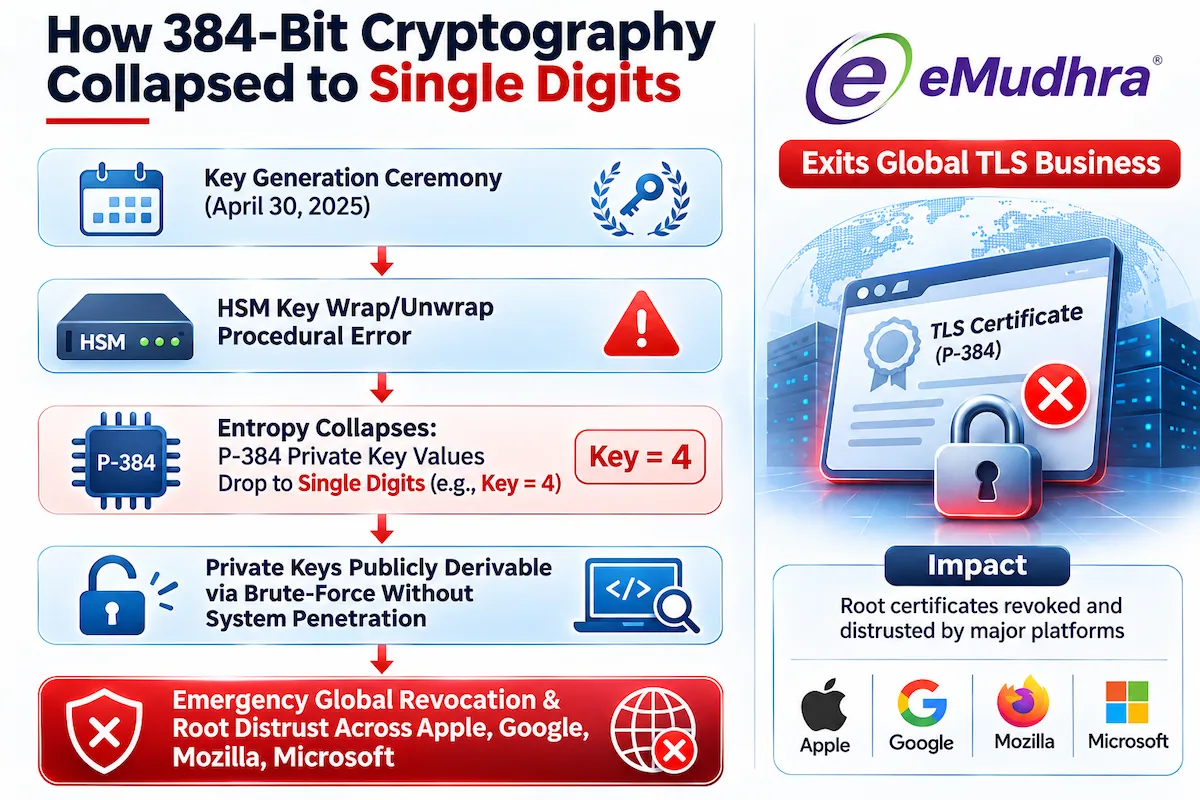
1. Procedural HSM Ceremony Error: On April 30, 2025, eMudhra generated 24 subordinate CAs under its `emSign Root TLS CA – G3`. During a key wrap/unwrap sequence, a procedural error stripped entropy from the process for eight P-384 Elliptic Curve keys.
2. Near-Zero Entropy: Rather than producing a cryptographically secure 100-digit prime integer, the system generated basic low-value integers. Security researchers demonstrating the flaw showed that one of the live CA private signing keys was simply the number `4`.
3. Public Exposure: Because the public key was published to global Certificate Transparency (CT) logs, anyone could reverse-engineer the matching private key within seconds using standard open-source tools.
Global Infrastructure & Browser Response
Because an intermediate CA key can sign valid SSL certificates for any web domain on the internet, global technology providers executed immediate containment measures:
| Organization / Platform | Action Taken | Security Impact |
| Mozilla / Firefox | OneCRL block pushed within hours; NSS 3.131.1 update | Full root trust revoked |
| Cloudflare | Edge mitigations deployed across CDN & WARP apps | Blocked fake eMudhra certs at gateway level |
Go Runtime (crypto/x509) |
Issued CVE-2026-111943 (Go 1.27.3 & 1.26.10) |
Hardcoded SPKI hash block in cloud tools |
| Node.js & Python | Updated bundled root stores & revoked CA key lists | Disallowed spoofed TLS handshakes |
| eMudhra | Voluntary withdrawal from WebPKI business | Replaces active client certs with alternate CAs |
Business Impact & Mitigation Status
Enterprise & eSign Unaffected: eMudhra clarified that its domestic India enterprise applications, digital signature services, and eSign infrastructure operate on isolated, distinct root hierarchies and remain fully secure and operational.
Client Transition: To protect its single major corporate ecosystem using the affected ECC root in the United States, eMudhra is issuing replacement certificates from an alternate, independently operated, publicly trusted CA hierarchy.