


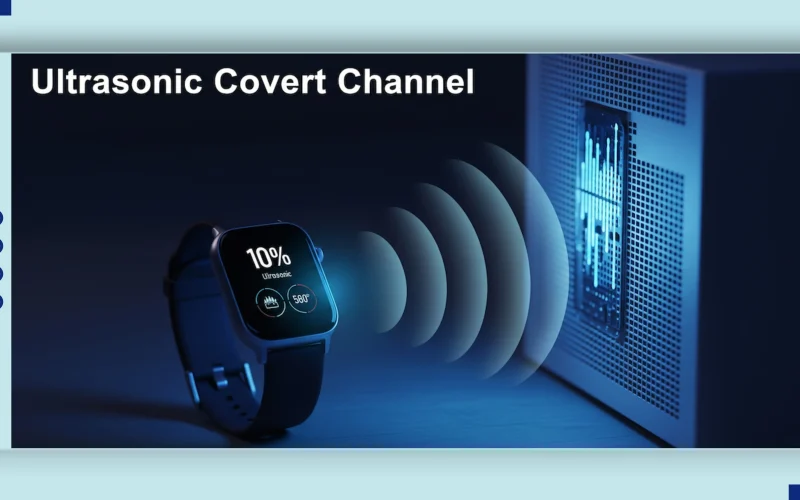
A groundbreaking new research paper, “SmartAttack: Air-Gap Attack via Smartwatches,” has sent ripples through the cybersecurity community, revealing a concerning new method for data exfiltration from highly secured, air-gapped systems. Published by israel researchers, the study by Mordechai Guri highlights how ubiquitous smartwatches, with their built-in microphones, can be weaponized for ultrasonic covert communication, posing a significant threat to critical infrastructure and sensitive data.
Air-gapped systems are traditionally considered the pinnacle of cybersecurity, relying on physical isolation from external networks to prevent unauthorized access and data leakage. However, this new research demonstrates that even these fortress-like environments are not immune.
Key Points of “SmartAttack”:
- Smartwatches as Covert Receivers: The paper introduces “SmartAttack,” a novel technique that leverages the microphones in ordinary smartwatches to capture ultrasonic signals in the 18-22 kHz range. These signals can be used to transmit data covertly.
- Ultrasonic Covert Channels: While ultrasonic communication has been explored as a data exfiltration method before, this research specifically focuses on smartwatches as an underexplored but highly effective attack vector.
- Real-time Data Capture: The study validates the feasibility of using smartwatches to capture covert signals in real-time, even under varying environmental conditions, distances, orientations, and noise levels.
- Unique Smartwatch Factors: The research delves into smartwatch-specific elements that influence ultrasonic covert channels, such as their continuous presence on the user’s wrist, the impact of the human body on signal propagation, and the directional constraints of their microphones.
- Feasibility Demonstrated: Through experimental validation, the paper confirms that smartwatches can indeed be used as effective receivers for data exfiltration in air-gapped environments.
The Alarming Impact:
The implications of “SmartAttack” are substantial, particularly for organizations and governments that rely heavily on air-gapped systems for sensitive operations:
- Compromise of Air-Gapped Systems: This research shatters the long-held belief in the absolute security of air-gapped networks, demonstrating a tangible pathway for data breaches even without direct network connectivity.
- Increased Attack Surface: The proliferation of smartwatches in daily life means that potential attack vectors are present in numerous high-security environments, often unknowingly. Employees and visitors wearing these devices could inadvertently become conduits for data theft.
- Difficulty of Detection: Ultrasonic covert channels are notoriously difficult to detect with traditional network monitoring tools, as they operate outside conventional network traffic.
- Insider Threat Amplified: While the attack still requires an insider or physical proximity to the air-gapped system, the ease and discreetness of using a smartwatch as a receiver could make insider threats even more potent.
More Important Points for Cybersecurity Professionals:
- Beyond Traditional DLP: Current Data Loss Prevention (DLP) solutions may not be equipped to detect ultrasonic data exfiltration, necessitating a re-evaluation of existing security protocols.
- Physical Security Redefined: This research underscores the critical need to extend physical security measures beyond network perimeters to include scrutiny of wearable devices in high-security zones.
- Awareness and Policy Changes: Organizations must educate their employees about the risks associated with smartwatches in secure environments and potentially implement policies restricting their use or requiring their storage outside sensitive areas.
- Future Research and Mitigation: The paper also outlines potential mitigation strategies, paving the way for future research into countermeasures and advanced detection techniques for ultrasonic covert channels.
- Vendor Responsibility: Smartwatch manufacturers may also face increasing pressure to incorporate security features that can detect or mitigate such ultrasonic communication vulnerabilities.
In a world increasingly reliant on interconnected devices, “SmartAttack” serves as a stark reminder that the boundaries of cyber threats are constantly evolving. As smartwatches become even more integrated into our lives, understanding and addressing these novel attack vectors will be paramount to safeguarding our most critical data. Cybersecurity professionals are urged to review this research and adapt their strategies to counter this emerging threat.