

PortSwigger has officially introduced Burp AT, an agentic AI assistant integrated directly into Burp Suite Professional. Now live in public beta, Burp AT marks a major evolution in web security testing—offering AI agents that act within Burp’s local workspace to automate deep recon, bug hunting, and vulnerability verification under strict human control.
What is Burp AT?
Burp AT is an agentic AI extension built natively into Burp Suite Professional. Unlike traditional LLM chatbots, Burp AT doesn’t just write code or answer questions—it actively interacts with web targets using Burp Suite’s native tools, project history, and PortSwigger’s specialized research skills.
Core Features & Technical Highlights
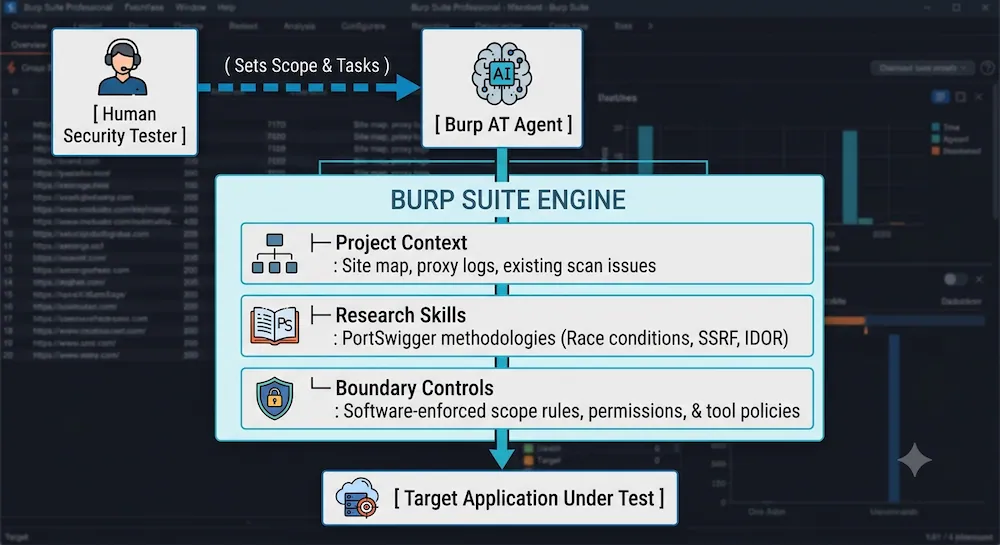
- Native Burp Engine Access: Agents execute scans, crawl targets, and test endpoints directly through Burp’s deterministic protocol engine rather than running unverified, custom scripts.
- Shared Project Context: Reads automatically from your proxy history, site map, and issue logs without requiring manual copy-pasting or risking third-party data leaks.
- PortSwigger Research Skills: Features built-in testing methodologies developed by PortSwigger Research for complex vulnerabilities like race conditions, server-side request forgery (SSRF), and broken access controls.
- Architectural Boundary Safety: Scope limits and tool permissions are enforced by the Burp software layer, not prompt instructions. The AI agent cannot execute an out-of-scope request, regardless of model behavior.
- Complete Reproducibility: Every HTTP request, response, and action taken by Burp AT is recorded in the project Logger and site map for full auditability.
Burp Suite has earned trust through more than two decades of use against real applications. Burp AT is new, and it has to earn that trust in the real world. That is why we are launching it as a public beta: so professional testers can put it to work, show us where it performs well and where it falls short, and help shape what it becomes. – said Dafydd Stuttard, Founder and CEO, PortSwigger
Autonomy Modes: Flexible Risk Control
Burp AT provides granular controls over how much independence an AI agent receives during a test:
Key Benefits for Security Professionals
1. Eliminates Manual Grind: Hands off tedious tasks—like auditing minified JavaScript files, parsing large sitemaps, or mapping edge APIs—to AI subagents.
2. Improves Finding Quality: Uncovers hidden vulnerabilities in complex client-side logic that humans often skip due to tight engagement deadlines.
3. Reduces False Positives: Because every finding is backed by reproducible HTTP traffic captured in Burp, testers can verify exploits before reporting.
Frequently Asked Questions
1. What is the difference between Burp AI and Burp AT?
While earlier Burp AI features acted as conversational assistants inside tools like Repeater, Burp AT introduces agentic AI. Burp AT can autonomously chain tools together, run sub-tasks, and pursue multi-step testing objectives inside Burp Suite.
2. Is Burp AT available now?
Yes, Burp AT is available in public beta for all licensed Burp Suite Professional users starting with release 2026.7.1.
3. How does Burp AT keep AI agents in scope?
Burp AT relies on hard software boundaries inside Burp Suite. Scope rules, target filters, and tool restrictions live in Burp’s tooling layer, making it impossible for the AI model to bypass or ignore scope limits.
The Bottom Line
PortSwigger’s release of Burp AT delivers a practical approach to AI in cybersecurity: Agents propose. Burp enforces. You decide. By placing agentic AI behind strict software boundaries, security teams can accelerate penetration testing without surrendering control or scope safety.