

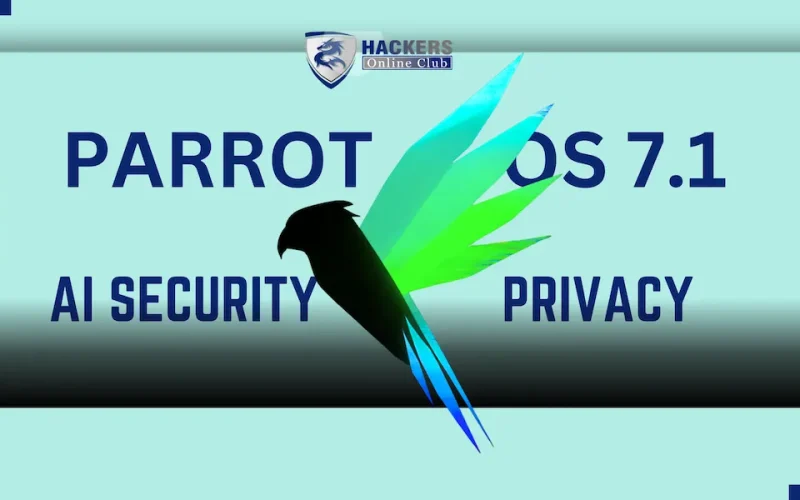
meeJust two months after the major leap to version 7.0, the Parrot Security team has released Parrot OS 7.1. Featuring with ethical hacking and digital forensics by introducing cutting-edge AI integration and critical hardware fixes.
Whether you are a seasoned security professional or a student, this latest release offers a smoother, more modern experience for security operations.
What’s New in Parrot OS 7.1?
The most significant highlight of this release is Parrot’s strategic move into AI-driven security research. As artificial intelligence becomes a larger part of the digital attack surface, Parrot is providing the tools to test and secure these systems.
1. Introducing MCPwn: AI-Powered Pentesting
Parrot 7.1 debuts MCPwn, a tool that utilizes the Model Context Protocol. This allows users to connect Large Language Models (LLMs) directly to security tools like nmap, sqlmap, and gobuster. By running these commands inside secure Docker containers, users can experiment with AI-driven automation without risking the stability of their main system.
2. Linux Kernel 6.17 & Hardware Fixes
Under the hood, Parrot 7.1 is powered by Linux Kernel 6.17. This update includes vital fixes for GRUB boot issues that previously affected several laptop models. Additionally, the update includes improved DKMS drivers, ensuring better compatibility with modern hardware and Wi-Fi adapters.

3. Expanded Desktop Environments
While Parrot 7.0 introduced the sleek KDE Plasma 6, version 7.1 brings more variety:
- Enlightenment Spin: A brand-new community version featuring the ultra-lightweight Enlightenment desktop environment.
- Raspberry Pi Updates: The Raspberry Pi edition has transitioned back to the MATE desktop as the default to ensure high performance on lower-resource ARM devices.
- LXQt Support: Developers are also testing LXQt to provide even more lightweight options for older hardware.
4. Updated Security Arsenal
The core toolset has been refreshed to ensure security researchers have the latest versions of industry-standard software:
- Metasploit 6.4.111
- Burp Suite 2025.11
- TruffleHog 3.92 (for finding leaked secrets)
- Rocket 1.5 (Parrot’s companion tool now features a new UI)
Key Takeaways for Users
Stable Base: Still built on the solid foundations of Debian, providing a “rolling release” feel with the stability of a long-term support system.
AI Focus: The introduction of the “AI Tools” category signals a new era for Parrot, focusing on how AI can be both a tool for and a target of security research.
Easy Upgrade: Existing users can jump to version 7.1 simply by running parrot-upgrade in their terminal.
Parrot OS 7.1 proves that the project is not just maintaining a distribution, but actively evolving to meet the challenges of 2026’s cybersecurity landscape.
Frequently Asked Questions (FAQs)
Q1: How do I upgrade to Parrot OS 7.1?
If you are already running Parrot 7.0, you don’t need to reinstall. Simply open your terminal and run the following command:
sudo parrot-upgrade
Q2: What is the minimum system requirement for Parrot 7.1?
For the Security Edition, a dual-core processor, 4GB of RAM, and 40GB of disk space are recommended. For older hardware, the new Enlightenment or MATE editions are highly recommended.
Q3: Is Parrot OS 7.1 safe for beginners?
Yes. While it is a professional-grade tool, the Parrot Home Edition provides a user-friendly interface for those learning Linux, while the Security Edition is pre-configured with everything needed for cybersecurity education.
Q4: Can I run Parrot 7.1 on a Raspberry Pi?
Absolutely. Parrot 7.1 features a dedicated image for Raspberry Pi, now optimized with the MATE desktop environment for better resource management.
Q5: What makes MCPwn different from other AI tools?
MCPwn is unique because it creates a “sandbox” (via Docker). This allows an AI model to execute security commands and analyze data without the risk of the AI making unauthorized changes to your primary operating system.