




HOC Shorts
The Alert: Drupal Fail2Install critical flaw (`CVE-2026-132165`, CVSS 9.8, advisory `SA-CORE-2026-017`)—discovered by Anthropic’s OSS Scanner—is now under active exploitation on live sites, prompting CISA to add it to its Known
- Exploited Vulnerabilities (KEV) catalog with a November 27, 2026 remediation deadline for federal agencies.
The Risk: Under specific conditions, an unauthenticated attacker can abuse Drupal’s built-in installer (`core/install.php`) to attempt a reinstallation, leading to full site takeover or remote code execution. - Patched Versions: Upgrade immediately to Drupal `10.6.22`, `11.3.22`, or `11.4.13`. Older branches (including Drupal 8, 9, and unsupported 10.x/11.x lines) are end-of-life and receive no official patches.
- Pro Tip: Block public access to `/core/install.php` at the web server level and keep `settings.php` locked down—even after patching—to shrink your attack surface.
Drupal Fail2Install Exploit Details Emerge as Attackers Hit Live Sites
If your organization runs Drupal, patch day just moved to the top of the list. Technical details around Fail2Install (`CVE-2026-132165`, rated 9.8 on CVSS) are now public alongside reports of active attacks against live websites—and the U.S. Cybersecurity and Infrastructure Security Agency (CISA) has added the flaw to its Known Exploited Vulnerabilities catalog.
Drupal originally disclosed the flaw on November 18, 2026 (`SA-CORE-2026-017`) after it was uncovered by Anthropic’s OSS Scanner. Reports now indicate live exploitation began as early as November 19, turning a theoretical reinstallation trick into an immediate operational threat for site owners.
How Fail2Install Works (Without the Jargon)
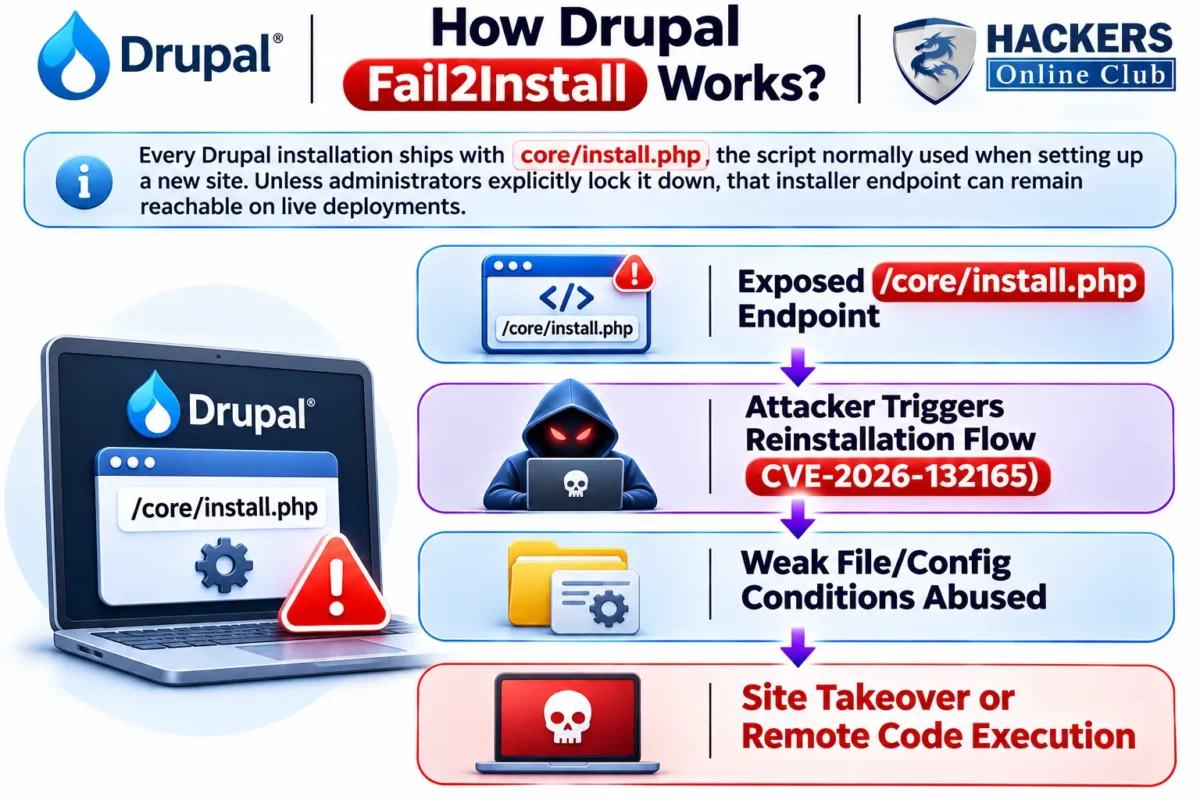
- Installer Abuse: Under specific conditions, an unauthenticated attacker can interact with `install.php` to attempt re-running the installation flow.
- Takeover or Code Execution: Depending on file permissions and site configuration, successfully abusing that flow can hand attackers administrative control over the site or let them execute arbitrary code.
- Why It Matters Now: Exploitation requires specific conditions rather than every single default site, but with proof-of-concept details out and active exploitation confirmed, automated scanning and opportunistic attacks become far more likely.
cPatched Versions at a Glance
| Drupal Branch | Patched Version | Action Needed |
| Drupal 11.4.x | 11.4.13 |
Upgrade immediately |
| Drupal 11.3.x | 11.3.22 |
Upgrade immediately |
| Drupal 10.6.x | 10.6.22 |
Upgrade immediately |
| Older / EOL Branches (e.g., 8, 9, 10.5 & below, 11.0-11.2) | No official fix | Block /core/install.php and migrate to a supported branch |
Pro Tips for Site Admins & DevOps Teams
- Pro Tip 1 — Block `/core/install.php` at the Web Server Layer: Do not rely solely on application defaults. Add a web server rule in NGINX or Apache to block access to `/core/install.php` (returning `403 Forbidden`), and verify that the rule survives core updates.
- Pro Tip 2 — Lock Down `settings.php` Permissions: Ensure the web server account cannot freely overwrite or alter permissions on `settings.php` or `sites/default` when not actively running legitimate updates—Drupal notes that restricting write access blocks several attack paths.
- Pro Tip 3 — Patch Core and PHP Together: Update Drupal to `10.6.22`, `11.3.22`, or `11.4.13`, run database updates and cache clears, and make sure your underlying PHP runtime is also patched against recent session and engine flaws.
- Pro Tip 4 — Check for Signs of Intrusion: Review web server logs for suspicious requests hitting `/core/install.php`, watch for unexpected changes to `settings.php` or new admin accounts, and monitor for rogue processes spawned by PHP or web workers.