50 SOC Analyst Interview Questions and Answers (2026 Guide)

50 SOC Analyst Interview Questions
By HOC Team  |  Last updated: August 30, 2026  |  Read time: ~26 min

50 SOC Analyst Interview Questions and Answers (2026 Guide)

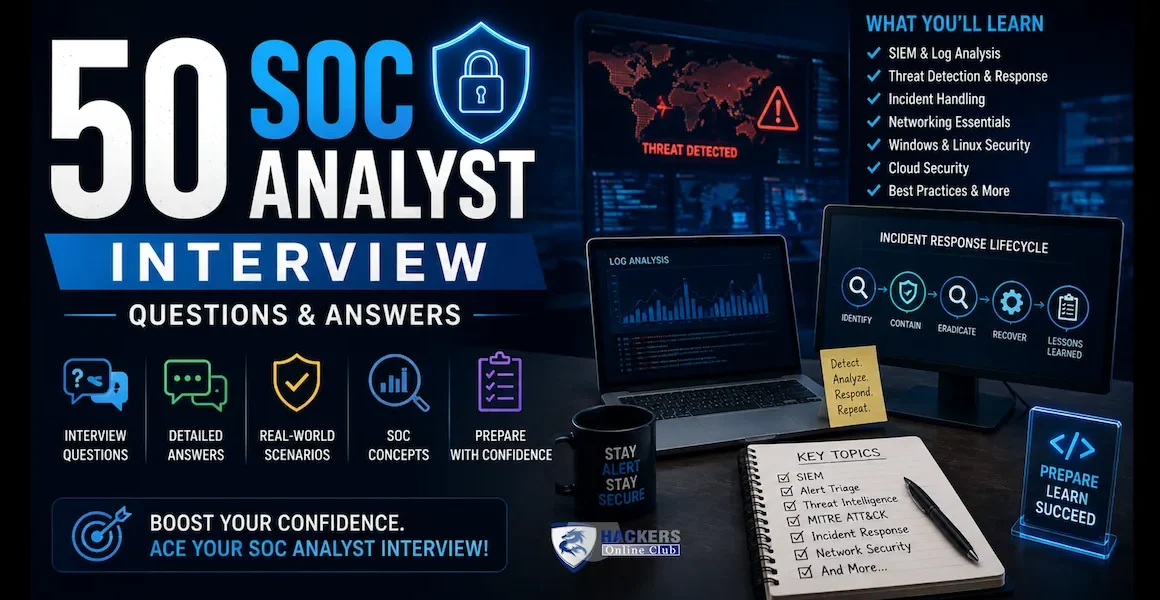
The Security Operations Center (SOC) analyst interview in 2026 is fundamentally different from what it was five years ago. Interviewers no longer just ask you to define the CIA triad. They want to know how you triage a cloud identity anomaly, how you handle AI-generated false positives, and how you think when the SIEM is flooded with 10,000 alerts.

As hiring managers, we don't just look for candidates who memorized textbook definitions. We look for methodology. We want to see your thought process when you are staring at a suspicious PowerShell script or an impossible travel alert.

This guide contains the 50 most critical SOC analyst interview questions asked in 2026, categorized by domain. Whether you are applying for a Tier 1 Triage role or a Tier 2 Incident Response position, these questions and answers will give you the exact technical vocabulary and structured thinking required to pass.

Also read: How to become SOC analyst.

📊 SOC Analyst Job Market in 2026

  • Average Tier 1 Salary (US): $65,000 - $85,000
  • Average Tier 2/3 Salary (US): $90,000 - $130,000+
  • Top Required Skills: SIEM Triage, Cloud Security (AWS/Azure), Identity Threat Detection, EDR Analysis
  • Most Valued Certs: CompTIA CySA+, BTL1 (Blue Team Level 1), Microsoft SC200, GIAC GCIH
  • Interview Format: 40% Behavioral, 60% Technical/Scenario-based

Category 1: General Security & SOC Fundamentals (1-10)

01 What is the difference between a False Positive and a False Negative? Which is worse?
A False Positive is a benign activity flagged as malicious (causes alert fatigue). A False Negative is actual malicious activity that the security tool failed to detect. False Negatives are worse because they result in undetected breaches, whereas False Positives only waste analyst time.
02 Explain the Cyber Kill Chain and how it helps a SOC analyst.
The Cyber Kill Chain (Lockheed Martin) maps the stages of an attack: Reconnaissance, Weaponization, Delivery, Exploitation, Installation, C2, and Actions on Objectives. It helps SOC analysts identify where in the attack lifecycle the adversary is, allowing us to break the chain early (e.g., blocking Delivery via email filters) rather than just reacting at the end.
03 What is the MITRE ATT&CK framework?
MITRE ATT&CK is a globally accessible knowledge base of adversary Tactics, Techniques, and Procedures (TTPs). Unlike the Kill Chain, which is linear, ATT&CK maps how attackers actually operate across different environments. SOCs use it to map detection rules, identify coverage gaps, and understand threat actor behavior.
04 What is the difference between IDS and IPS?
An IDS (Intrusion Detection System) passively monitors network traffic and generates alerts when it sees suspicious activity. An IPS (Intrusion Prevention System) is deployed inline and can actively block or drop malicious traffic in real-time. In modern SOCs, IPS is often integrated into Next-Gen Firewalls (NGFW).
05 What is the difference between EDR and traditional Antivirus?
Traditional AV relies primarily on signatures to detect known malware. EDR (Endpoint Detection and Response) monitors behavioral patterns and system telemetry (process execution, memory injections, registry changes) to detect fileless malware and zero-day threats. EDR also provides SOCs with remote investigation and containment capabilities.
06 What are the three main tiers in a SOC?
Tier 1 (Triage): Monitors alerts, filters false positives, and escalates genuine incidents. Tier 2 (Incident Responder): Performs deep-dive investigations, contains threats, and leads remediation. Tier 3 (Threat Hunter/ SME): Proactively hunts for hidden threats, performs advanced forensics, and tunes detection engineering.
07 What is Zero Trust Architecture?
Zero Trust operates on the principle of "never trust, always verify." It assumes the network is already compromised. Every access request must be authenticated, authorized, and encrypted, regardless of whether it originates inside or outside the corporate perimeter. Identity and micro-segmentation are its core pillars.
08 What is a SIEM and what is its primary function?
A SIEM (Security Information and Event Management) aggregates log data from across the organization, normalizes it, and applies correlation rules to identify security incidents. In 2026, modern SIEMs also integrate UEBA (User and Entity Behavior Analytics) and AI to detect anomalies that rule-based systems miss.
09 What is the difference between a vulnerability and an exploit?
A vulnerability is a weakness or flaw in a system (e.g., unpatched software). An exploit is the actual code or technique used by an attacker to take advantage of that vulnerability to gain unauthorized access or cause damage.
10 What is "Defense in Depth"?
Defense in Depth is a security strategy that employs multiple layered controls to protect assets. If one layer fails (e.g., the firewall is bypassed), subsequent layers (e.g., EDR, network segmentation, MFA) are in place to stop the attacker. It ensures no single point of failure exists.

Category 2: SIEM, Log Analysis & Alert Triage (11-20)

11 Walk me through your triage process when you receive a high-severity alert.
1. Contextualize: Read the alert details and identify the affected asset and user. 2. Scope: Check if this is an isolated event or part of a broader campaign (look for related alerts). 3. Investigate: Query the SIEM/EDR for the specific process, IP, or hash. Check threat intel. 4. Determine: Is it a True or False positive? 5. Action: If true, contain and escalate. If false, tune the rule and close.
12 What is log normalization and why is it important?
Log normalization is the process of parsing raw logs from different vendors and mapping them to a common schema (e.g., mapping "src_ip", "SourceIP", and "client" to a single "SourceIP" field). It is critical because it allows the SIEM to write vendor-agnostic correlation rules and search across disparate data sources efficiently.
13 How do you handle alert fatigue?
Alert fatigue occurs when analysts are overwhelmed by volume, leading to missed true positives. I handle it by: 1. Identifying the top 5 noisiest rules. 2. Analyzing the false positive rate. 3. Tuning the logic (adding exclusions for known admin IPs or safe processes). 4. Leveraging SOAR to auto-close low-fidelity alerts. 5. Escalating persistent noise to Detection Engineering.
14 You get an alert for "Malicious PowerShell Execution." What do you look for?
I look for obfuscation techniques (encoded commands, -enc, string manipulation), execution context (was it spawned by Word/Excel? indicating macro malware?), network connections (did it call out to an external IP?), and privilege escalation (did it download a second stage or modify registry keys for persistence?).
15 How do you investigate a Phishing alert?
1. Extract the email headers (check Return-Path, Reply-To, and SPF/DKIM/DMARC results). 2. Analyze the sender reputation and domain age. 3. Extract and scan any URLs (using sandboxing) or attachments (hash check). 4. Crucial step: Check the SIEM to see if any users actually clicked the link or submitted credentials. 5. Purge the email from all other inboxes.
16 What is the difference between a hash and an IP address in threat hunting?
A hash (MD5, SHA256) is a fingerprint of a specific file. It is highly accurate but fragile—attackers change the file slightly, and the hash changes. An IP address represents infrastructure. It is less accurate (due to CDNs or compromised hosts) but more persistent, as attackers reuse infrastructure for campaigns.
17 What is a "beacon" in the context of malware?
A beacon is a periodic network communication sent from a compromised host to a Command and Control (C2) server. It is used to check for new commands or exfiltrate data. In SOC logs, beacons often appear as regular, rhythmic network connections (e.g., exactly every 60 seconds) to an external IP, which is a key indicator of compromise.
18 How do you verify if a file hash is malicious?
I don't just rely on one source. I check the hash against VirusTotal (looking at the detection ratio and community comments), internal threat intel platforms, and vendor databases (like Microsoft Defender or CrowdStrike). I also check the file's first seen date and digital signature. If it's unsigned and brand new, I treat it as highly suspicious.
19 What is the purpose of a SOAR platform?
SOAR (Security Orchestration, Automation, and Response) allows SOCs to automate repetitive tasks (like pulling IP reputation or isolating a host) via playbooks. It orchestrates data from multiple tools (SIEM, EDR, Firewalls) into a single pane of glass, drastically reducing Mean Time to Respond (MTTR).
20 An alert says "Brute Force Successful," but the user claims they didn't log in. What do you do?
I immediately treat it as a compromised account. I verify the source IP and geolocation. If it's anomalous, I force a password reset, revoke active sessions/tokens, and check for lateral movement or MFA bypass. I then investigate how the initial password was compromised (e.g., credential stuffing, phishing) and check if the attacker added a backdoor (like a new MFA device).

Category 3: Network Security & Traffic Analysis (21-30)

21 Explain the TCP 3-way handshake.
1. SYN: The client sends a synchronize packet to the server to initiate a connection. 2. SYN-ACK: The server acknowledges and sends its own synchronize packet. 3. ACK: The client acknowledges the server's response. The connection is established. In SOC logs, an incomplete handshake (SYN with no ACK) might indicate a port scan.
22 What is ARP Poisoning and how do you detect it?
ARP Poisoning is a Layer 2 attack where an attacker sends falsified ARP messages to link their MAC address with the IP address of a legitimate host (like the gateway), allowing them to intercept traffic. I detect it by looking for multiple IP addresses mapping to a single MAC address, or a single IP rapidly changing MAC addresses in the switch logs.
23 How does DNS Tunneling work?
Attackers encode malicious data or C2 commands inside DNS queries and responses. Since DNS traffic is rarely blocked, it bypasses firewalls. In the SIEM, I look for anomalies like: unusually long subdomain names (high entropy), high volumes of TXT record queries, or a single host querying the same external domain hundreds of times a minute.
24 What is the difference between TCP and UDP?
TCP is connection-oriented, reliable, and ensures packets arrive in order (used for HTTP, SSH, SMB). UDP is connectionless, faster, but unreliable (used for DNS, DHCP, VoIP). In the SOC, UDP is harder to monitor for session-based attacks, but high-volume UDP traffic often indicates DDoS or DNS amplification attacks.
25 What common ports are used by SMB, RDP, SSH, and DNS?
SMB: 445 (and 137-139). RDP: 3389. SSH: 22. DNS: 53 (TCP/UDP). As an analyst, seeing SMB (445) exposed to the internet is an immediate critical alert due to ransomware risks.
26 How do you identify a DDoS attack in network logs?
I look for a massive spike in traffic volume or connection requests from multiple disparate source IPs targeting a single destination IP or port. I also check for protocol anomalies, like a flood of SYN packets without completing the handshake (SYN flood), or massive UDP responses (amplification). I verify with the network team if it's legitimate traffic or an attack.
27 What is the difference between a Firewall and a WAF?
A Firewall operates at Layer 3/4 (Network/Transport), filtering traffic based on IPs, ports, and protocols. A WAF (Web Application Firewall) operates at Layer 7 (Application), inspecting the actual HTTP/HTTPS payload to block web-specific attacks like SQL Injection, XSS, and directory traversal.
28 What is a Rogue Access Point?
A Rogue AP is an unauthorized wireless access point connected to the corporate network, often set up by an employee for convenience or by an attacker for physical access. It bypasses perimeter security. I detect it via wireless intrusion prevention systems (WIPS) or by spotting unknown MAC addresses on the wired network acting as a bridge.
29 What is Network Segmentation and why does a SOC care?
Segmentation divides the network into isolated zones (e.g., separating HR from Engineering, or production from dev). The SOC cares because it limits lateral movement. If an attacker compromises a web server in the DMZ, segmentation prevents them from easily pivoting to the internal database or Active Directory.
30 You see outbound traffic on port 445 to an external IP. What is happening?
Port 445 is SMB. Outbound SMB to the internet is highly anomalous and almost always indicates malicious activity. It is likely data exfiltration, ransomware spreading to a cloud share, or a C2 channel. I would immediately isolate the host and block the external IP at the firewall.

Category 4: Incident Response & Threat Hunting (31-40)

31 What are the phases of the NIST Incident Response lifecycle?
1. Preparation: Tools, policies, and training. 2. Detection & Analysis: Triage and scoping. 3. Containment, Eradication, & Recovery: Stopping the bleed, removing the threat, restoring systems. 4. Post-Incident Activity: Lessons learned and updating defenses.
32 How do you handle a Ransomware alert?
1. Contain: Immediately isolate the infected host from the network (do NOT power it off, to preserve RAM for forensics). 2. Scope: Check the SIEM/EDR to see if the ransomware has spread to other hosts. 3. Identify: Determine the variant and entry point. 4. Eradicate/Recover: Wipe and rebuild from clean backups. 5. Communicate: Notify management and legal.
33 What is Lateral Movement?
Lateral movement is the process of an attacker pivoting from the initially compromised system to other systems within the network to find high-value assets (like Domain Controllers). In logs, I look for a single user account authenticating to multiple disparate hosts in a short time, or the use of admin shares (C$, ADMIN$).
34 How do you detect Credential Dumping (like Mimikatz)?
I look for Event ID 4688 (process creation) showing tools like Mimikatz or Procdump. I also monitor for Event ID 4662 (directory replication) indicating DCSync, and check EDR telemetry for LSASS memory access by non-system processes. Access to LSASS is the hallmark of credential dumping.
35 What is Pass-the-Hash (PtH)?
PtH is an attack where the attacker captures an NTLM password hash and uses it to authenticate to other systems without needing the plaintext password. I detect it by looking for logons where the authentication package is NTLM, but the logon type is Network (Type 3), especially if the source IP is anomalous or the account is not typically used for admin tasks.
36 What does "Living off the Land" (LotL) mean?
LotL refers to attackers using legitimate, built-in administrative tools (like PowerShell, WMI, PsExec, or Netcat) to conduct their operations instead of dropping custom malware. This bypasses traditional antivirus. SOCs detect LotL by monitoring for anomalous command-line arguments and unusual parent-child process relationships.
37 What is a C2 (Command and Control) framework?
A C2 framework (like Cobalt Strike, Sliver, or Mythic) is software used by attackers to communicate with and control compromised agents on victim machines. It allows them to issue commands, exfiltrate data, and pivot. In the SOC, we hunt for C2 by looking for beaconing behavior, unusual DNS queries, or traffic to known malicious infrastructure.
38 How do you hunt for unauthorized PowerShell execution?
I enable PowerShell Script Block Logging (Event ID 4104) and Module Logging. I hunt for encoded commands (-enc), downloads from the internet (IEX(New-Object Net.WebClient)), and AMSI (Antimalware Scan Interface) bypasses. I also look for PowerShell spawned by unusual parents, like a web browser or email client.
39 What is Memory Forensics and when would you use it?
Memory forensics involves analyzing the RAM of a compromised system. I use it when dealing with fileless malware, rootkits, or encrypted payloads that only exist in memory and leave no trace on the hard drive. Tools like Volatility are used to extract running processes, network connections, and injected code from a memory dump.
40 How do you contain a compromised endpoint without alerting the attacker?
If I suspect the attacker is actively monitoring the network, standard network isolation might tip them off. Instead, I use EDR containment features (which isolate the host at the agent level), block C2 domains at the DNS/Firewall level silently, and revoke the user's Active Directory tokens. I avoid making drastic changes to the host itself until forensics are captured.

Category 5: Cloud, Identity, AI & Modern SOC (41-50)

41 How does cloud logging differ from traditional on-premises logging?
In on-prem, we control the hardware and collect OS-level logs. In the cloud (AWS/Azure), we rely on API-driven control plane logs (like AWS CloudTrail or Azure Activity Logs). We don't see the underlying hypervisor; we see who made API calls, what resources were modified, and from what IP. Identity becomes the new perimeter.
42 What is "Impossible Travel" in identity logs?
Impossible Travel is an identity anomaly where a user account authenticates from two geographically distant locations in a timeframe that makes physical travel impossible (e.g., logging in from New York and London within 30 minutes). It strongly indicates credential theft and session hijacking, or a misconfigured VPN.
43 How is AI changing SOC operations in 2026?
AI (like Microsoft Security Copilot or Splunk AI Assistant) is automating Tier 1 triage. It can summarize complex incidents, translate natural language into SIEM queries (KQL/SPL), and suggest remediation steps. This shifts the SOC analyst's role from manual log-parsing to strategic decision-making and AI-prompt engineering.
44 How do you investigate an AWS IAM anomaly?
I check CloudTrail for the specific API calls. I look for: 1. ConsoleLogin from an unknown IP. 2. Creation of new access keys (CreateAccessKey). 3. Attempts to disable MFA or modify security groups. 4. Enumeration activities (ListBuckets, DescribeInstances). I immediately rotate the compromised credentials.
45 What is a Supply Chain Attack?
A supply chain attack occurs when an attacker compromises a trusted third-party vendor or software update to distribute malware to their targets (e.g., SolarWinds, MOVEit). It is incredibly difficult to detect because the traffic and files come from trusted, whitelisted sources. SOCs detect it by monitoring for anomalous behavior from trusted vendors, like a backup server suddenly initiating outbound connections.
46 How do you monitor for Data Exfiltration?
I monitor for: 1. Volume anomalies: Unusual spikes in outbound traffic. 2. Protocol anomalies: Data sent over non-standard ports, DNS tunneling, or encrypted channels to unknown IPs. 3. User behavior: A user downloading massive amounts of data from a file share right before their resignation. 4. DLP alerts: Sensitive data patterns (credit cards, PII) leaving the network.
47 What is Threat Intelligence and how do you use it in the SOC?
Threat Intel is information about existing or emerging threats (TTPs, IOCs, threat actor motives). In the SOC, I use it to proactively hunt for indicators in our environment, tune SIEM rules to detect specific threat actor behaviors, and enrich alerts (e.g., if an alert fires for an IP that Threat Intel flags as APT29 infrastructure, I escalate it immediately).
48 What is the difference between IOCs and IOAs?
IOCs (Indicators of Compromise) are forensic artifacts left behind after an attack (e.g., file hashes, malicious IPs). They are reactive. IOAs (Indicators of Attack) focus on the behavior and intent of the adversary (e.g., process injection, credential dumping). IOAs are proactive and allow the SOC to stop an attack in progress, even if the malware is entirely new (zero-day).
49 What is XDR and how does it differ from EDR?
EDR focuses solely on the endpoint. XDR (Extended Detection and Response) aggregates and correlates telemetry from multiple security layers—endpoints, network, cloud, and identity—into a single platform. It provides much richer context for the SOC, reducing false positives and enabling cross-vector incident detection.
50 Where do you see the SOC evolving in the next 3 years?
The SOC is moving toward AI-driven autonomous triage, where AI handles 80% of Tier 1 alert routing and false positive closure. Human analysts will shift to Tier 2/3 roles, focusing on complex threat hunting, detection engineering, and managing AI prompts. Furthermore, Identity will completely replace the network perimeter as the primary focus of security monitoring.

⚡ How to prepare for your SOC interview — 4 steps

  1. Master the "Walk me through your triage" question. This is asked in 90% of interviews. Have a structured, repeatable framework (Context → Scope → Investigate → Action) memorized for Phishing, Malware, and Brute Force alerts.
  2. Know your tools, but focus on methodology. Interviewers care less about whether you know the exact Splunk SPL syntax, and more about what you are trying to find and why. Explain your thought process out loud.
  3. Set up a home lab. Use AttackBox or TryHackMe to attack a machine, then look at the logs in Splunk or Sentinel. Being able to say "I saw this in my home lab" puts you in the top 5% of candidates.
  4. Prepare behavioral stories. Use the STAR method (Situation, Task, Action, Result) to prepare stories about a time you handled a high-stress situation, dealt with a difficult team member, or solved a complex technical problem.

Frequently asked questions

How do I prepare for a SOC analyst interview?

Focus on three areas: technical fundamentals (networking, OS internals, SIEM), practical triage methodology (how you investigate an alert step-by-step), and behavioral scenarios (how you handle stress and false positives). Practice explaining your thought process out loud, as interviewers care more about your methodology than memorized definitions. Setting up a home lab to practice log analysis is the single best way to prepare.

What is the salary of a SOC analyst in 2026?

In 2026, the average salary for a Tier 1 SOC Analyst in the US ranges from $65,000 to $85,000. Tier 2 and Tier 3 analysts, or those with specialized skills in cloud security and threat hunting, typically earn between $90,000 and $130,000. Salaries are higher in major tech hubs and for candidates holding practical certifications like BTL1, CySA+, or OSCP.

What tools should a SOC analyst know in 2026?

A modern SOC analyst must be proficient in SIEM platforms (Splunk, Microsoft Sentinel, QRadar), EDR solutions (CrowdStrike, Defender for Endpoint), ticketing systems (ServiceNow, Jira), and network analysis tools (Wireshark, Zeek). In 2026, familiarity with AI-assisted triage tools (like Security Copilot) and SOAR platforms is highly expected.

What is the difference between Tier 1, Tier 2, and Tier 3 SOC analysts?

Tier 1 analysts are responsible for initial alert triage, filtering false positives, and escalating genuine incidents. Tier 2 analysts perform deep-dive investigations, incident containment, and remediation. Tier 3 analysts (Threat Hunters/Incident Responders) proactively hunt for hidden threats, perform advanced forensics, and handle complex breach remediation.

About the author
Written by the HOC Team at Hackers Online Club — a cybersecurity community trusted by SOC analysts, incident responders, and security engineers since 2010. 15+ years of practical cybersecurity guides, interview preparation resources, and enterprise security tutorials. Learn more about HOC →
Join Our Club

Enter your Email address to receive notifications | Join over Million Followers

Previous Article
OSCP Certification guide

OSCP Certification Guide: How to Prepare and Pass in 2026

Next Article
Terminalflix- fake cloudflare captcha

TerminalFix: Fake Cloudflare CAPTCHA Campaign Deploys Reverse-Tunnel Backdoor

Related Posts