


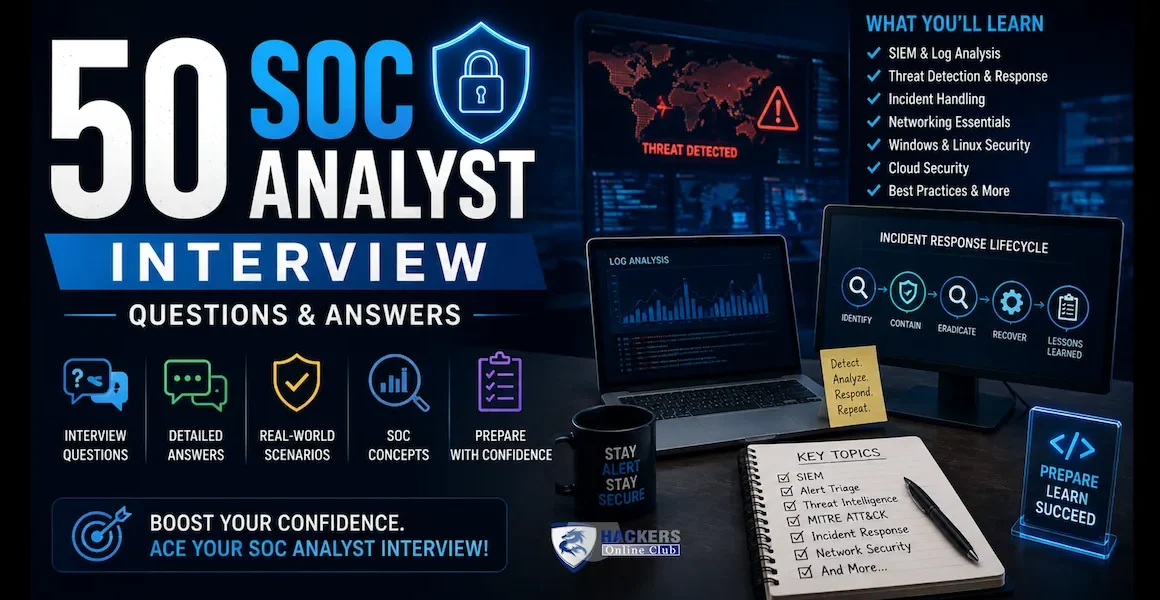
50 SOC Analyst Interview Questions and Answers (2026 Guide)
The Security Operations Center (SOC) analyst interview in 2026 is fundamentally different from what it was five years ago. Interviewers no longer just ask you to define the CIA triad. They want to know how you triage a cloud identity anomaly, how you handle AI-generated false positives, and how you think when the SIEM is flooded with 10,000 alerts.
As hiring managers, we don't just look for candidates who memorized textbook definitions. We look for methodology. We want to see your thought process when you are staring at a suspicious PowerShell script or an impossible travel alert.
This guide contains the 50 most critical SOC analyst interview questions asked in 2026, categorized by domain. Whether you are applying for a Tier 1 Triage role or a Tier 2 Incident Response position, these questions and answers will give you the exact technical vocabulary and structured thinking required to pass.
Also read: How to become SOC analyst.
- Average Tier 1 Salary (US): $65,000 - $85,000
- Average Tier 2/3 Salary (US): $90,000 - $130,000+
- Top Required Skills: SIEM Triage, Cloud Security (AWS/Azure), Identity Threat Detection, EDR Analysis
- Most Valued Certs: CompTIA CySA+, BTL1 (Blue Team Level 1), Microsoft SC200, GIAC GCIH
- Interview Format: 40% Behavioral, 60% Technical/Scenario-based
Category 1: General Security & SOC Fundamentals (1-10)
Category 2: SIEM, Log Analysis & Alert Triage (11-20)
-enc, string manipulation), execution context (was it spawned by Word/Excel? indicating macro malware?), network connections (did it call out to an external IP?), and privilege escalation (did it download a second stage or modify registry keys for persistence?).Return-Path, Reply-To, and SPF/DKIM/DMARC results). 2. Analyze the sender reputation and domain age. 3. Extract and scan any URLs (using sandboxing) or attachments (hash check). 4. Crucial step: Check the SIEM to see if any users actually clicked the link or submitted credentials. 5. Purge the email from all other inboxes.Category 3: Network Security & Traffic Analysis (21-30)
Category 4: Incident Response & Threat Hunting (31-40)
-enc), downloads from the internet (IEX(New-Object Net.WebClient)), and AMSI (Antimalware Scan Interface) bypasses. I also look for PowerShell spawned by unusual parents, like a web browser or email client.Category 5: Cloud, Identity, AI & Modern SOC (41-50)
ConsoleLogin from an unknown IP. 2. Creation of new access keys (CreateAccessKey). 3. Attempts to disable MFA or modify security groups. 4. Enumeration activities (ListBuckets, DescribeInstances). I immediately rotate the compromised credentials.⚡ How to prepare for your SOC interview — 4 steps
- Master the "Walk me through your triage" question. This is asked in 90% of interviews. Have a structured, repeatable framework (Context → Scope → Investigate → Action) memorized for Phishing, Malware, and Brute Force alerts.
- Know your tools, but focus on methodology. Interviewers care less about whether you know the exact Splunk SPL syntax, and more about what you are trying to find and why. Explain your thought process out loud.
- Set up a home lab. Use AttackBox or TryHackMe to attack a machine, then look at the logs in Splunk or Sentinel. Being able to say "I saw this in my home lab" puts you in the top 5% of candidates.
- Prepare behavioral stories. Use the STAR method (Situation, Task, Action, Result) to prepare stories about a time you handled a high-stress situation, dealt with a difficult team member, or solved a complex technical problem.
Frequently asked questions
How do I prepare for a SOC analyst interview?
Focus on three areas: technical fundamentals (networking, OS internals, SIEM), practical triage methodology (how you investigate an alert step-by-step), and behavioral scenarios (how you handle stress and false positives). Practice explaining your thought process out loud, as interviewers care more about your methodology than memorized definitions. Setting up a home lab to practice log analysis is the single best way to prepare.
What is the salary of a SOC analyst in 2026?
In 2026, the average salary for a Tier 1 SOC Analyst in the US ranges from $65,000 to $85,000. Tier 2 and Tier 3 analysts, or those with specialized skills in cloud security and threat hunting, typically earn between $90,000 and $130,000. Salaries are higher in major tech hubs and for candidates holding practical certifications like BTL1, CySA+, or OSCP.
What tools should a SOC analyst know in 2026?
A modern SOC analyst must be proficient in SIEM platforms (Splunk, Microsoft Sentinel, QRadar), EDR solutions (CrowdStrike, Defender for Endpoint), ticketing systems (ServiceNow, Jira), and network analysis tools (Wireshark, Zeek). In 2026, familiarity with AI-assisted triage tools (like Security Copilot) and SOAR platforms is highly expected.
What is the difference between Tier 1, Tier 2, and Tier 3 SOC analysts?
Tier 1 analysts are responsible for initial alert triage, filtering false positives, and escalating genuine incidents. Tier 2 analysts perform deep-dive investigations, incident containment, and remediation. Tier 3 analysts (Threat Hunters/Incident Responders) proactively hunt for hidden threats, perform advanced forensics, and handle complex breach remediation.
Written by the HOC Team at Hackers Online Club — a cybersecurity community trusted by SOC analysts, incident responders, and security engineers since 2010. 15+ years of practical cybersecurity guides, interview preparation resources, and enterprise security tutorials. Learn more about HOC →