

In 2026, the average enterprise SOC ingests over 15 Terabytes of log data per day. Yet, according to the latest Ponemon Institute report, 62% of security professionals still suffer from severe alert fatigue, and the mean time to identify (MTTI) a breach remains stubbornly high at 14 days.
A SIEM plays an important role in a Security Operations Center (SOC) by bringing security data and alerts together in one place. When it is properly configured and tuned, it helps security teams monitor activity, identify potential threats, and respond more efficiently. In this tutorial, we’ll look at how SIEM works, its common use cases, and how modern automation can make security monitoring easier.
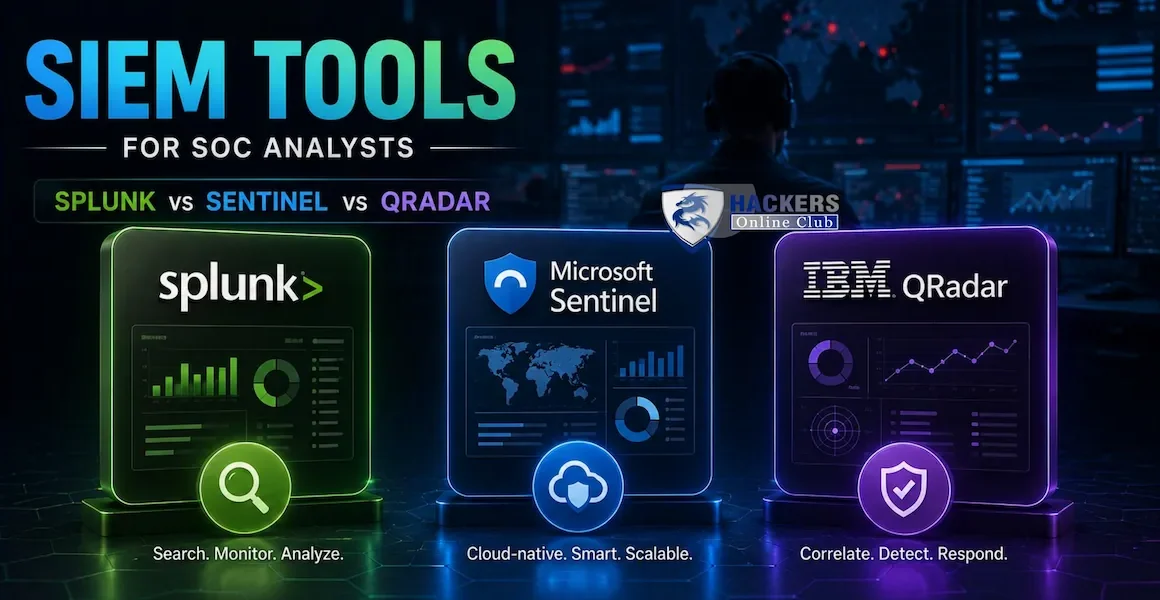
The SIEM market has consolidated and evolved. Following Cisco's acquisition of Splunk, and Microsoft's aggressive integration of Security Copilot into Sentinel, the "Big Three" — Splunk, Microsoft Sentinel, and IBM QRadar — have diverged sharply in their architectures, pricing models, and AI capabilities.
Also Read:- What is a SIEM? How it Works, Use Cases, and Top Tools (2026)
This guide provides a technical comparison of the top three SIEM platforms for 2026. We break down query languages (SPL vs KQL vs AQL), AI automation, pricing traps, and exactly how to choose the right platform for your specific environment.
Market Leaders: Splunk (Cisco), Microsoft Sentinel, IBM QRadar hold ~65% combined market share
Average Data Ingestion: 15 TB/day for enterprise SOCs (up 40% from 2023)
AI Adoption: 78% of SOCs now use AI/ML for alert triage and tuning
Alert Fatigue: 62% of analysts report burnout due to un-tuned SIEM alerts
Cloud-Native Shift: 65% of new SIEM deployments are 100% cloud-native (SaaS)
Average Annual Cost: $150,000 - $800,000+ (highly dependent on data volume and architecture)
- The 2026 SIEM landscape: What changed?
- Deep Dive: Splunk (Cisco)
- Deep Dive: Microsoft Sentinel
- Deep Dive: IBM QRadar
- Splunk vs Sentinel vs QRadar — Feature Comparison
- Query Languages: SPL vs KQL vs AQL
- How to choose based on your environment
- Common SIEM implementation failures
- First actions for SOC teams
- Frequently asked questions
1. The 2026 SIEM landscape: What changed?
If you evaluated SIEMs in 2022, the market looks completely different today. The shift from "log aggregation" to "AI-driven security operations" is complete.
- Cisco bought Splunk ($28B): Splunk is no longer just a data platform; it is the analytics engine for Cisco's entire security portfolio (Umbrella, Secure Endpoint, XDR). Expect deep network-to-endpoint correlation.
- Microsoft Copilot is everywhere: Sentinel's biggest advantage in 2026 is natural language querying. Tier 1 analysts can now ask Copilot, "Show me unusual sign-ins from Russia," and get a formatted KQL query and visual graph instantly.
- Pricing models shifted: The industry is moving away from strict "GB per day" ingestion pricing toward "workload-based" or "employee-based" licensing to combat cloud data explosion.
- SIEM and SOAR are one: Standalone SOAR tools are dying. Automation playbooks are now native to all three major SIEMs. If your SIEM doesn't auto-remediate, it's obsolete.
2. Deep Dive: Splunk (Cisco)
Splunk The undisputed heavyweight champion of data analytics and complex hybrid environments.
Splunk remains the most powerful SIEM on the market, provided you have the budget and the engineering talent to wield it. Following the Cisco acquisition, Splunk's integration with Cisco's network telemetry (via XDR) has created a formidable threat-hunting platform.
🔍 Key Strengths
- Search Processing Language (SPL): The most powerful, flexible query language in the industry. If you can imagine a data correlation, SPL can do it.
- Unmatched Integrations: Over 3,000 pre-built add-ons in Splunkbase. It ingests and normalizes data from literally everything.
- Cisco XDR Integration: Native, high-fidelity correlation between network traffic (Cisco), endpoint (Splunk), and cloud workloads.
- Advanced Analytics: Best-in-class machine learning toolkit for anomaly detection and predictive threat hunting.
⚠️ The Drawbacks
- Cost: It is incredibly expensive. While they introduced workload-based pricing, large enterprises still routinely spend $500k–$1M+ annually.
- Complexity: Splunk requires dedicated "Splunk Engineers" to maintain parsers, optimize searches, and manage infrastructure. It is not a "plug-and-play" tool.
- Steep Learning Curve: SPL is powerful but difficult to master. Tier 1 analysts will struggle without extensive training.
3. Deep Dive: Microsoft Sentinel
Sentinel The cloud-native king for Microsoft-centric environments.
Microsoft Sentinel (built on Azure Monitor Logs) has completely disrupted the SIEM market by offering a truly cloud-native, highly scalable platform with a lower barrier to entry. In 2026, its integration with Microsoft Security Copilot makes it the most accessible SIEM for junior analysts.
🔍 Key Strengths
- Microsoft Ecosystem Integration: If you use M365, Entra ID (Azure AD), and Defender, Sentinel provides out-of-the-box, zero-configuration visibility. No parsers required.
- Security Copilot (AI): The best AI assistant in the market. Natural language to KQL translation, automated incident summarization, and reverse query translation.
- Native SOAR: Logic Apps provide incredibly powerful, visual automation playbooks that integrate natively with Azure and third-party APIs.
- Cost Predictability: Pay-as-you-go ingestion pricing, with options to commit to capacity reservations for discounts. Free ingestion for Microsoft Defender alerts.
⚠️ The Drawbacks
- Cloud Egress Costs: While ingestion is cheap, pulling data *out* of Azure (to send to a third-party tool or on-prem SIEM) incurs massive egress fees.
- Non-Microsoft Data Parsing: Ingesting and normalizing data from non-Microsoft sources (like Linux, AWS, or legacy firewalls) requires writing custom KQL parsers or using expensive third-party normalizers.
- KQL Limitations: KQL is easier to learn than SPL, but lacks some of the deep, complex statistical transformation capabilities of SPL.
4. Deep Dive: IBM QRadar
QRadar The hybrid powerhouse for regulated, legacy, and network-heavy environments.
IBM QRadar has historically been the go-to for large, regulated enterprises (banking, government, telcos) with complex on-premises infrastructure. While it has pushed hard into the cloud with "QRadar on Cloud," its core strength remains in deep network traffic analysis and hybrid correlation.
🔍 Key Strengths
- QFlow & Network Visibility: QRadar's QFlow collectors provide unmatched visibility into network flows, making it exceptional at detecting lateral movement and data exfiltration.
- Hybrid Architecture: Excels in environments that are 50/50 on-premises and cloud. It handles legacy mainframes and modern AWS workloads equally well.
- IBM Watson AI: Strong automated alert triage and risk scoring. Watson automatically assigns a risk weight to offenses based on asset criticality and threat intel.
- Compliance Reporting: Best-in-class out-of-the-box reporting for PCI-DSS, HIPAA, and SOX compliance.
⚠️ The Drawbacks
- UI/UX is Dated: Compared to Sentinel and Splunk, QRadar's interface feels clunky and slow. Navigating complex offenses can be frustrating for analysts.
- EPS Licensing: Traditional Events Per Second (EPS) licensing can lead to massive cost spikes if your network generates unexpected log bursts (e.g., a routing loop).
- Resource Heavy: On-premises QRadar deployments require significant hardware resources and dedicated IBM administrators to maintain.
5. Splunk vs Sentinel vs QRadar — Feature Comparison
Here is the definitive feature-by-feature breakdown. Rows highlighted in green indicate the "Best in Class" winner for that category.
| Feature Category | Splunk | Sentinel | QRadar |
|---|---|---|---|
| Deployment Model | Cloud, On-Prem, Hybrid | 100% Cloud-Native (Azure SaaS) Best | On-Prem, Hybrid, Cloud |
| Query Language Power | SPL — Pipeline-based, extremely powerful Best | KQL — SQL-like, easier to learn | AQL — SQL-based, familiar |
| Data Ingestion / Integrations | 3,000+ apps via Splunkbase Best | Excellent for Microsoft sources | Strong legacy/enterprise support |
| AI / Copilot Capabilities | Splunk AI Assistant, UBA | Security Copilot (GPT-4), Fusion rules Best | IBM Watson AI, auto triage |
| SOAR / Automation | Splunk SOAR (Phantom) | Logic Apps — visual, Azure-native Best | QRadar SOAR (add-on license) |
| Network Visibility (NTA) | Good with Cisco integration | Limited — needs third-party NTA | QFlow — deep network flows Best |
| Threat Intelligence | Splunk Intelligence Mgmt, TAXII | Native TI, Defender TI Best | X-Force Exchange, custom feeds |
| Compliance Reporting | Extensive via apps | Good for Microsoft compliance | Out-of-box PCI-DSS, HIPAA, SOX Best |
| Scalability | Excellent — handles petabytes | Auto-scales with Azure, no infra mgmt Best | Good — requires hardware planning |
| Learning Curve | Very Steep |
Moderate Easiest |
Steep |
| Cost / Licensing | $150k–$1M+ |
Pay-as-you-go Best Value |
EPS-based (can spike) |
| Community & Ecosystem | Massive (Splunkbase) Best | Growing community | Smaller community |
| Mobile Access | Splunk Mobile App — good | Sentinel Mobile — improving | QRadar Mobile — basic only |
| 🏆 Best For | Complex hybrid, data science teams | Cloud-native, Microsoft shops, modern SOCs | Regulated industries, network-heavy |
🟠 Choose Splunk if: You have complex multi-vendor environments, need maximum flexibility, and have the budget/engineering resources.
🔵 Choose Sentinel if: You're 70%+ Microsoft cloud, want modern AI features, and need cost predictability.
🟣 Choose QRadar if: You're in banking/telco/government, need deep network visibility, and have strict compliance requirements.
6. Query Languages: SPL vs KQL vs AQL
The query language is the daily interface for your SOC analysts. Here is how the "Big Three" handle the exact same scenario: Finding users with more than 5 failed logins followed by a successful login in the last 24 hours (Brute Force Success).
🟠 Splunk: Search Processing Language (SPL)
SPL uses a pipeline model. You start with a broad search and pipe (|) the results through transformation commands.
🔵 Microsoft Sentinel: Kusto Query Language (KQL)
KQL uses a tabular model. It reads top-to-bottom, filtering and summarizing data sets. It is highly optimized for cloud-scale speed.
🟣 IBM QRadar: Ariel Query Language (AQL)
AQL is heavily based on standard SQL. If your analysts know SQL, they will feel at home, but it lacks the pipeline flexibility of SPL or KQL.
7. How to choose based on your environment
Don't choose a SIEM based on a vendor's marketing deck. Choose it based on your actual data architecture and team skills.
| Your Environment | The Right Choice | Why? |
|---|---|---|
| 80%+ Microsoft Cloud (M365, Azure, Entra ID) | Sentinel | Native integration is unbeatable. You get Defender alerts for free, and Copilot will make your junior analysts perform like seniors. |
| Complex Hybrid (On-prem AD, AWS, Linux, Cisco Network) | Splunk | Splunk's parsing engine and Cisco network integration will handle the messy, multi-vendor reality of your environment better than anyone. |
| Highly Regulated / Legacy (Banking, Telco, Mainframes) | QRadar | QRadar's QFlow network visibility and out-of-the-box compliance reporting are tailored for strict regulatory and legacy environments. |
| Small SOC / Limited Budget | Sentinel | Pay-as-you-go pricing and free Microsoft alert ingestion make it the most accessible for smaller teams. |
8. Common SIEM implementation failures
Buying the SIEM is 10% of the battle. Here is how SOCs fail during implementation and operation.
| Failure Mode | Symptom | The Fix |
|---|---|---|
| "Ingest Everything" Approach | Data costs explode. 90% of ingested data is never searched. Alert fatigue peaks. | Implement a strict data onboarding policy. Only ingest data that maps to a specific detection rule or compliance requirement. |
| Ignoring Log Normalization | Queries break when a firewall vendor updates their log format. Parsers fail silently. | Use the SIEM's Common Information Model (CIM in Splunk, ASIM in Sentinel). Never write queries against raw, unnormalized fields. |
| Copy-Pasting Detection Rules | Turning on 500 out-of-the-box rules generates 10,000 false positives a day. | Deploy rules in "Observation Mode" first. Tune the thresholds based on your baseline for 30 days before turning on automated ticketing. |
| No Dedicated SIEM Engineer | Analysts spend 4 hours a day just waiting for slow queries to return results. | Dedicate at least 0.5 FTE to SIEM engineering (index tuning, search optimization, parser maintenance). Slow queries kill SOC morale. |
9. First actions for SOC teams
Whether you're implementing a new SIEM or optimizing an existing one, these four actions will deliver immediate value.
⚡ Week 1: Audit your top 10 most expensive data sources
Pull your SIEM billing or ingestion report. Identify the top 10 noisiest log sources by GB/day. For each source, ask your SOC team:
- "Do we have detection rules that use this data?"
- "When was the last time we searched this data?"
- "Is this required for compliance?"
Action: If the answer is "no" to all three, stop ingesting it or reduce verbosity. This alone can cut your SIEM bill by 15-25%.
⚡ Week 2: Implement a "Tuning Sprint" for top 5 alerts
Take your 5 most-fired alert rules. Export the last 30 days of closures and calculate the false positive rate.
- If FP rate > 50%: Rewrite the query with contextual exclusions (admin IPs, service accounts, maintenance windows)
- If FP rate > 80%: Disable the rule entirely and rebuild it from scratch
- Deploy all rules in "Observation Mode" for 2 weeks before enabling automated ticketing
Expected outcome: 40-60% reduction in alert volume within 30 days.
⚡ Week 3: Train Tier 1 analysts on custom queries
Don't let your analysts rely solely on out-of-the-box dashboards. Schedule 2-hour weekly "Query Labs":
- Week 1: Basic filtering and time ranges (where, ago(), between)
- Week 2: Aggregation and grouping (stats, summarize, count)
- Week 3: Joins and lookups (join, lookup, enrich with threat intel)
- Week 4: Building detection rules from scratch
Goal: Every Tier 1 analyst should be able to write a custom query to investigate an incident without asking a senior analyst.
⚡ Week 4: Map SIEM coverage to MITRE ATT&CK
Use your SIEM's built-in MITRE ATT&CK coverage dashboard (all three platforms have this):
- Identify which critical techniques have zero detection coverage (common gaps: T1003 OS Credential Dumping, T1021 Remote Services, T1071 Application Layer Protocol)
- Prioritize building rules for techniques mapped to your top 3 threat scenarios
- For each new rule, document: the MITRE technique, the data sources required, the SPL/KQL/AQL query, and the expected false positive rate
Target: Achieve 60%+ coverage of high-priority MITRE techniques within 90 days.
10. Frequently asked questions
Which SIEM is best for a cloud-native environment?
Microsoft Sentinel is the undisputed leader for cloud-native environments, especially those heavily invested in Microsoft 365 and Azure. Its native integration with Entra ID, Defender, and Azure resources provides out-of-the-box visibility that Splunk and QRadar require extensive custom parsing to match.
Is Splunk still worth the high cost in 2026?
Splunk (now owned by Cisco) remains the gold standard for complex, hybrid, and data-heavy environments. While its licensing is significantly more expensive than Sentinel or QRadar, its Search Processing Language (SPL) and unmatched third-party integration ecosystem justify the cost for large enterprises with dedicated SIEM engineering teams.
How hard is it to learn KQL compared to SPL?
KQL (Kusto Query Language) used in Microsoft Sentinel is generally considered easier to learn for beginners than Splunk's SPL. KQL uses a tabular data flow model similar to SQL, while SPL uses a pipeline model. However, SPL is vastly more powerful for complex data manipulation and statistical analysis.
Can IBM QRadar integrate with cloud workloads?
Yes, IBM QRadar has significantly improved its cloud capabilities with QRadar on Cloud and native AWS/Azure integrations. However, its core strength remains in hybrid environments where it can correlate deep on-premises network traffic (via QFlow) with modern cloud logs.
Which SIEM has the best AI and automation features?
In 2026, Microsoft Sentinel leads in accessible AI with its deep integration of Microsoft Security Copilot, allowing analysts to use natural language for threat hunting. Splunk counters with Splunk AI Assistant and powerful SOAR automation, while QRadar utilizes IBM Watson for automated alert triage.
What is the biggest mistake SOCs make when choosing a SIEM?
Choosing a SIEM based solely on features rather than the team's existing skill set and the organization's data architecture. A powerful tool like Splunk will fail if the SOC lacks the engineering resources to maintain it, while Sentinel will underperform if the organization doesn't use the Microsoft ecosystem.
Written by the HOC Team at Hackers Online Club — a cybersecurity community trusted by SOC analysts, threat hunters, CISOs, and security engineers since 2010. 15+ years of practical cybersecurity guides, SIEM tuning tutorials, and enterprise security resources. Learn more about HOC →