
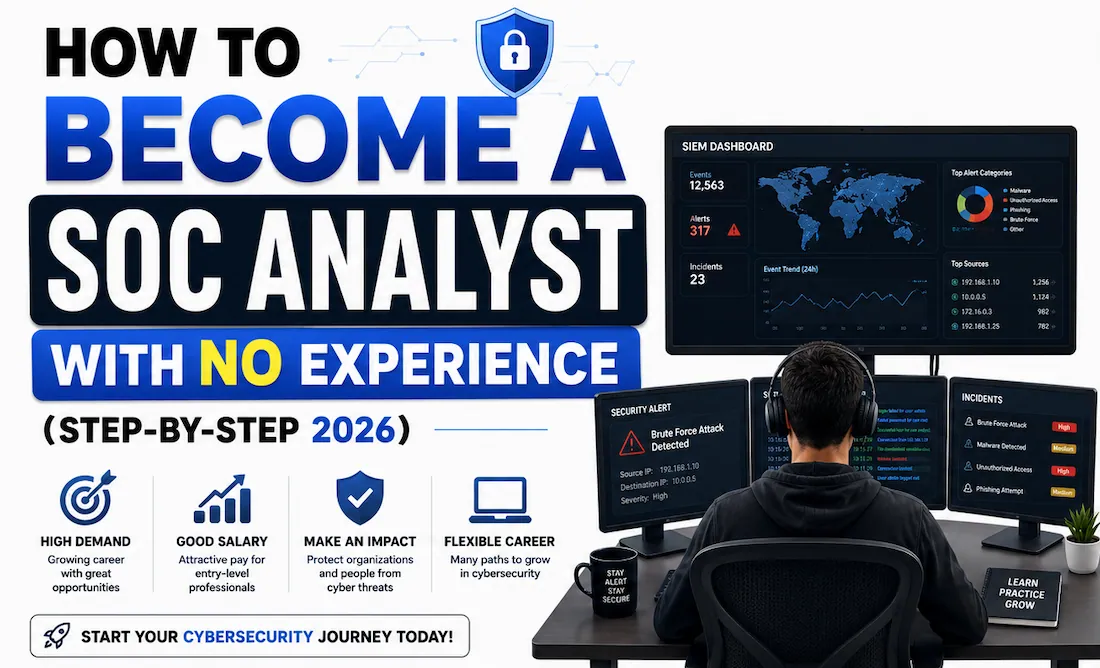
The SOC Analyst role is the most realistic first job in cybersecurity — and one of the most in-demand positions in the industry. Unlike penetration testing, which typically requires 1–3 years of hands-on experience before employers take you seriously, SOC Analyst Tier 1 positions are genuinely entry-level. Companies hire people with zero professional experience, train them on the job, and promote fast.
This guide is a complete, step-by-step roadmap to landing your first SOC Analyst job in 2026 — with no prior experience. We cover exactly what skills to learn, which certifications to get in which order, which tools to master, how to build a portfolio, and how to write a CV that gets past the ATS and lands interviews.
- What is a SOC Analyst — and what do they actually do?
- SOC Analyst tiers — Tier 1 vs Tier 2 vs Tier 3
- SOC Analyst salary — what can you expect to earn?
- Core skills every SOC Analyst needs
- Which certifications to get — in the right order
- Tools you must know before your interview
- Step-by-step roadmap — 0 to hired in 6 months
- How to build a portfolio with no work experience
- CV tips — how to write a SOC Analyst resume that gets interviews
- SOC Analyst interview — what to expect
- Frequently asked questions
A SOC (Security Operations Centre) Analyst monitors an organisation's IT infrastructure 24/7 for signs of cyber attacks, data breaches, and security incidents. When a threat is detected — whether it's malware on a workstation, an unusual login at 3am, or a phishing email that made it past the filter — the SOC Analyst investigates, triages, and responds.
In plain terms: you are the first line of defence. When something goes wrong, you are the person who notices it first and decides what to do about it.
- Monitor security dashboards, SIEM alerts, and log data for suspicious activity
- Investigate security alerts — determine if they are real threats or false positives
- Analyse network traffic, endpoint logs, and email headers for indicators of compromise (IOCs)
- Create and document incident reports for every confirmed security event
- Escalate confirmed incidents to Tier 2/3 analysts or the incident response team
- Tune SIEM rules and detection logic to reduce false positive alert volumes
- Stay up to date on new threats, CVEs, and attacker techniques (MITRE ATT&CK)
SOC teams are structured in tiers. Understanding the tier system is critical because it tells you exactly what you need to know for each career stage — and what the progression looks like.
Your entry point. Monitor SIEM dashboards, triage incoming alerts, classify as true/false positive, escalate. Works from runbooks and playbooks. Requires Security+ or equivalent. 0–1 year experience needed.
12–24 months in. Deeper investigation of escalated incidents. Threat hunting. Malware analysis basics. Creates detection rules. Requires CySA+ or equivalent. 1–3 years experience.
Senior role. Proactive threat hunting, advanced malware reverse engineering, red team collaboration, SOC tool development. Requires GIAC certs or equivalent. 3–5+ years experience.
| Level | Experience | USA (avg) | UK (avg) | India (avg) | Remote possible? |
|---|---|---|---|---|---|
| Tier 1 SOC Analyst | 0–1 year | $55,000–$75,000 | £28,000–£38,000 | ₹4–7 LPA | Partially |
| Tier 2 SOC Analyst | 1–3 years | $75,000–$100,000 | £38,000–£55,000 | ₹7–14 LPA | Yes |
| Tier 3 / Lead | 3–5+ years | $100,000–$140,000 | £55,000–£80,000 | ₹15–25 LPA | Yes |
| SOC Manager | 5+ years | $120,000–$160,000 | £65,000–£100,000 | ₹20–40 LPA | Hybrid |
You do not need to be a programmer or a hacker to become a SOC Analyst. You need to understand how attacks work well enough to recognise them in log data. Here is exactly what to learn.
You will spend most of your time analysing network traffic. Understanding how data moves across networks is non-negotiable.
- TCP/IP model — how packets are structured and routed
- DNS — how domain resolution works and how attackers abuse it (DNS tunnelling, C2 beaconing)
- HTTP/HTTPS — request/response structure, status codes, headers
- Ports and protocols — common ports (22 SSH, 80 HTTP, 443 HTTPS, 445 SMB, 3389 RDP) and what running them means
- Firewalls and proxies — how traffic is filtered and logged
- Subnetting basics — understanding IP ranges and CIDR notation
Most enterprise environments run Windows. You need to know where Windows stores logs, how processes work, and what normal system behaviour looks like — so you can spot abnormal behaviour.
- Windows Event Logs — Event IDs 4624 (logon), 4625 (failed logon), 4688 (process creation), 4698 (scheduled task), 7045 (new service)
- Windows registry — persistence locations attackers use (HKCU\Run, HKLM\Run)
- Active Directory basics — users, groups, domain controllers, Kerberos authentication
- Linux command line — navigating the filesystem, reading logs in /var/log/, using grep, cat, awk
- Process analysis — spotting unusual parent-child process relationships
4624 = Successful logon | 4625 = Failed logon | 4648 = Logon with explicit credentials | 4688 = New process created | 4698 = Scheduled task created | 7045 = New service installed. These appear in nearly every SOC interview.
You don't need to be able to execute attacks — you need to recognise them. Learn the attacker's playbook so you can spot the signatures in log data.
- MITRE ATT&CK framework — the industry-standard taxonomy of attacker techniques. Every alert maps to a MITRE technique. Learn it early.
- Cyber kill chain — Reconnaissance → Weaponisation → Delivery → Exploitation → Installation → C2 → Actions on Objectives
- Common attack types — phishing, brute force, SQL injection, XSS, privilege escalation, lateral movement, ransomware
- Indicators of Compromise (IOCs) — malicious IPs, domains, file hashes, registry keys, process names
- Malware families — recognise common malware behaviour (keyloggers, RATs, ransomware, rootkits)
SIEM (Security Information and Event Management) is the primary tool you will use every single day. It aggregates logs from across the entire organisation and generates alerts when suspicious patterns are detected.
- What a SIEM does — log collection, correlation, alerting, dashboards
- Reading raw logs — Windows Event Logs, firewall logs, web server access logs, DNS query logs
- Writing basic queries — filtering logs by IP, user, time range, event type
- Splunk basics — SPL (Search Processing Language) queries are the most in-demand SIEM skill in job postings
- Alert triage workflow — how to classify, prioritise, investigate, and document an alert
Certifications matter for SOC Analyst roles more than almost any other cybersecurity position — because hiring managers use them as an objective filter when sorting through hundreds of CVs. Here is the exact order to pursue them.
(optional — if no IT background) → CompTIA Network+
(2–4 weeks) → CompTIA Security+
★ Get this first → CompTIA CySA+
(after 6 months in role) → GIAC GCIH / GSOC
(Tier 2 progression)
Security+ is the de facto baseline certification for Tier 1 SOC positions. It is recognised globally, vendor-neutral, and appears as a requirement in more SOC job postings than any other certification. The DoD 8570 mandate requires it for US government security roles.
- Cost: ~$380 USD (vouchers available cheaper on Reddit/eBay)
- Study time: 4–8 weeks if starting from scratch, 2–3 weeks with IT background
- Pass mark: 750/900 — multiple choice + performance-based questions
- Best free resource: Professor Messer's free SY0-701 course on YouTube (60+ hours, fully updated)
- Best paid resource: Jason Dion's Udemy course (~$15 on sale) + Darril Gibson's study guide
Before paying for any cert exam, get hands-on experience using free platforms. This builds your practical skills AND gives you something to talk about in interviews.
- TryHackMe SOC Level 1 path — free tier available, covers Nmap, Wireshark, Splunk basics, SIEM, phishing analysis, incident response. Designed specifically for people who want to become SOC analysts.
- Blue Team Labs Online (BTLO) — free SOC-specific challenges. Practice investigating real log files, PCAP files, and memory dumps.
- LetsDefend — browser-based SOC simulator. You monitor a live SIEM dashboard and close real alerts. The closest thing to doing the actual job.
- CyberDefenders — free Blue Team CTF-style challenges with real artefacts (logs, PCAPs, memory dumps).
CySA+ (Cybersecurity Analyst+) validates your ability to perform threat detection, data analysis, and incident response — the core Tier 2 skills. Get this once you are 6–12 months into your first SOC role.
- Cost: ~$392 USD
- Study time: 4–6 weeks for someone already working in a SOC
- Requires: Security+ plus practical experience (highly recommended, not mandatory)
- Microsoft SC-200 — Microsoft Security Operations Analyst. Excellent if you want to work with Microsoft Sentinel (Azure SIEM). Highly valued in enterprises running M365.
- Splunk Core Certified User — free training, demonstrates Splunk query proficiency. High ROI for the time invested since Splunk appears in ~40% of SOC job postings.
- Google Cybersecurity Certificate (Coursera) — ~$200 for the full course, designed for complete beginners. Good structured foundation if you are new to IT entirely.
- ISC2 CC (Certified in Cybersecurity) — free exam until further notice, good baseline credential to put on your CV while studying for Security+.
Hiring managers for Tier 1 SOC roles don't expect you to be an expert in every tool — they expect you to have used the most important ones. Here are the tools that appear most frequently in job postings and interviews.
| Tool | Category | Why it matters | Free to learn? |
|---|---|---|---|
| Splunk | SIEM | Most common SIEM in enterprise job postings. SPL query skills are highly valued. | Yes — free cloud trial |
| Microsoft Sentinel | SIEM | Azure-native SIEM, growing rapidly in M365 enterprises. KQL query language. | Yes — Azure free trial |
| IBM QRadar | SIEM | Common in large enterprises and government. Less hands-on access but understand concepts. | Community edition free |
| Wireshark | Packet analysis | Analysing network PCAPs is a core SOC skill. Read PCAP, filter traffic, spot IOCs. | Yes — free |
| Nmap | Network scanning | Used for asset discovery and understanding network topology. See our Nmap tutorial → | Yes — free |
| VirusTotal | Threat intelligence | First tool used when investigating suspicious files, URLs, or IP addresses. | Yes — free web tool |
| AbuseIPDB | Threat intel | Check if an IP has been reported as malicious. Used in almost every alert investigation. | Yes — free |
| TheHive | Incident management | Open-source incident response platform. Understanding SOAR/ticketing is expected. | Yes — open source |
| MITRE ATT&CK Navigator | Framework | Map attacker techniques to detections. Used in threat hunting and report writing. | Yes — free web tool |
This is the specific month-by-month plan. Adjust timings based on your available hours per day — this assumes 1–2 hours daily.
- Complete Professor Messer's free Network+ course on YouTube (skip to the networking sections)
- Sign up for TryHackMe (free) — complete the "Pre-Security" and "SOC Level 1" paths
- Start Professor Messer's free Security+ (SY0-701) course
- Create a GitHub account — this will be your portfolio
- Set up a free home lab: install VirtualBox, download a Windows Server VM and a Kali Linux VM
- Learn the MITRE ATT&CK framework — spend 2 hours reading through the tactics and techniques
- Finish Professor Messer's Security+ course
- Start using Splunk free cloud trial — complete Splunk Fundamentals 1 (free course)
- Take the ISC2 CC (Certified in Cybersecurity) exam — free until further notice. Good first cert on your CV.
- Complete Blue Team Labs Online (BTLO) beginner challenges — Phishing Analysis, Log Analysis, PCAP Analysis
- Start reading the CrowdStrike 2026 Global Threat Report (free, 60 pages) — you will get asked about current threats
- Begin studying Windows Event Logs — download DeepBlueCLI and run it against sample log files
- Book and pass CompTIA Security+ — this is your primary goal for month 3
- Complete LetsDefend free SOC challenges — document your investigation process for each one
- Practice Wireshark on sample PCAPs from malware-traffic-analysis.net — identify the attack in each capture
- Start building your GitHub portfolio — write up 3–5 investigations as markdown documents
- Learn basic Python for log parsing — reading JSON logs and filtering by field is a bonus skill that appears in Tier 2 job descriptions
- Polish your GitHub portfolio — each project should have a clear README explaining: what the scenario was, what you investigated, what you found, and what you recommended
- Write your SOC Analyst CV (see Section 9 for exact format)
- Apply for 5–10 Tier 1 SOC Analyst or Junior SOC roles per week on LinkedIn, Indeed, and CyberSecJobs
- Start applying at MSSPs specifically — they hire entry-level more reliably than single enterprises
- Complete CyberDefenders free challenges — add top ones to your portfolio
- Practise answering interview questions out loud — see Section 10
- Apply consistently — 5–10 applications per week minimum
- After each interview, write down every technical question asked. Research any you couldn't answer fully.
- If you get rejected, follow up by email and ask for feedback — many interviewers will tell you exactly what you were missing
- Consider LinkedIn outreach to SOC team leads at target companies — a brief, specific message referencing their company's security challenges has a much higher response rate than cold applications
- While interviewing, start studying for CySA+ — you will hit the ground running in your first role
A portfolio answers the hiring manager's biggest question before they can ask it: "Can this person actually do the work?" With no professional experience, your portfolio is the proof.
-
✓TryHackMe SOC Level 1 badge — screenshot your completed path and include the certificate URL. Takes 2–4 weeks to complete and directly demonstrates SOC skills.
-
SSplunk investigation write-up — take a free BOSS of the SOC (BOTS) dataset challenge, investigate an attack, and document your findings. Include your SPL queries, screenshots, and a 1-page summary of what you found. Upload to GitHub.
-
WWireshark PCAP analysis — download a malicious PCAP from malware-traffic-analysis.net, analyse it, identify the attack type, extract IOCs, and write it up. Shows packet analysis skills without needing a job to practice.
-
📧Phishing email analysis — analyse a real phishing email (from BTLO or PhishTool), document the headers, identify spoofed domains, extract URLs, check IOCs on VirusTotal. Clean 1-page report format.
-
HHome lab documentation — document your home lab setup: what VMs you run, what logs you forward, what SIEM you use. Even a basic Splunk + Windows VM setup demonstrates practical initiative that most candidates lack.
Most junior applicants lose before they start because their CV fails the 30-second scan. Here is exactly what to include — and what to cut.
- Professional summary (3 sentences) — who you are, what you can do, what you are looking for. Example: "Motivated cybersecurity professional with CompTIA Security+ certification and hands-on SOC experience via TryHackMe and LetsDefend. Proficient in Splunk log analysis, Windows Event Log investigation, and phishing triage. Seeking a Tier 1 SOC Analyst role to contribute to a security operations team."
- Certifications section near the top — Security+, ISC2 CC, TryHackMe badges. Put this before work experience if your experience is unrelated to security.
- Technical skills table — SIEM tools (Splunk, Sentinel), network protocols (TCP/IP, DNS, HTTP), OS (Windows, Linux), frameworks (MITRE ATT&CK), tools (Wireshark, Nmap, VirusTotal)
- Projects / Portfolio section — 3–5 bullet points linking to your GitHub write-ups. This is your experience section if you have none professionally.
- Keywords from the job description — ATS systems filter on exact keyword matches. Mirror the language in the job post (e.g., if it says "incident response", use exactly that phrase).
- Objective statements like "I want to grow my career in cybersecurity" — replace with a specific professional summary
- Unrelated work experience listed in detail — keep it brief (just job title, company, dates) if it's not security-related
- Generic skills like "Microsoft Office", "team player", "hard working"
- Photos, graphics, tables — ATS systems cannot parse them and will reject your application
- CV longer than 2 pages at entry level — 1 page is ideal, 2 is acceptable
SOC Analyst interviews typically have three stages: a recruiter screen, a technical interview, and sometimes a practical assessment (investigating a sample alert or log file).
- "Walk me through how you would investigate a suspicious login alert." — Your answer: check source IP (AbuseIPDB, geolocation), check if the user account is legitimate, look at login history for the account, check if MFA was bypassed, look at what the account did after login. Document findings.
- "What is the difference between an IDS and an IPS?" — IDS (Intrusion Detection System) detects and alerts. IPS (Intrusion Prevention System) detects and blocks automatically.
- "What is a false positive in a SOC context?" — An alert that fires but turns out to be legitimate activity — not a real threat. Reducing false positives through rule tuning is a core SOC function.
- "What Windows Event IDs do you know and why are they important?" — List 4624, 4625, 4688, 4698, 7045 with explanations (see Section 4).
- "What is the MITRE ATT&CK framework?" — A globally-accessible, structured knowledge base of attacker tactics and techniques based on real-world observations. Used to classify, detect, and respond to threats.
- "What would you do if you found malware on a workstation?" — Isolate the machine from the network, preserve evidence (take a memory dump, disk image if possible), document timeline of events, escalate to Tier 2/incident response team, check for lateral movement to other systems.
- "What is phishing and how would you analyse a suspicious email?" — Check sender domain (WHOIS, SPF/DKIM/DMARC records), analyse headers for relay hops, extract URLs and check on VirusTotal and URLScan.io, check for typosquatting domains.
- "What is a SIEM and how does it work?" — Aggregates log data from multiple sources, normalises it, applies correlation rules to detect suspicious patterns, generates alerts for analyst review.
⚡ Your action plan — start today
- Sign up for TryHackMe right now — free account, start the SOC Level 1 path tonight. tryhackme.com →
- Watch Professor Messer's Security+ course — free on YouTube, start with Domain 1. professormesser.com →
- Get the ISC2 CC cert — free exam, basic credential you can put on your CV immediately. isc2.org/CC →
- Build your toolkit — learn Nmap for network scanning, Wireshark for packet analysis. Our Nmap tutorial → | Kali Linux commands →
- Create your GitHub portfolio — document every lab and investigation you complete from day one.
Yes. Many Tier 1 SOC Analysts come from non-IT backgrounds — customer service, military, retail, and teaching are common prior careers. What matters is that you demonstrate you have learned the core skills through self-study, certifications, and practical labs. CompTIA Security+ combined with hands-on TryHackMe and LetsDefend experience is enough to get Tier 1 interviews.
No. A degree is helpful but not required for Tier 1 positions. Most job postings list a degree as "preferred" rather than "required" and will accept equivalent certifications and demonstrable experience in its place. CompTIA Security+, hands-on lab experience, and a professional portfolio carry more weight with technical hiring managers than a non-security degree.
Most people land their first Tier 1 SOC Analyst role within 3–8 months of committed self-study with 1–2 hours per day. The main milestone is passing CompTIA Security+, which typically takes 4–8 weeks to prepare for. The timeline speeds up significantly if you already have IT support or networking experience.
A SOC Analyst is defensive (Blue Team) — monitoring, detecting, and responding to attacks. A penetration tester is offensive (Red Team) — simulating attacks to find vulnerabilities before real attackers do. SOC Analyst is typically easier to enter with no experience. Penetration testing generally requires 1–3 years of hands-on experience and certifications like OSCP before employers hire at entry level.
Learn Splunk first. It appears in more job postings globally than any other SIEM. The SPL (Search Processing Language) query skills are highly transferable. After Splunk, learn Microsoft Sentinel if you are targeting enterprises running Microsoft 365 environments — it is the fastest-growing enterprise SIEM as of 2026.
Yes — it is one of the fastest-growing cybersecurity roles in India. The CERT-In mandate requiring organisations to report incidents within 6 hours has dramatically increased demand for SOC teams across Indian enterprises. MSSPs like TCS, Infosys, Wipro, HCL, and Tech Mahindra actively hire Tier 1 SOC Analysts. Starting salary ranges from ₹4–7 LPA for freshers with Security+ or equivalent certification.
The typical progression is: Tier 1 SOC Analyst (0–1yr) → Tier 2 Incident Responder (1–3yr) → Tier 3 Threat Hunter or Security Engineer (3–5yr) → SOC Lead or CISO track (5yr+). Many Tier 2 analysts branch into specialisms: malware analysis, threat intelligence, digital forensics, or cloud security engineering — each commanding higher salaries.