


A finance manager at a UK logistics company received a WhatsApp voice note in March 2026. It was unmistakably her CEO's voice -- the same Northern Irish accent, the same measured pace, the same habit of starting sentences with "Right, so."
The message instructed her to process an urgent supplier payment of £218,000 before 5 PM and not to go through the usual approvals because the deal was commercially sensitive. She processed the payment. The CEO had never recorded that message. His voice had been cloned from three publicly available podcast appearances. Total cost to the attacker: a free trial of a voice cloning API and thirty minutes of preparation.
This is deepfake phishing: social engineering attacks that use AI-synthesised audio, video, or text to impersonate a trusted person with a level of fidelity that defeats the human ability to distinguish real from fake. Unlike traditional phishing -- which relies on urgency and volume -- deepfake phishing relies on identity fraud.
The victim does not click a suspicious link; they take an action because they genuinely believe they are responding to someone they know and trust. This makes deepfake phishing fundamentally harder to counter with awareness training alone, and requires a combination of procedural controls, technical detection, and organisational policy that most security programmes have not yet implemented.
This guide covers every aspect of deepfake phishing for 2026: how each attack type works, the technology behind it, documented case studies, how to detect deepfakes (and the limits of detection technology), and a complete prevention framework your organisation can implement immediately -- including the low-cost procedural controls that are more reliable than any AI detection tool currently available.
- Types of deepfake phishing attacks
- How deepfake phishing works -- the technology
- The deepfake phishing attack chain
- Real-world case studies 2024-2026
- How to detect deepfake phishing
- Deepfake detection tools and their limitations
- Prevention framework -- procedural and technical controls
- Deepfake phishing response policy template
- Security awareness training for deepfake attacks
- Frequently asked questions
Deepfake phishing encompasses several distinct attack categories, each using different AI synthesis technology and targeting different communication channels. Understanding the distinctions matters because each type has different detection indicators and requires different preventive controls.
Understanding the underlying technology helps security teams assess detection reliability and prevention effectiveness. Deepfake technology in 2026 uses three primary AI architectures: diffusion models for image and video synthesis, neural vocoders for voice synthesis, and transformer-based face-swap models for real-time video.
Modern voice cloning uses neural text-to-speech (TTS) models trained on a speaker's voice. The process:
- Speaker encoding: A speaker encoder network analyses a voice sample (as short as 3 seconds) and produces a speaker embedding -- a mathematical representation of the unique characteristics of that voice: pitch, timbre, cadence, accent, and speech patterns.
- Text synthesis: A synthesis network generates mel spectrograms (audio frequency maps) from the input text, conditioned on the speaker embedding. The result sounds like the target person saying the input text.
- Vocoding: A neural vocoder (WaveNet, HiFi-GAN, or similar) converts the mel spectrogram into a realistic audio waveform.
Commercial APIs (ElevenLabs, Resemble AI, PlayHT, Murf) make this accessible with no machine learning expertise. An attacker uploads a voice sample, types a script, and downloads a convincing audio file in under two minutes. Open-source alternatives (XTTS, Coqui TTS, OpenVoice) provide the same capability for free with a GPU or cloud compute.
Real-time deepfake video uses a different architecture: a face-swapping model that processes incoming video frames and replaces the source face with the target face in real time. Tools like DeepFaceLive, Rope (successor to Roop), and commercial APIs process frames at 25-30 FPS with latency under 50ms -- within normal video call variation. The model requires a collection of reference images of the target (easily harvested from LinkedIn, the company website, press photos, or social media) to learn the target's face geometry and expressions.
LLMs impersonate writing style through few-shot prompting: the attacker provides the model with examples of the target's actual writing (from LinkedIn posts, published articles, emails obtained from breaches, or Slack messages) and instructs the model to write new content in the same style. Advanced attackers fine-tune smaller open-source models specifically on a target's writing corpus for more consistent impersonation at scale.
A fully developed deepfake phishing attack against a corporate finance target follows a structured six-stage chain. Understanding each stage reveals where preventive controls can interrupt the attack.
-
1Target selection and OSINT gatheringAttacker identifies a high-value target organisation (finance team, HR with payroll access, IT admin with privileged access). Automated OSINT tools scrape LinkedIn for finance team members, the CFO or CEO name and role, and the organisational hierarchy. Company website, press releases, and news articles identify recent events (new CFO, acquisition, system rollout) that create plausible pretexts. Podcast appearances, YouTube videos, and earnings call recordings are downloaded for voice source material. The attacker builds a target dossier in under an hour.
-
2Pretext and script developmentAn LLM generates a plausible pretext based on the OSINT gathered. Common pretexts: urgent supplier payment before a deal closes, payroll account change, IT credential re-validation for a system migration, legal settlement requiring confidential wire transfer. The pretext uses details from the OSINT to increase credibility (references the actual CFO's name, a real project, a real supplier relationship if visible from public sources). The script includes urgency, a secrecy request ("don't discuss this with others until it closes"), and a clear action the victim must take.
-
3Deepfake asset creationVoice clone is generated from source audio using a commercial API (under 2 minutes). If a video call is planned, the face-swap model is configured using reference images of the impersonated executive (minimum 10-20 clear images, easily obtained from LinkedIn, company website, and Google Images). The script is fed into the voice clone API to produce the audio for a WhatsApp voice note or phone call. For a text attack, the LLM generates emails or messages in the target's writing style.
-
4Initial contact and credibility establishmentThe attack often starts with a lower-friction channel to establish context before the main request. A spoofed or look-alike email from the "CEO" mentions that they will be calling shortly about a confidential matter. The voice clone WhatsApp voice note then arrives, referencing the email. Each channel reinforces the other -- the victim has now received two independent-seeming confirmations. If suspicion is raised and the victim asks a question, the LLM responds intelligently in the CEO's style.
-
5Action extractionThe victim is asked to take the target action: process a wire transfer, change payroll bank account details, provide credentials for a system, approve an access request, or click a link to complete a "secure document signing". Urgency and secrecy are maintained throughout. The attacker provides all the details needed (account numbers, reference codes) to make the action as frictionless as possible, minimising any reason for the victim to pause and verify.
-
6Cover and extractionOnce the action is taken, the attacker goes silent or provides a plausible reason for why the CEO will be unreachable ("I'm going into meetings for the rest of the day -- I'll confirm once I'm out"). Wire transfers to foreign accounts are typically moved within minutes through multiple intermediary accounts. By the time the fraud is discovered (often the following day when the real CEO or CFO is contacted about the transaction), the funds are unrecoverable.
A finance employee at the Hong Kong office of British engineering firm Arup attended a video conference call with who appeared to be the company's CFO and several London-based colleagues. All other participants except the victim were deepfakes -- real-time face-swapped video using the identities of real Arup employees, whose faces had been harvested from internal communications and public sources. The "CFO" instructed the employee to make 15 transactions totalling HK$200 million ($25.6 million USD) to five different bank accounts. The employee was initially suspicious after receiving what he thought was a phishing email, but the video call "confirmed" the legitimacy of the request. This case is the largest known single deepfake fraud incident.
The managing director of a UK-based energy company received a phone call from who he believed was the CEO of his German parent company, requesting an urgent transfer of €220,000 to a Hungarian supplier. The voice was described as having the CEO's characteristic German accent and speech patterns. The transfer was made. A second call requesting an additional transfer was interrupted when the MD called the real CEO on another line. Investigation concluded the voice was AI-synthesised -- one of the earliest documented real-world uses of voice cloning for corporate fraud.
A senior Ferrari executive received a WhatsApp message and subsequent calls from someone impersonating CEO Benedetto Vigna, including the use of a voice that matched Vigna's accent and manner of speaking. The caller attempted to extract information and approvals related to a confidential acquisition. The fraud was detected when the executive, following internal protocol, asked the caller a specific personal question that the real Vigna would know the answer to. The deepfake could not answer. No financial loss occurred -- the case is notable as an example of a procedural control (personal verification question) successfully defeating a high-quality voice clone attack.
Recorded Future and IBM X-Force jointly documented a criminal campaign targeting mid-market manufacturers and logistics firms across the UK, Germany, and the Netherlands. The campaign used a three-stage approach: LLM-generated email in the CFO's writing style, followed by a voice clone WhatsApp message, followed by a brief real-time deepfake video call for "final confirmation". The campaign targeted accounts payable staff specifically. Of 34 documented attempts, 11 resulted in successful fund transfers. Average loss per successful attack: €380,000. The campaign ran for approximately eight months before attribution.
Detection of deepfakes is a genuine technical challenge in 2026 -- current generation voice clones and real-time video deepfakes defeat unaided human detection in the majority of cases. However, there are both technical artefacts and behavioural indicators that can raise suspicion. The key principle: deepfake detection should inform suspicion and prompt verification -- it should never be the only control between suspicion and action.
Current voice cloning artefacts that may be detectable (though these are reducing with each model generation):
- Unnatural cadence: AI-synthesised speech sometimes has slightly robotic timing -- uniform word spacing, slightly flat intonation in emotional content, or abrupt transitions between phrases. Conversational speech has natural rhythm variation that current TTS models approximate but do not perfectly replicate.
- Background noise inconsistency: A cloned voice call may have an unusual background environment -- too quiet (no ambient office noise), or with a different acoustic signature than expected from the claimed location ("If the CFO is calling from the New York office, why does it sound like a soundproofed booth?").
- Inability to respond to unexpected prompts: Voice clone systems in real-time mode have latency when generating responses to unexpected questions. If you ask a question the attacker's script did not anticipate, there may be a noticeable delay or the response may sound scripted.
- Emotional flatness: AI voice synthesis handles neutral speech better than emotionally charged speech. Requests for urgency or expressions of stress may sound slightly flat or artificially emphasised.
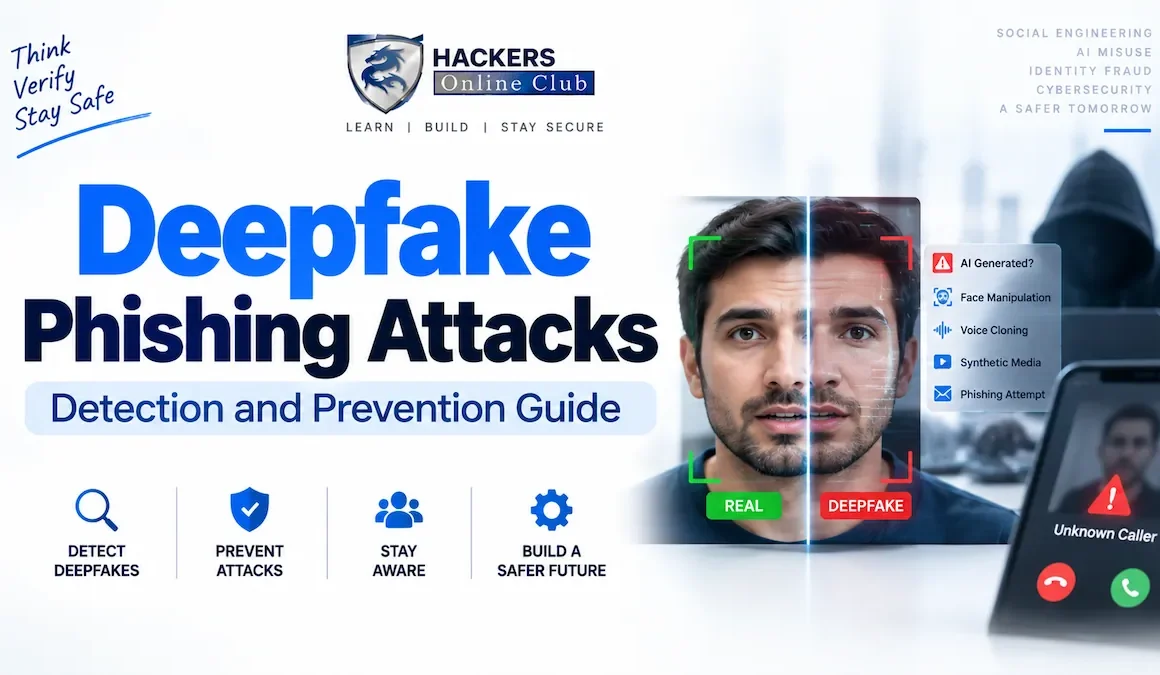
- Face boundary artefacts: Real-time face swap sometimes shows subtle blurring or pixel distortion at the edges of the face, particularly around the hair line, ears, and jaw -- especially when the person moves quickly or turns their head.
- Lighting inconsistency: The synthesised face may have lighting that does not perfectly match the scene -- the light source on the face does not match the light sources visible in the background.
- Eye and teeth anomalies: Deepfake models handle the whites of eyes and teeth less reliably than other facial features. In lower-quality deepfakes, these areas may look slightly waxy, unnaturally bright, or inconsistently rendered.
- Profile view degradation: Most real-time deepfake models are trained primarily on frontal face data. When the person turns significantly to one side, the synthesis quality often degrades visibly. Asking a call participant to turn sideways is a reliable challenge that degrades most current real-time deepfakes.
- Unnatural blinking: Early deepfake models famously failed to blink correctly. Current models handle blinking well, but rapid or exaggerated blinks may still reveal artefacts. Conversely, some models blink on a regular mechanical schedule rather than the variable pattern of natural human blinking.
| Tool | Type | What it detects | Deployment | Limitation |
|---|---|---|---|---|
| Reality Defender | Commercial SaaS | Video, audio, and image deepfakes; real-time video call analysis via browser plugin | API, browser extension, enterprise platform | Arms race with generation -- detection rates degrade as models update; requires integration |
| Pindrop Pulse | Commercial (call centre focus) | Audio deepfakes and voice clones in phone calls; liveness detection | Call centre integration, API | Optimised for call centre infrastructure; not designed for WhatsApp/consumer voice note analysis |
| Intel FakeCatcher | Research / Commercial preview | Real-time video deepfakes via blood flow analysis (rPPG) in facial pixels | Server-side integration | Requires video at sufficient resolution and frame rate; compute-intensive; not publicly GA |
| Microsoft Video Authenticator | Research tool | Pre-recorded video deepfakes; provides confidence score per frame | API (limited access) | Not publicly available at scale; optimised for older generation deepfakes; not real-time |
| Sensity AI | Commercial SaaS | Image and video deepfakes; face manipulation; GAN-generated faces | API, enterprise dashboard | Best for image verification; video analysis has processing delay; subscription cost |
| Hive Moderation | Commercial API | AI-generated image and video detection; deepfake faces | REST API | Primarily designed for content moderation use cases; not optimised for live call analysis |
| ElevenLabs AI Speech Classifier | Free, public | Detects audio generated by ElevenLabs specifically | Web upload | Only detects ElevenLabs-generated audio -- useless against other voice clone tools |
The most effective deepfake phishing prevention controls are procedural, not technical. This is counterintuitive for security teams accustomed to solving problems with tools, but it reflects the fundamental nature of the attack: deepfakes defeat sensory verification (you cannot trust what you see and hear), so the control must be independent of sensory verification.
-
1Safe word protocol -- Establish a pre-agreed secret word or phrase between executives and finance/HR/IT teams. Any request for a payment, access change, or sensitive action made through an unusual channel must include the safe word. If the safe word is absent, the request is declined and the real person is called on their verified number. A deepfake cannot know the safe word. Rotate quarterly. Store securely (not in email). This single control would have prevented the Ferrari attack and the majority of documented voice clone fraud cases.
-
2Out-of-band callback verification -- Any payment instruction or sensitive request received via an unusual channel (WhatsApp, unexpected call, video call not in the calendar) requires a callback to a verified number before action. The callback must be initiated by the recipient using a number from their existing verified contacts or the company directory -- never using a number provided in the suspicious communication. A deepfake caller cannot receive a callback on the real executive's actual phone number.
-
3Dual authorisation for all wire transfers above threshold -- Require two independent human authorisations for any wire transfer above a defined amount (e.g. £10,000). Both authorisers must verify the request independently, through separate channels. An attacker cannot simultaneously deepfake two different executives convincingly enough to deceive two independently verifying employees.
-
4New payee verification process -- Any first-time payment to a new bank account requires a separate verification step: callback to the supplier on their independently verified number, plus manager sign-off. First-time payment fraud (including deepfake-initiated new payee fraud) accounts for the majority of BEC losses. Slowing down first payments by 24 hours eliminates the urgency that attackers rely on.
-
5Video call verification challenges -- For any high-value decision made during a video call, implement a standard verification challenge: ask the caller to turn their head sideways to the camera (degrades most real-time deepfakes), write a specific word on paper and hold it up to the camera, or physically relocate to a window or specific identifiable location. These challenges are trivial for a real person and difficult for current deepfake pipelines.
- Deploy a deepfake detection layer for inbound calls -- Pindrop Pulse or Reality Defender API integrated with your call centre and executive phone systems analyses incoming audio for voice clone artefacts. Triggers a verification prompt if deepfake probability is above a threshold. Not a blocking control -- a friction-adding one.
- Email gateway AI-generated content detection -- Abnormal Security and Proofpoint TAP both include detection for AI-generated email content. Flag emails with high AI-content probability for additional scrutiny, particularly for payment-related requests.
- DMARC, DKIM, and SPF enforcement -- Enforced DMARC (policy=reject) prevents domain spoofing. Combined with display name impersonation detection, this eliminates the email vector for deepfake phishing that relies on a spoofed sender address.
- Browser plugin for video call deepfake detection -- Reality Defender and Sentinel offer browser plugins that analyse video calls in real time and surface a confidence score. Deploy to all executive and finance team endpoints.
- Limit public OSINT exposure -- Restrict executive video appearances on public platforms where possible. Remove unnecessary audio and video content from LinkedIn and company website. Limit the source material available for voice and face model training. For executives at high risk of targeted deepfake attacks, consider a policy of minimal video/audio presence.
- Payment process audit -- Review your end-to-end wire transfer authorisation process with deepfake fraud specifically in mind. Map every point where a voice call, WhatsApp message, or video call could substitute for or override a written instruction. Close those gaps with procedural controls.
- Executive communication policy -- Define which channels executives use for payment instructions and which they never use (e.g. "The CFO never makes payment requests via WhatsApp. Any such request is fraudulent."). Publish this policy to finance and HR teams and include it in onboarding.
- Incident reporting culture -- Ensure employees who receive suspected deepfake communications report them without fear of being seen as gullible or causing disruption. Many deepfake fraud victims did not report their suspicions because they second-guessed themselves. A no-blame reporting culture surfaces intelligence about active campaigns.
Traditional security awareness training focuses on teaching employees to spot suspicious indicators: bad grammar, generic greetings, suspicious links, mismatched sender addresses. Deepfake phishing invalidates most of these tells -- the grammar is perfect, the sender appears real, the voice sounds genuine. Training must therefore shift from indicator-spotting to process-following.
| Old training focus | Why it fails against deepfakes | New training focus |
|---|---|---|
| "Spot bad grammar and spelling" | AI-generated text has perfect grammar in any language | "Follow the verification process regardless of how legitimate it sounds" |
| "Check the sender's email address" | LLM email impersonation uses stylistic match; AiTM proxies capture real sessions | "Verify unusual requests out-of-band using contacts you already have" |
| "Trust your instincts if something feels wrong" | Deepfake voice and video are designed to override instinct -- victims describe them as convincing | "Urgency and secrecy are always red flags regardless of how convincing the source seems" |
| "Look for mismatched logos or branding" | Voice clone attacks have no visual component to examine | "Use the safe word protocol for all unusual payment or access requests" |
| "Hover over links to check the URL" | Voice and video deepfakes don't involve links | "No payment instruction received via phone or video call is actioned without written backup and callback" |
Run simulated deepfake phishing exercises against your finance and HR teams before attackers do. A controlled exercise using a voice clone of an internal executive (with full consent and HR involvement) tests whether employees follow verification procedures when receiving a convincing voice clone request. The exercise reveals gaps in procedure adherence and builds muscle memory for the correct response. Vendors offering simulated deepfake exercises include Armorblox (now Cisco), SANS Institute, and specialist social engineering testing firms.
⚡ Implement deepfake defences this week -- priority actions
- Establish your safe word protocol today -- it takes 30 minutes and costs nothing. Write a one-page policy defining the safe word, which channels it applies to, and what to do when a request lacks the safe word. Distribute the safe word securely (in person or via encrypted message, never email). Brief your finance, HR, and IT teams. This single control defeats voice clone fraud regardless of how convincing the voice sounds and would have prevented the majority of documented deepfake BEC incidents.
- Document and publish your executive communication policy. Define explicitly which channels your executives never use for payment instructions. "The CFO never requests wire transfers via WhatsApp. The CEO never asks you to keep a payment confidential from your manager." Make this a one-page policy and brief all finance and administrative staff. Attackers rely on ambiguity -- remove the ambiguity.
- Audit your wire transfer authorisation process for deepfake attack paths. Map every scenario where a voice call or video call can initiate or approve a payment. Each of those paths needs a procedural control (dual authorisation, callback verification, or safe word) that cannot be defeated by a convincing impersonation.
- Deploy DMARC enforcement (policy=reject) if not already in place. This is the baseline email security control that prevents domain spoofing -- the email impersonation vector for deepfake phishing. Check your DMARC record in MXToolbox. If your policy is p=none or p=quarantine, upgrade to p=reject after validating all legitimate sending sources. AI-powered attacks overview | Social engineering guide | MFA guide
Deepfake phishing is a social engineering attack that uses AI-synthesised audio, video, or text to impersonate a trusted person -- typically an executive, colleague, or authority figure -- with sufficient realism to defeat human detection. Unlike traditional phishing which relies on mass volume and urgency cues, deepfake phishing relies on identity fraud: the victim takes a harmful action because they genuinely believe they are responding to someone they know and trust. Attack types include voice clone phone calls and voice notes, real-time deepfake video calls, LLM-generated emails in a person's writing style, and multi-channel attacks combining all three. Average financial loss per successful corporate deepfake phishing incident is $450,000 (FBI IC3 2025).
Current voice deepfake detection cues include slightly unnatural cadence or emotional flatness, unexpected delays when the caller responds to off-script questions, background noise inconsistencies, and inability to correctly answer personal verification questions that only the real person would know. However, these cues are unreliable -- 70% of people fail to detect voice clones in controlled tests. The reliable method is not detection but verification: use a pre-established safe word and require the caller to use it, or hang up and call back on the person's verified number from your contacts. If the safe word is absent or the real person answers your callback immediately, the call was fraudulent.
Detection indicators for real-time deepfake video include: facial edge blurring or pixel distortion particularly around hair and jaw, lighting on the face inconsistent with the background, unusual or mechanical blinking patterns, and significant quality degradation when the person turns sideways. To verify, ask the caller to turn sideways to the camera (most real-time deepfakes degrade in profile view), write a word on paper and hold it up, or move to a window or identifiable location. AI detection tools such as Reality Defender and Intel FakeCatcher can analyse video streams for synthesis artefacts. However, like voice detection, these should be treated as additional indicators rather than definitive -- always apply procedural controls (safe word, callback) for high-value decisions made during video calls.
A safe word is a pre-agreed secret word or phrase shared between executives and the teams who handle sensitive requests (finance, HR, IT). Any payment instruction, access request, or other sensitive action received via an informal channel (phone call, WhatsApp, unexpected video call) must include the safe word before action is taken. A deepfake attacker cannot know the safe word because it was shared privately between real people -- no amount of voice or face synthesis realism can reproduce knowledge that was never publicly available. If the safe word is absent, the request is declined and the real person is called on their independently verified number. This control costs nothing, requires no technology, and defeats deepfake fraud regardless of the quality of the synthesis.
The barrier is very low in 2026. A convincing voice clone can be created using a free trial of ElevenLabs or similar services from 3 seconds of publicly available source audio. A complete multi-channel deepfake phishing attack (voice clone + LLM-generated email + basic face-swap for video) requires approximately $0-$50 in API costs and 30-90 minutes of preparation time for an attacker familiar with the tools. Open-source alternatives (XTTS, DeepFaceLive) reduce costs to near-zero for attackers willing to run local models. The extremely low cost of attack relative to the potential financial gain (average $450,000 per successful incident) means even a low success rate makes deepfake BEC highly profitable for criminals.
Not as a primary or sole control. Current deepfake detection tools (Reality Defender, Pindrop, Intel FakeCatcher) identify statistical artefacts left by today's synthesis models. However, synthesis model quality improves roughly every six months, and detection tools trained on older artefact patterns miss newer generation fakes. It is an adversarial arms race with no stable equilibrium. Detection tools are valuable as an additional layer -- they add friction, flag suspicious content for review, and catch lower-quality attacks. But they should not be the control that stands between a deepfake request and a wire transfer. Procedural controls (safe word, callback verification, dual authorisation) are technology-independent and defeat all deepfake quality levels because they do not rely on detecting synthesis artefacts.