

What is GRC in Cybersecurity? A Complete Beginner's Guide (2026)
Picture this: It's 2 AM on a Tuesday. A Fortune 500 company's CISO gets a call. Their customer database—containing 40 million records—has been exfiltrated by a ransomware gang. The stock price will crater by morning. Regulatory fines are inevitable. The board is demanding answers.
But here's the twist: This breach wasn't caused by a zero-day exploit or a nation-state actor. It happened because a mid-level employee clicked a phishing link, and the company's GRC program had failed to enforce mandatory security awareness training for the past 18 months.
This is the hidden power of GRC.
While hackers and SOC analysts get the Hollywood treatment, Governance, Risk, and Compliance (GRC) professionals are the unsung architects of organizational security. They don't configure firewalls or hunt malware. Instead, they answer the questions that keep CISOs awake at Are we protected? Are we compliant? And if we get breached, can we prove we did everything reasonable to prevent it?
If you're burned out from 24/7 SOC shifts, or you're a non-technical professional looking to break into cybersecurity's most stable and lucrative career path, GRC might be your golden ticket. This guide will transform you from a GRC novice into someone who understands exactly how this discipline protects billion-dollar organizations—and how you can build a six-figure career doing it.
- Global GRC Market Size: $150+ Billion (projected 2027)
- Average Breach Cost Without GRC: $4.45 Million (IBM 2025)
- Breach Cost Reduction With GRC: 32% lower (organizations with mature GRC)
- Entry-Level GRC Salary (US): $70,000 - $90,000
- Mid-Level GRC Analyst Salary: $95,000 - $130,000
- CISO / GRC Director Salary: $150,000 - $250,000+
- Job Growth Rate: 32% (much faster than average)
- Coding Required? No. Communication and analytical skills are key.
- Top Industries Hiring: Finance, Healthcare, Tech/SaaS, Government, Consulting
- What is GRC? The 3 Pillars Explained
- The "Building a House" Analogy (That Actually Makes Sense)
- Why GRC Matters: The $4.45 Million Question
- The Big 5 GRC Frameworks You Must Know
- GRC vs. Technical Cybersecurity: What's the Difference?
- Top GRC Tools and Software in 2026
- GRC Career Paths and Salary Expectations
- Step-by-Step Roadmap to Start a GRC Career
- Common GRC Misconceptions Debunked
- First Actions: Start Your GRC Journey Today
- Frequently Asked Questions
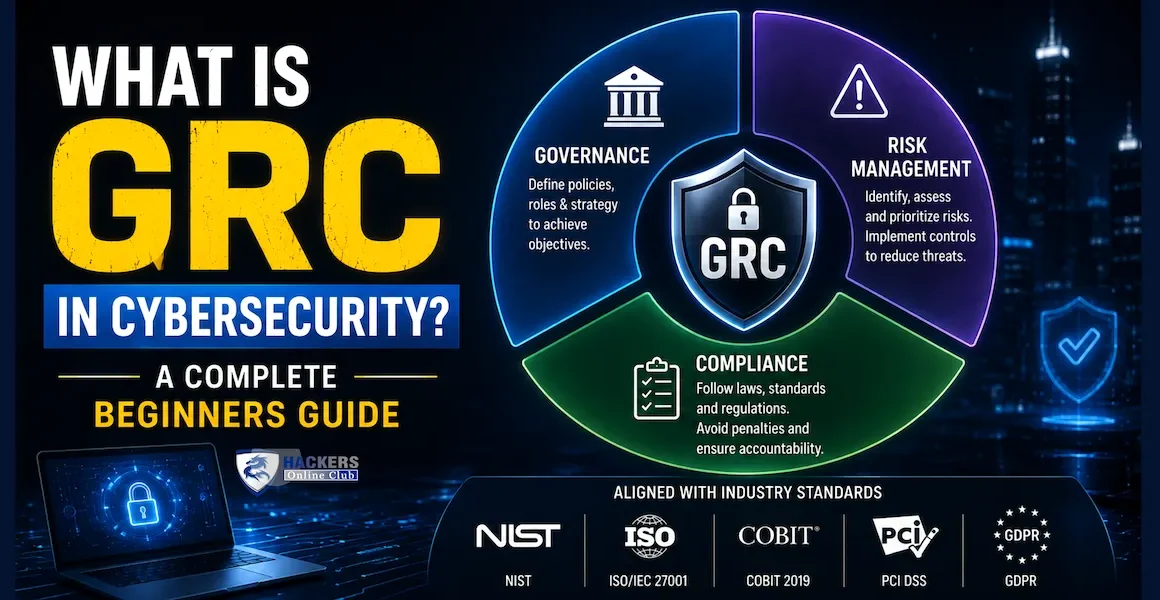
1. What is GRC? The 3 Pillars Explained
GRC is not a job title. It's not a software platform. It's a strategic discipline that ensures an organization's cybersecurity efforts align with business objectives, manage risk intelligently, and comply with legal requirements.
Think of GRC as the bridge between technical security and business strategy. Without it, you have hackers building walls in random places. With it, you have a coordinated defense that protects what matters most.
Governance (The "Rules of the Game")
Governance is the framework of policies, procedures, and decision-making authority that guides an organization's security strategy. It answers: Who decides what? What are the rules? How do we ensure everyone follows them?
Real-world example: A governance policy might state: "All employees must complete security awareness training within 30 days of hire, and annually thereafter. The CISO is responsible for enforcement, and HR cannot grant system access until training is complete."
Risk Management (The "What Could Go Wrong?")
Risk management is the process of identifying, analyzing, and mitigating threats to the organization's assets. It answers: What are our biggest threats? How likely are they? How bad would it be? What are we doing about it?
Real-world example: A risk assessment might identify that storing customer credit card data on an unencrypted server poses a "High" risk. The mitigation? Encrypt the data, implement access controls, and purchase cyber insurance to transfer residual financial risk.
Compliance (The "Legal Guardrails")
Compliance ensures the organization adheres to external laws, regulations, and industry standards. It answers: What laws apply to us? Are we following them? Can we prove it?
Real-world example: A healthcare provider must comply with HIPAA, which requires protecting patient health information (PHI). Compliance activities include conducting annual risk assessments, implementing encryption, training staff, and maintaining audit logs to prove compliance during inspections.
You cannot have one without the others. A company with great governance but poor compliance will get fined. A company with great compliance but poor risk management will get breached. GRC is the holistic approach that prevents both disasters.
2. The "Building a House" Analogy (That Actually Makes Sense)
Cybersecurity concepts can feel abstract. Let's make it concrete with an analogy that sticks:
Imagine you're building a house.
- Governance is the architect's blueprint. It dictates the design, the materials to be used, and the rules for construction. "All exterior doors must have deadbolts. The garage must have a fire-rated door. The electrical system must be installed by a licensed electrician."
- Risk Management is the home inspector. They walk through the house, identify that the basement floods when it rains (a risk), and recommend installing a sump pump (mitigation). They also note that the neighborhood has a high burglary rate, so they recommend a security system.
- Compliance is the city building code. It ensures the house meets legal safety standards (electrical wiring up to code, proper fire exits, structural integrity) so the city doesn't condemn the property or fine the owner.
Technical cybersecurity (firewalls, antivirus, encryption) is the actual locks, alarms, and fences installed on the house. GRC ensures the right locks are chosen, installed correctly, and meet the neighborhood's legal requirements.
3. Why GRC Matters: The $4.45 Million Question
Many technical professionals view GRC as "just paperwork" or "the boring stuff." This is a dangerous misconception that has cost companies billions. Let's look at the hard data:
| Business Driver | How GRC Delivers Value | Real-World Consequence of Failure |
|---|---|---|
| Avoiding Financial Ruin | Proactive risk management prevents costly breaches. Compliance avoids massive regulatory fines. GRC programs reduce breach costs by 32% on average. | Equifax (2017): Failed to patch a known vulnerability. 147 million records breached. Total cost: $700+ million in settlements, fines, and remediation. Stock dropped 35%. |
| Winning Enterprise Customers | Enterprise buyers demand proof of security before signing contracts. GRC provides this proof via certifications (SOC 2, ISO 27001). Without them, you're locked out of 80% of enterprise deals. | SaaS Startup Example: A $10M ARR startup lost a $2M enterprise deal because they couldn't produce a SOC 2 report. The competitor who had SOC 2 won the contract. The startup eventually went bankrupt. |
| Building Trust & Reputation | Demonstrating adherence to recognized frameworks builds trust with customers, partners, and investors. It's a competitive differentiator in crowded markets. | Healthcare Provider: A regional hospital failed HIPAA compliance. After a breach exposing 50,000 patient records, they faced $2.4M in HHS fines, lost patient trust, and saw a 23% decline in new patient registrations. |
Target Corporation (2013): The $185 Million GRC Failure
In 2013, hackers breached Target's payment system, stealing 40 million credit card numbers. The breach wasn't technically sophisticated—it exploited a vulnerability in a third-party HVAC vendor's network access.
The GRC Failure: Target had a vendor management policy, but it wasn't enforced. The HVAC vendor had network access to Target's payment systems—a massive risk that was never identified or mitigated. Target's GRC program failed to assess third-party risk, enforce network segmentation, or monitor vendor access.
The Cost: $18.5 million in settlement with 47 states, $10 million in customer refunds, $200+ million in remediation costs, and incalculable reputational damage. The CEO resigned.
The Lesson: GRC isn't paperwork. It's the difference between a $185 million disaster and a prevented breach.
4. The Big 5 GRC Frameworks You Must Know
Frameworks are the "playbooks" or blueprints that organizations use to build their GRC programs. You don't need to memorize them, but you must understand what they are, when they're used, and why they matter.
| Framework | What It Is | Who Uses It | Why It Matters |
|---|---|---|---|
| NIST CSF (Cybersecurity Framework) |
A voluntary framework consisting of 6 core functions: Govern, Identify, Protect, Detect, Respond, Recover. It's the most logical and widely adopted framework globally. | Almost everyone. The global gold standard for structuring a security program, especially in the US and critical infrastructure. | It's the foundation. Once you understand NIST CSF, learning other frameworks becomes much easier. It's also the framework most likely to be referenced in US federal contracts. |
| ISO 27001 | An international standard for Information Security Management Systems (ISMS). Highly prescriptive with 93 controls across 4 themes (Organizational, People, Physical, Technological). | Global enterprises, especially in Europe, Asia, and organizations dealing with international clients. Often required for government contracts. | It's the global standard. If you're selling to European or Asian enterprises, they'll ask for ISO 27001 certification. It's also a prerequisite for many other certifications. |
| SOC 2 (Service Organization Control 2) |
An auditing procedure that ensures service providers securely manage customer data based on 5 "Trust Services Criteria" (Security, Availability, Confidentiality, Processing Integrity, Privacy). | B2B SaaS companies, cloud providers, and tech startups selling to enterprise clients. It's become the de facto standard for SaaS security. | If you're a SaaS company, SOC 2 is non-negotiable. Enterprise buyers won't sign contracts without it. It's also faster and less expensive than ISO 27001. |
| GDPR / CCPA | Data privacy regulations. GDPR (Europe) and CCPA (California) dictate how personal data is collected, stored, processed, and deleted. They grant individuals rights over their data. | Any organization that processes the personal data of EU or California residents. This includes most websites, apps, and SaaS platforms. | Violations are catastrophic. GDPR fines can reach €20 million or 4% of global annual revenue (whichever is higher). CCPA allows private lawsuits. Compliance is not optional. |
| HIPAA / PCI DSS | HIPAA: Protects patient health information (PHI) in healthcare. PCI DSS: Secures credit card transactions for any business that accepts cards. |
HIPAA: Healthcare providers, insurers, and their business associates. PCI DSS: Any business that accepts credit cards (which is almost everyone). |
These are industry-specific but non-negotiable. HIPAA violations can result in criminal charges. PCI DSS non-compliance can result in losing the ability to process credit cards—a death sentence for retail businesses. |
Download it from the NIST website, read the "Core" section, and understand the 6 functions. Once you grasp NIST, learning ISO 27001 or SOC 2 becomes much easier because you'll see how they map to the same concepts.
5. GRC vs. Technical Cybersecurity: What's the Difference?
It's crucial to understand where GRC fits in the broader cybersecurity ecosystem. Many people confuse GRC with technical security, but they're fundamentally different disciplines.
- Focus: Hands-on implementation, configuration, and monitoring.
- Daily Tasks: Writing detection rules, patching servers, analyzing malware, configuring firewalls, hunting threats.
- Tools: SIEM (Splunk), EDR (CrowdStrike), Wireshark, Burp Suite, Linux CLI.
- Mindset: "How do I technically stop this attack?"
- Stress Level: High. 24/7 on-call rotations. Constant alert fatigue.
// GRC (The "Strategists") - Focus: Policy creation, risk assessment, auditing, and regulatory alignment.
- Daily Tasks: Reviewing vendor security questionnaires, conducting risk assessments, preparing for ISO 27001 audits, writing security policies, presenting to the board.
- Tools: GRC platforms (Vanta, Drata, ServiceNow), Excel, Jira, Confluence, PowerPoint.
- Mindset: "Does this technical control adequately reduce the business risk, and does it meet our compliance requirements?"
- Stress Level: Moderate. Predictable hours. Deadlines instead of emergencies.
The Bridge: The best GRC professionals have a foundational understanding of technical cybersecurity. You don't need to know how to write a Python exploit, but you do need to know what a vulnerability is, how patching works, and why encryption matters, so you can accurately assess risk and communicate with engineers.
6. Top GRC Tools and Software in 2026
Gone are the days of managing compliance entirely in massive, error-prone Excel spreadsheets. Modern GRC relies on specialized software to automate evidence collection, track risk, and streamline audits.
| Tool Category | Popular Examples | What It Does | Who Uses It |
|---|---|---|---|
| Compliance Automation | Vanta, Drata, Secureframe, Sprinto | Connects to your cloud infrastructure (AWS, GitHub, etc.) to automatically collect evidence (e.g., "Is MFA enabled?") and map it to frameworks like SOC 2 or ISO 27001. Reduces audit preparation time by 80%. | Startups and mid-sized companies pursuing SOC 2 or ISO 27001 certification. |
| Enterprise GRC (eGRC) | ServiceNow GRC, RSA Archer, OneTrust, MetricStream | Heavy-duty platforms for large enterprises to manage complex risk registers, audit workflows, policy management, and third-party risk at scale. Highly customizable but expensive. | Fortune 500 companies, financial institutions, healthcare systems. |
| Vendor Risk Management (VRM) | BitSight, SecurityScorecard, Prevalent | Assigns a "credit score" to third-party vendors based on their external security posture. Helps GRC teams decide if a vendor is safe to do business with and monitor them continuously. | Organizations with 50+ vendors, especially in finance and healthcare. |
| Policy Management | Confluence, SharePoint, Dedicated GRC modules | Centralized repositories for creating, reviewing, approving, and tracking employee acknowledgment of security policies. Ensures policies are current and employees have read them. | Every organization. This is table stakes for any GRC program. |
7. GRC Career Paths and Salary Expectations
GRC offers a clear, lucrative, and relatively low-stress career ladder compared to technical operations. Here's what the progression looks like in 2026:
| Role | Experience | Average Salary (US) | Key Responsibilities |
|---|---|---|---|
| IT / GRC Analyst | 0–2 years | $70,000 - $90,000 | Assisting with risk assessments, tracking compliance tasks, answering basic vendor security questionnaires, maintaining policy documents, conducting employee training. |
| GRC Consultant / Specialist | 2–5 years | $95,000 - $130,000 | Leading specific compliance projects (e.g., guiding a company through a SOC 2 audit), conducting detailed third-party risk reviews, mapping controls to frameworks, writing policies. |
| GRC Manager / Lead | 5–8 years | $130,000 - $160,000 | Managing a team of analysts, owning the enterprise risk register, liaising with external auditors, presenting risk posture to senior leadership, managing GRC tool implementation. |
| Director of GRC / CISO | 8+ years | $160,000 - $250,000+ | Setting the overall security strategy, aligning cybersecurity with business objectives, managing multimillion-dollar security budgets, reporting to the Board of Directors, handling breach response. |
8. Step-by-Step Roadmap to Start a GRC Career
You don't need a computer science degree to succeed in GRC. Many successful GRC professionals come from backgrounds in auditing, law, project management, or general IT. Follow this 5-step roadmap:
🚀 Your 5-Step GRC Career Roadmap
- Step 1: Build Foundational IT Knowledge (2-4 weeks). You cannot assess risk if you don't understand the technology. Study the basics of networking (CompTIA Network+ level), cloud computing (AWS/Azure fundamentals), and operating systems. Free resource: Professor Messer's Network+ videos on YouTube.
- Step 2: Get an Entry-Level Security Certification (4-8 weeks). Prove you understand the baseline concepts. The CompTIA Security+ is the absolute best starting point. It covers risk management, compliance, and basic technical controls. It's also required for many GRC roles.
- Step 3: Master One Framework (2-3 weeks). Don't try to learn them all. Download the NIST CSF 2.0 document from the NIST website. Read it. Understand the 6 core functions (Govern, Identify, Protect, Detect, Respond, Recover) and the categories beneath them. This is your foundational mental model.
- Step 4: Gain Practical Experience (Ongoing).
- Offer to help a local non-profit or small business write their first Acceptable Use Policy or Incident Response Plan.
- Complete a "mock" SOC 2 readiness assessment using a free trial of a tool like Vanta or Drata.
- Transition internally: If you work in IT helpdesk or project management, volunteer to assist your company's compliance or security team with audits or vendor reviews.
- Join open-source GRC projects or contribute to community frameworks.
- Step 5: Pursue a GRC-Specific Certification (6-12 months). Once you have 1-2 years of experience, level up with the ISC2 CGRC (Certified in Governance, Risk and Compliance) or the ISACA CISA (Certified Information Systems Auditor). These are highly respected by hiring managers and can increase your salary by 15-25%.
9. Common GRC Misconceptions Debunked
Let's address the elephant in the room. GRC has a reputation problem. Here are the most common misconceptions—and the reality:
| Misconception | The Reality |
|---|---|
| "GRC is just boring paperwork." | While documentation is part of it, modern GRC is highly strategic. You're actively shaping business decisions, negotiating with vendors, and preventing multi-million dollar breaches. Automation tools have also eliminated much of the manual "paperwork." The role is evolving from "compliance checker" to "strategic advisor." |
| "I need to know how to code." | You don't. You need to be able to read technical concepts and translate them into business risk. Strong written and verbal communication skills are far more valuable than coding skills in GRC. If you can explain why encryption matters to a CFO, you're more valuable than someone who can write a Python script. |
| "GRC is only for massive corporations." | Startups and mid-sized companies desperately need GRC professionals to help them achieve SOC 2 or ISO 27001 certification so they can close enterprise deals. The startup GRC market is booming. Companies like Vanta and Drata exist specifically to serve this market. |
| "Compliance equals Security." | Compliance is the minimum baseline. A company can be 100% compliant with a framework and still get hacked. GRC's job is to push the organization beyond mere compliance to achieve true risk reduction. Compliance is necessary but not sufficient. |
| "GRC is a dead-end job." | GRC is actually one of the fastest paths to the CISO role. Many CISOs come from GRC backgrounds because they understand both the technical and business sides of security. GRC professionals are also highly sought after in consulting, where they can earn $150-250/hour. |
10. First Actions: Start Your GRC Journey Today
Don't just read about GRC—take action. Here are four things you can do this week to move forward:
- Download the NIST CSF 2.0. Go to the NIST website (nist.gov/cyberframework), download the PDF, and read the "Core" section. Highlight the terms you don't understand and look them up. This is your foundational document.
- Update your LinkedIn profile. Add keywords like "Risk Assessment," "Policy Development," "NIST CSF," "Compliance," and "Vendor Risk Management" to your skills section. Recruiters actively search for these terms. Also, follow GRC thought leaders like Dr. Eric Cole, Kevin Stine, and the ISACA community.
- Join a GRC community. Join the "GRC Professionals" group on LinkedIn or the r/GRC subreddit. Lurk, read the discussions, and learn what real professionals are struggling with and discussing daily. Don't be afraid to ask questions—the GRC community is surprisingly welcoming to newcomers.
- Schedule an informational interview. Find a GRC Analyst or Manager on LinkedIn at a company you admire. Send a polite message: "Hi [Name], I'm transitioning into cybersecurity and am very interested in GRC. Would you have 15 minutes for a quick virtual coffee chat to share your experience?" Most people love to help, and you'll gain insights you can't get from articles.
11. Frequently Asked Questions
What does GRC stand for in cybersecurity?
GRC stands for Governance, Risk, and Compliance. Governance is the set of rules and policies that guide an organization. Risk is the process of identifying and managing threats to the business. Compliance is ensuring the organization adheres to external laws, regulations, and industry standards. Together, they form a strategic discipline that aligns cybersecurity with business objectives.
Is GRC a good career in cybersecurity?
Yes, GRC is one of the fastest-growing and most stable career paths in cybersecurity. It offers high demand, excellent salaries (typically $80,000–$130,000+ for mid-level roles), and does not require heavy coding or deep technical hacking skills, making it highly accessible for career changers from fields like auditing, law, or project management. The 32% projected job growth rate also means strong job security.
What is the difference between GRC and technical cybersecurity?
Technical cybersecurity (like penetration testing or SOC analysis) focuses on the hands-on implementation of security controls, such as configuring firewalls, analyzing logs, or hunting malware. GRC focuses on the strategic side: defining the policies, assessing the business risk of threats, and ensuring the organization meets legal and regulatory requirements. GRC is about the "why" and "what," while technical security is about the "how."
What are the most common GRC frameworks?
The most common GRC frameworks include the NIST Cybersecurity Framework (CSF), ISO 27001, SOC 2, GDPR (for data privacy), HIPAA (for healthcare), and PCI DSS (for payment card data). Organizations use these frameworks as blueprints to build and audit their security programs. NIST CSF is the most widely adopted globally, while SOC 2 is essential for SaaS companies.
Do I need to know how to code to work in GRC?
No, coding is not required for most GRC roles. However, a foundational understanding of IT concepts (networking, cloud architecture, operating systems) is highly beneficial so you can accurately assess technical risks and communicate effectively with engineering teams. If you can explain why encryption matters to a non-technical executive, you're more valuable than someone who can write code but can't communicate.
What certifications are best for a GRC career?
Top entry-level to mid-level GRC certifications include CompTIA Security+ (for foundational knowledge), ISACA CISA (Certified Information Systems Auditor), ISC2 CGRC (Certified in Governance, Risk and Compliance), and ISACA CISM (Certified Information Security Manager) for advanced leadership roles. Start with Security+, then progress to CISA or CGRC after gaining 1-2 years of experience.
Written by the HOC Team at Hackers Online Club — a cybersecurity community trusted by security professionals, auditors, and career changers since 2010. 15+ years of practical cybersecurity guides, certification roadmaps, and enterprise security resources. Learn more about HOC →