

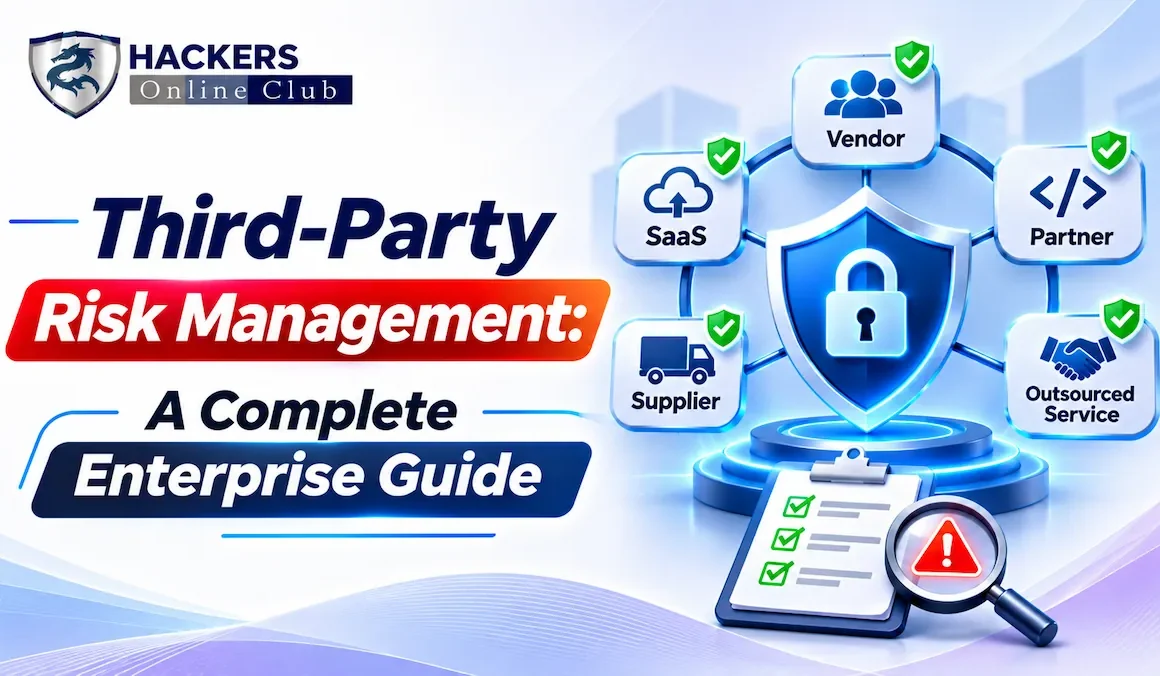
Third-Party Risk Management: A Complete Enterprise Guide
Third party risk management is the discipline of finding, assessing, contracting for, monitoring and exiting the vendors, suppliers, partners and service providers that touch your data, systems or operations.
It matters because attackers increasingly go through the supplier instead of the front door: Verizon's 2026 Data Breach Investigations Report, as reported by Expert Insights, found that 48% of confirmed breaches involved a third party, up from 30% in the prior dataset. This guide walks through the full program: scope and vocabulary, risk types, regulations, the vendor lifecycle, tiering, due diligence, contracts, continuous monitoring, real incidents, and a tested scoring script you can adapt.
- What Is Third-Party Risk Management?
- Why It Matters Now
- Types of Third-Party Risk
- Frameworks and Regulations
- The Vendor Lifecycle, Inventory and Tiering
- Due Diligence and Risk Assessment
- Contracts and Security Requirements
- Monitoring, Fourth Parties, Incidents and Exit
- Case Studies
- Building the Program, With Code
- Frequently Asked Questions
A third party is any external organization that provides a product or service to you, processes or stores your data, connects to your network, or acts on your behalf. That includes software vendors, cloud and SaaS providers, managed service providers, payment processors, contractors, consultants, law and accounting firms, and open-source maintainers whose code you ship. Third-party risk management, often shortened to TPRM, is the program that keeps the resulting risk within your appetite.
| Term | Meaning |
|---|---|
| TPRM (third-party risk management) | The enterprise-wide program covering every external relationship and every risk type: cyber, operational, financial, legal, compliance and reputational |
| VRM (vendor risk management) | Often used as a synonym; more narrowly, the process around suppliers you buy from |
| C-SCRM | Cybersecurity supply chain risk management; NIST's term for managing cyber risk across suppliers and the products and services they provide |
| Fourth party | A subcontractor or provider your vendor relies on, such as the cloud platform hosting your SaaS vendor |
| Inherent risk | Risk from the relationship before considering the vendor's controls |
| Residual risk | Risk that remains after controls are verified |
| Concentration risk | Over-reliance on one provider, or on one shared fourth party |
- Breaches increasingly run through suppliers. The 2026 DBIR, as reported by Expert Insights, puts third-party involvement at 48% of confirmed breaches, after the figure had already doubled between the 2024 and 2025 reports. The dataset covers more than 22,000 breaches across 145 countries.
- Vendors fix basic gaps slowly. The same coverage reports that only 23% of third-party organizations fully fixed missing or misconfigured MFA on cloud accounts, and that half of MFA findings were closed within a month while weak-password and excessive-permission findings took nearly eight months to reach the halfway point.
- One supplier can fail many customers at once. A software update, a file-transfer product or a shared cloud platform can turn one vendor event into thousands of customer incidents. See the case studies in section 9.
- Regulators now name the vendor. The EU's DORA has applied to financial entities since January 17, 2025 and requires a register of ICT third-party contracts, contract terms and exit plans. NIS2 and sector rules add supply-chain duties.
- Attackers read your vendor list too. Support desks, managed service providers and integrations hold privileged access that bypasses your perimeter. Compare insider-style abuse of trusted access in Insider Threat Detection.
Verizon describes third-party exposure through three archetypes: a vendor in your software supply chain, a vendor that hosts your data, and a vendor connected into your environment. Each fails differently, so each needs different questions.
Software, libraries, models, firmware, build tools.
Ask: how is it built, signed and updated?
SaaS, cloud, payroll, CRM, analytics.
Ask: who can access it, how is it protected, where does it live?
MSPs, support desks, integrations, API keys, VPN accounts.
Ask: what access, with what authentication, monitored how?
| Risk Category | What Goes Wrong | Example Signal |
|---|---|---|
| Cybersecurity | Vendor compromise exposes your data or credentials | No MFA on admin access, long-open critical findings |
| Operational and resilience | Vendor outage halts your service | Single region, no tested recovery, no exit path |
| Compliance and privacy | Vendor mishandles regulated data, you are accountable | Data stored in unapproved countries, missing processing agreement |
| Concentration | Many critical services depend on one provider | Several vendors sharing the same cloud platform |
| Financial | Vendor fails and cannot support you | Going-concern warnings, ownership change |
| Fourth-party | Vendor's supplier fails or is breached | Undisclosed subprocessors |
| AI-specific | Vendor trains on your data or ships an unsafe model | No AI use disclosure; see AI Model Supply Chain Risks |
You do not need to invent a program. Choose a framework as the backbone, then map regulatory obligations onto it. The table summarizes widely used sources; details change, so verify against the current text.
| Source | What It Gives You |
|---|---|
| NIST SP 800-161 Rev. 1 (Update 1, Nov 2024) | Guidance on cybersecurity supply chain risk management at enterprise, mission and system levels, covering malicious functionality, counterfeits and weak development practices |
| NIST CSF 2.0 (Feb 2024) | The Govern function includes cybersecurity supply chain risk management as a category |
| ISO/IEC 27001:2022 and 27036 | Supplier relationship controls and guidance for information security in supplier relationships |
| DORA (EU, applies from Jan 17, 2025) | For financial entities: register of information on ICT third-party contracts, due diligence, mandatory contract terms such as audit rights and exit strategies, concentration management, and direct oversight of designated critical ICT providers |
| NIS2 (EU) | Requires in-scope entities to address supply chain security as part of their risk-management measures |
| SEC cyber disclosure rules (U.S. public companies) | Annual disclosure of risk management processes, including oversight of third-party risk, and current reporting of material incidents |
| Sector rules (HIPAA business associates, banking guidance, PCI DSS) | Contractual and oversight duties for providers handling regulated data |
| Shared questionnaires (SIG, CAIQ) and attestations (SOC 2, ISO 27001 certificates) | Standard evidence to reduce questionnaire fatigue; useful, but scope and date must be checked |
Run every relationship through the same lifecycle, with the depth of each step set by the vendor's tier.
You cannot manage vendors you cannot list. Start from accounts payable and procurement data, then add single sign-on application lists, cloud and SaaS discovery, network and API logs, and a survey of business owners. Expect surprises: shadow IT and free tools with real data are common. For each vendor record the business owner, services, data types, access type, hosting location, subprocessors, contract dates and an internal risk owner.
Tiering decides where scarce assessment time goes. Score each vendor on a few factors before looking at its controls:
| Factor | Low (1) | High (5) |
|---|---|---|
| Data sensitivity | No personal or confidential data | Regulated, customer or crown-jewel data |
| Access | No connection to your systems | Privileged or network-level access |
| Business criticality | Outage is an inconvenience | Outage stops a core service |
| Substitutability | Easy to replace in days | Months to replace, deeply embedded |
Due diligence asks whether the vendor's controls are good enough for the risk it creates. Match the depth to the tier and ask for evidence, not just answers.
| Evidence | What It Shows | What to Check |
|---|---|---|
| Security questionnaire (SIG, CAIQ or your own) | Self-reported control design | Ask for evidence on the answers that matter; short and tiered beats long and generic |
| SOC 2 Type II or ISO 27001 certificate | Independent attestation against a stated scope | Scope, period, exceptions, subservice organizations, user-entity controls |
| Penetration test summary | Technical weaknesses found and fixed | Date, scope, severity of open findings, retest |
| Architecture and data-flow review | Where your data goes and who can touch it | Encryption, tenant isolation, admin access, data location, subprocessors |
| Identity controls | How access to your data is protected | MFA on all admin and support access, SSO support, service-account handling |
| Resilience evidence | Ability to survive an outage | RTO and RPO, tested recovery, region design |
| Outside-in signals | Externally visible posture | Exposed services, certificate hygiene, breach history; treat ratings as prompts for questions, not verdicts |
| Incident history and response | Maturity under pressure | Past incidents, notification practice, forensics retainers |
- No MFA on administrator, support or API access to your data
- Refusal to share scope of a certificate or to answer subprocessor questions
- Customer data in production used for testing or AI training without a written basis
- No documented incident notification process or no named security contact
- Findings open for long periods with no owner, mirroring the slow remediation described in the DBIR coverage
The contract is where findings become enforceable. Work with legal and procurement to standardize a security addendum, and scale it to the tier.
Where DORA applies, contract terms are prescribed in more detail, including service descriptions, data locations, audit and access rights and exit strategies. Check the regulation and your supervisor's guidance rather than copying a generic template.
An annual questionnaire is a snapshot taken from far away. Add signals between reviews: external posture changes, new public vulnerabilities in the vendor's products, breach news, financial or ownership changes, expired certificates, and the vendor's own attestation updates. Define trigger events that force an out-of-cycle review, such as a reported breach, a major outage, an acquisition, or a new data type in scope.
Ask Tier 1 and Tier 2 vendors for their critical subprocessors, then map shared dependencies. If five of your nine hosted vendors run on the same cloud platform, a platform outage is a multi-vendor event even though each contract looks independent. The example script in section 10 shows a simple concentration count.
Most programs are weak at the end of the relationship. At termination, revoke accounts and API keys, remove network paths, collect or delete data with written certification, confirm backups and subprocessors are covered, and transfer the service without a gap. For critical vendors, write and test an exit plan before you need it.
These widely reported incidents show different failure modes. Figures are public estimates and details evolved after first reports, so treat them as approximate.
A ransomware attack on a major U.S. healthcare payments and claims provider disrupted pharmacies and providers nationwide for weeks. Later reporting put the number of people affected near 190 million, which would make it one of the largest healthcare breaches on record; treat that figure as reported and approximate. UnitedHealth's chief executive told Congress in 2024 that attackers entered through a remote-access portal that lacked multi-factor authentication, as widely reported. Lesson: a vendor can be both a data holder and an operational dependency, so tier on criticality and substitutability, not data alone, and ask pointed identity-control questions.
Attackers accessed customer accounts on a cloud data platform that did not require MFA, using stolen credentials, and took data from a number of well-known organizations; Ticketmaster, Santander, LendingTree and AT&T are among those reported. Lesson: in a shared-responsibility model the vendor's secure platform does not protect you if your tenant is configured weakly. Verify your own configuration, enforce MFA and SSO, and monitor service accounts.
A defective content update to a widely deployed endpoint security product crashed an estimated 8.5 million Windows devices and disrupted airlines, hospitals and banks worldwide; one vendor estimate puts direct losses above $5 billion, an estimate rather than an audited number. Lesson: resilience and change control are part of third-party risk. Ask how vendors test and stage updates, and whether you can control rollout rings and recover quickly when a trusted agent fails.
| Role | Responsibility |
|---|---|
| Business owner | Owns the relationship and the risk; requests the vendor, accepts conditions |
| TPRM or risk team | Runs inventory, tiering, assessment workflow and reporting |
| Security | Reviews technical evidence, advises on controls and monitoring |
| Legal and privacy | Contract terms, data protection agreements, regulatory duties |
| Procurement | Enforces that no purchase completes without tiering |
| Executive sponsor and board | Sets appetite, approves exceptions for critical vendors, receives reporting |
The script scores inherent risk from four factors, assigns a tier, reduces risk by an evidence-based control score to get residual risk, and flags overdue reviews, missing MFA on higher tiers and concentration on a shared hosting provider. The vendors are fictional and the weights are illustrative; replace the list with your inventory export. The output below is the real output of the code.
# tprm_tiering.py: tier vendors by inherent risk, adjust by control evidence, flag gaps.
# Synthetic vendors for illustration. Standard library only.
from datetime import date
from collections import Counter

TODAY = date(2026, 11, 1)
# Weights for inherent risk (each factor rated 1 low .. 5 high)
WEIGHTS = {"data": 0.30, "access": 0.25, "criticality": 0.30, "substitutability": 0.15}
TIER_CUTOFFS = [(4.0, "Tier 1"), (3.0, "Tier 2"), (2.0, "Tier 3")]   # else Tier 4
REVIEW_MONTHS = {"Tier 1": 12, "Tier 2": 12, "Tier 3": 24, "Tier 4": 36}

# name, data, access, criticality, substitutability(5 = hard to replace), control score 0-100,
# last assessed, MFA enforced on access to our data, hosting provider (fourth party)
VENDORS = [
    ("PayrollCo",      5, 3, 5, 4, 82, date(2026, 3, 10), True,  "CloudA"),
    ("CRM-SaaS",       4, 4, 4, 3, 74, date(2025, 8, 2),  True,  "CloudA"),
    ("MSP-Helpdesk",   3, 5, 4, 3, 58, date(2025, 6, 20), False, "CloudB"),
    ("EmailGateway",   3, 4, 4, 2, 88, date(2026, 5, 14), True,  "CloudA"),
    ("BIAnalytics",    4, 2, 3, 2, 69, date(2025, 2, 11), True,  "CloudB"),
    ("MarketingTool",  3, 2, 2, 1, 61, date(2024, 9, 5),  False, "CloudA"),
    ("OfficeCatering", 1, 1, 1, 1, 0,  None,              False, "None"),
    ("LegalDocs",      5, 2, 3, 2, 79, date(2026, 1, 22), True,  "CloudC"),
    ("FileTransfer",   4, 4, 3, 2, 55, date(2025, 4, 3),  False, "CloudB"),
    ("TrainingPortal", 2, 2, 1, 1, 70, date(2025, 10, 1), True,  "CloudA"),
]

def inherent(d, a, c, s):
    return WEIGHTS["data"] * d + WEIGHTS["access"] * a + WEIGHTS["criticality"] * c + WEIGHTS["substitutability"] * s

def tier(score):
    return next((t for cut, t in TIER_CUTOFFS if score >= cut), "Tier 4")

def months_since(d):
    return 999 if d is None else (TODAY.year - d.year) * 12 + TODAY.month - d.month

def residual(inh, ctrl):
    """Inherent risk reduced by evidenced controls; a 100-point control score removes 60% of it."""
    return inh * (1 - 0.6 * ctrl / 100)

if __name__ == "__main__":
    rows = []
    for n, d, a, c, s, ctrl, last, mfa, host in VENDORS:
        inh = inherent(d, a, c, s)
        t = tier(inh)
        due = months_since(last) > REVIEW_MONTHS[t] and not (last is None and t == "Tier 4")
        rows.append((n, inh, t, ctrl, residual(inh, ctrl), due, mfa, host))
    rows.sort(key=lambda r: -r[4])
    print(f"{'Vendor':15}{'Inherent':>9} {'Tier':7}{'Controls':>9}{'Residual':>9}  Flags")
    for n, inh, t, ctrl, res, due, mfa, host in rows:
        flags = []
        if due: flags.append("REVIEW OVERDUE")
        if t in ("Tier 1", "Tier 2") and not mfa: flags.append("NO MFA")
        print(f"{n:15}{inh:9.2f} {t:7}{ctrl:9}{res:9.2f}  {', '.join(flags) or '-'}")
    hosts = Counter(r[7] for r in rows if r[7] != "None")
    top, cnt = hosts.most_common(1)[0]
    share = 100 * cnt / sum(hosts.values())
    print(f"\nConcentration: {cnt} of {sum(hosts.values())} hosted vendors depend on {top} ({share:.0f}%)")
    t12 = [r for r in rows if r[2] in ("Tier 1", "Tier 2")]
    cov = 100 * sum(1 for r in t12 if not r[5]) / len(t12)
    print(f"Tier 1-2 vendors assessed on schedule: {cov:.0f}%")
Output:
Vendor          Inherent Tier    Controls Residual  Flags
MSP-Helpdesk        3.80 Tier 2        58     2.48  REVIEW OVERDUE, NO MFA
FileTransfer        3.40 Tier 2        55     2.28  REVIEW OVERDUE, NO MFA
PayrollCo           4.35 Tier 1        82     2.21  -
CRM-SaaS            3.85 Tier 2        74     2.14  REVIEW OVERDUE
BIAnalytics         2.90 Tier 3        69     1.70  -
LegalDocs           3.20 Tier 2        79     1.68  -
EmailGateway        3.40 Tier 2        88     1.60  -
MarketingTool       2.15 Tier 3        61     1.36  REVIEW OVERDUE
OfficeCatering      1.00 Tier 4         0     1.00  -
TrainingPortal      1.55 Tier 4        70     0.90  -

Concentration: 5 of 9 hosted vendors depend on CloudA (56%)
Tier 1-2 vendors assessed on schedule: 50%
Read the result the way a reviewer would: the managed helpdesk and file-transfer vendors rank highest on residual risk because they combine high access with weak evidence, and both lack MFA. The vendor with the biggest inherent score, PayrollCo, ranks third because its controls are well evidenced. Half of the higher-tier vendors are overdue, and over half of hosted vendors share one platform. Those three findings are exactly what a board summary should say.
| KPI | Formula | Illustrative Target |
|---|---|---|
| Inventory coverage | Vendors with an owner, tier and data map divided by known vendors | 100% of Tier 1 and 2 |
| Assessment on schedule | Tier 1 and 2 vendors reviewed within period divided by Tier 1 and 2 vendors | 95% or higher |
| Open high findings past due | High findings beyond agreed remediation date | Zero for Tier 1 |
| MFA on vendor access | Vendor accounts with phishing-resistant or strong MFA divided by vendor accounts | 100% privileged |
| Contract coverage | Tier 1 and 2 contracts with the security addendum divided by Tier 1 and 2 contracts | 100% |
| Concentration | Share of critical services dependent on one provider | Below board-set threshold |
| Exit plans tested | Tier 1 vendors with a tested exit plan divided by Tier 1 vendors | 100% over two years |
Put the top few on your executive dashboard alongside the measures in Cybersecurity Metrics: KPIs Every CISO Should Track, and tie vendor remediation work into the budget case from Corporate Cybersecurity Budget Planning.